







Pezeshkian prioritizes social health, commissions universities to draft national reform plan
Iranian President Masoud Pezeshkian on Sunday declared social and cultural health a higher-order responsibility than routine political management, urging universities in Tehran to draft a scientific, actionable framework to address emerging social challenges.
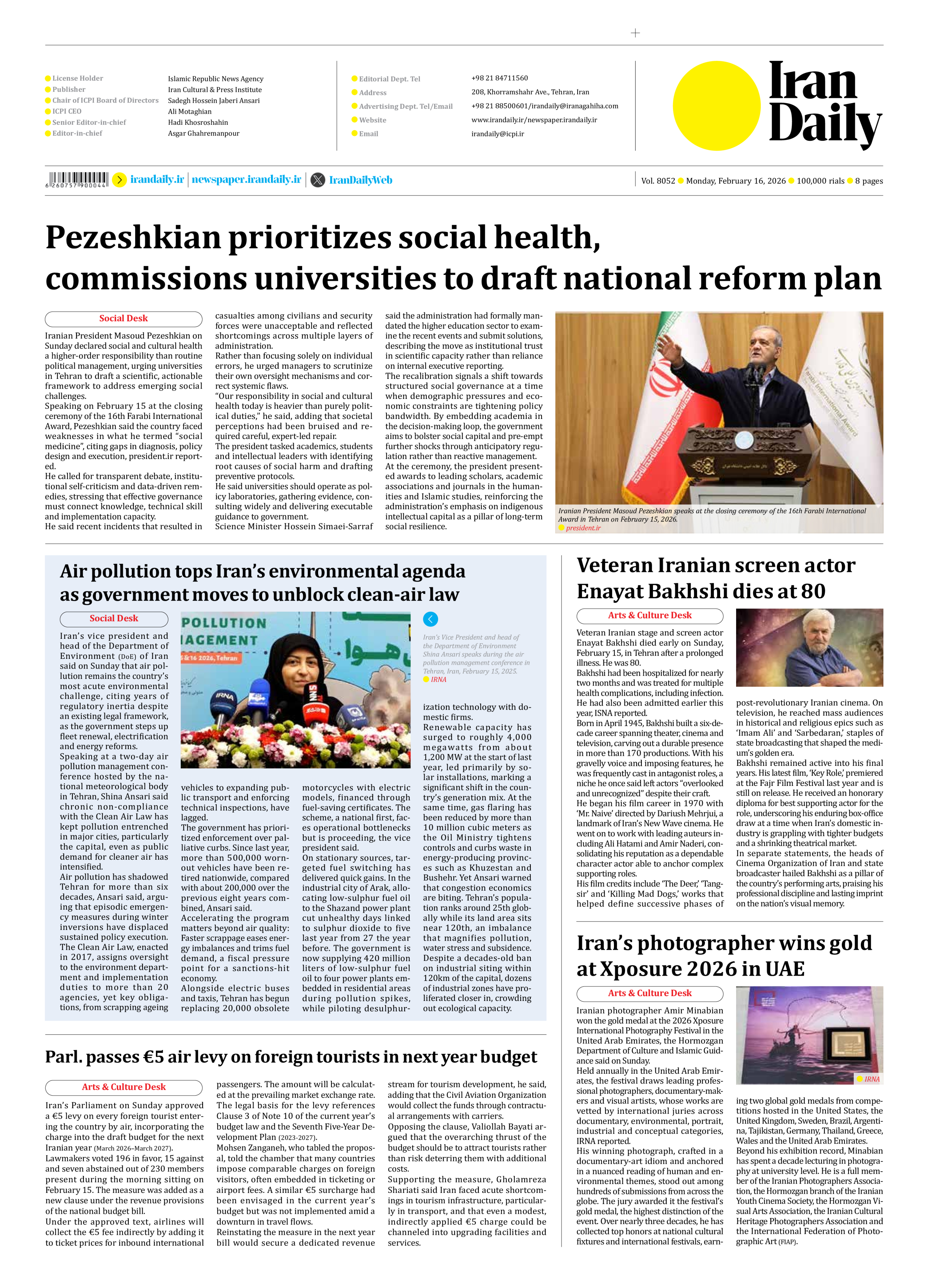
Speaking on February 15 at the closing ceremony of the 16th Farabi International Award, Pezeshkian said the country faced weaknesses in what he termed “social medicine”, citing gaps in diagnosis, policy design and execution, president.ir reported.
He called for transparent debate, institutional self-criticism and data-driven remedies, stressing that effective governance must connect knowledge, technical skill and implementation capacity.
He said recent incidents that resulted in casualties among civilians and security forces were unacceptable and reflected shortcomings across multiple layers of administration.
Rather than focusing solely on individual errors, he urged managers to scrutinize their own oversight mechanisms and correct systemic flaws.
“Our responsibility in social and cultural health today is heavier than purely political duties,” he said, adding that societal perceptions had been bruised and required careful, expert-led repair.
The president tasked academics, students and intellectual leaders with identifying root causes of social harm and drafting preventive protocols.
He said universities should operate as policy laboratories, gathering evidence, consulting widely and delivering executable guidance to government.
Science Minister Hossein Simaei-Sarraf said the administration had formally mandated the higher education sector to examine the recent events and submit solutions, describing the move as institutional trust in scientific capacity rather than reliance on internal executive reporting.
The recalibration signals a shift towards structured social governance at a time when demographic pressures and economic constraints are tightening policy bandwidth. By embedding academia in the decision-making loop, the government aims to bolster social capital and pre-empt further shocks through anticipatory regulation rather than reactive management.
At the ceremony, the president presented awards to leading scholars, academic associations and journals in the humanities and Islamic studies, reinforcing the administration’s emphasis on indigenous intellectual capital as a pillar of long-term social resilience.