







Shahr-e Sukhteh; ancient capital of peace, innovation
Across the ancient world, cities are often remembered for their wars, conquests, and empires. Yet some civilizations followed a different path — one shaped not by violence, but by cooperation, creativity, and long-term stability. Archaeological discoveries in southeastern Iran point to such a society, one that flourished thousands of years ago through innovation, social organization, and sustained peace.
At the heart of this story lies Shahr-e Sukhteh (Burned City), a city whose silent ruins conceal a remarkably advanced urban culture. Far from being a simple relic of the past, it offers fresh insight into how early societies could thrive through knowledge, planning, and equality — challenging long-held assumptions about the foundations of civilization itself.
Iran’s 17th site inscribed on the UNESCO World Heritage List is far more than a remnant of distant antiquity. Archaeological evidence shows it was home to a highly advanced, peaceful, and innovative society that, some 5,000 years ago, practiced principles comparable to modern urban planning, advanced medicine, and social equality.
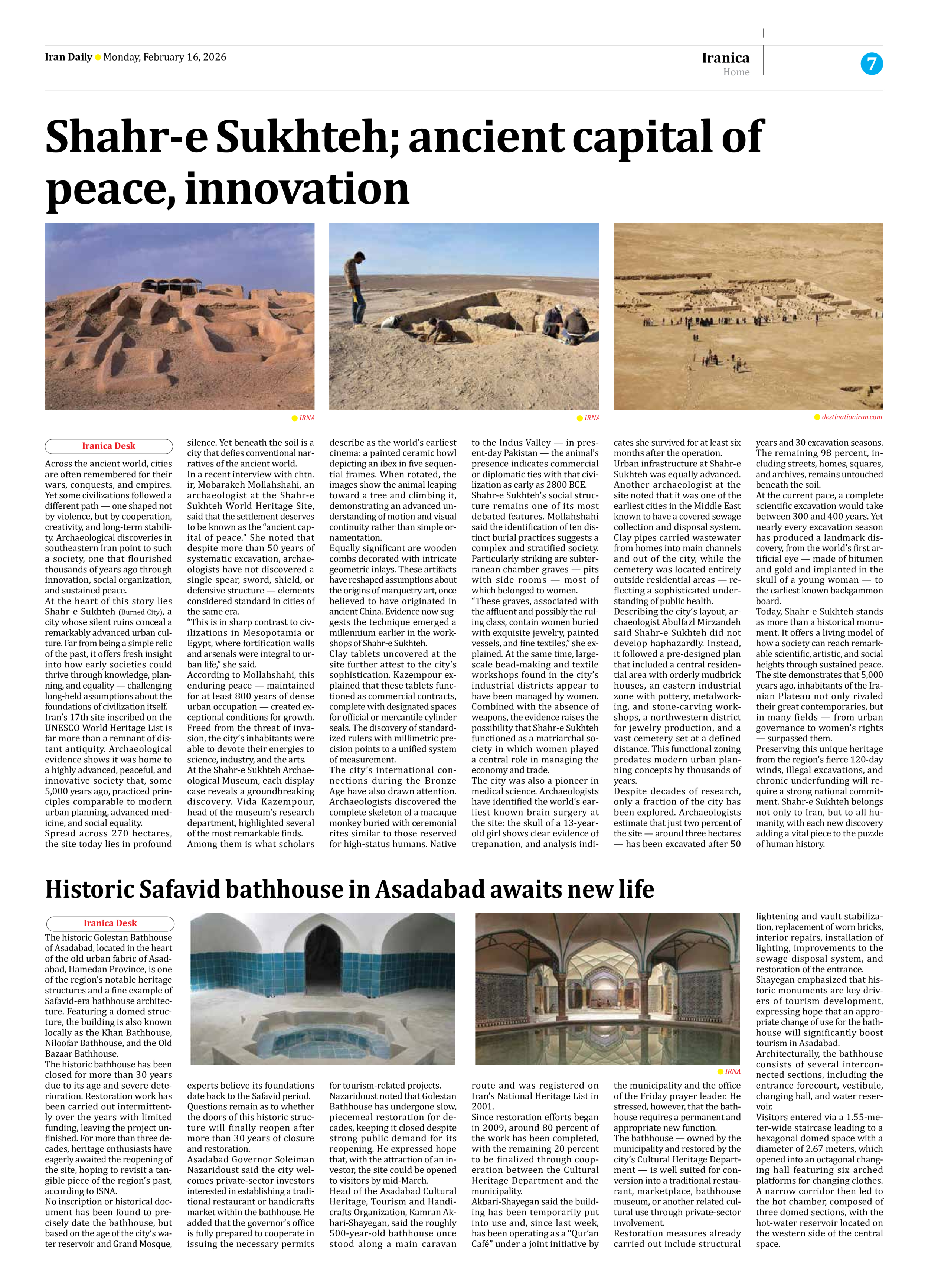
Spread across 270 hectares, the site today lies in profound silence. Yet beneath the soil is a city that defies conventional narratives of the ancient world.
In a recent interview with chtn.ir, Mobarakeh Mollahshahi, an archaeologist at the Shahr-e Sukhteh World Heritage Site, said that the settlement deserves to be known as the “ancient capital of peace.” She noted that despite more than 50 years of systematic excavation, archaeologists have not discovered a single spear, sword, shield, or defensive structure — elements considered standard in cities of the same era.
“This is in sharp contrast to civilizations in Mesopotamia or Egypt, where fortification walls and arsenals were integral to urban life,” she said.
According to Mollahshahi, this enduring peace — maintained for at least 800 years of dense urban occupation — created exceptional conditions for growth. Freed from the threat of invasion, the city’s inhabitants were able to devote their energies to science, industry, and the arts.
At the Shahr-e Sukhteh Archaeological Museum, each display case reveals a groundbreaking discovery. Vida Kazempour, head of the museum’s research department, highlighted several of the most remarkable finds.
Among them is what scholars describe as the world’s earliest cinema: a painted ceramic bowl depicting an ibex in five sequential frames. When rotated, the images show the animal leaping toward a tree and climbing it, demonstrating an advanced understanding of motion and visual continuity rather than simple ornamentation.
Equally significant are wooden combs decorated with intricate geometric inlays. These artifacts have reshaped assumptions about the origins of marquetry art, once believed to have originated in ancient China. Evidence now suggests the technique emerged a millennium earlier in the workshops of Shahr-e Sukhteh.
Clay tablets uncovered at the site further attest to the city’s sophistication. Kazempour explained that these tablets functioned as commercial contracts, complete with designated spaces for official or mercantile cylinder seals. The discovery of standardized rulers with millimetric precision points to a unified system of measurement.
The city’s international connections during the Bronze Age have also drawn attention. Archaeologists discovered the complete skeleton of a macaque monkey buried with ceremonial rites similar to those reserved for high-status humans. Native to the Indus Valley — in present-day Pakistan — the animal’s presence indicates commercial or diplomatic ties with that civilization as early as 2800 BCE.
Shahr-e Sukhteh’s social structure remains one of its most debated features. Mollahshahi said the identification of ten distinct burial practices suggests a complex and stratified society. Particularly striking are subterranean chamber graves — pits with side rooms — most of which belonged to women.
“These graves, associated with the affluent and possibly the ruling class, contain women buried with exquisite jewelry, painted vessels, and fine textiles,” she explained. At the same time, large-scale bead-making and textile workshops found in the city’s industrial districts appear to have been managed by women. Combined with the absence of weapons, the evidence raises the possibility that Shahr-e Sukhteh functioned as a matriarchal society in which women played a central role in managing the economy and trade.
The city was also a pioneer in medical science. Archaeologists have identified the world’s earliest known brain surgery at the site: the skull of a 13-year-old girl shows clear evidence of trepanation, and analysis indicates she survived for at least six months after the operation.
Urban infrastructure at Shahr-e Sukhteh was equally advanced. Another archaeologist at the site noted that it was one of the earliest cities in the Middle East known to have a covered sewage collection and disposal system. Clay pipes carried wastewater from homes into main channels and out of the city, while the cemetery was located entirely outside residential areas — reflecting a sophisticated understanding of public health.
Describing the city’s layout, archaeologist Abulfazl Mirzandeh said Shahr-e Sukhteh did not develop haphazardly. Instead, it followed a pre-designed plan that included a central residential area with orderly mudbrick houses, an eastern industrial zone with pottery, metalworking, and stone-carving workshops, a northwestern district for jewelry production, and a vast cemetery set at a defined distance. This functional zoning predates modern urban planning concepts by thousands of years.
Despite decades of research, only a fraction of the city has been explored. Archaeologists estimate that just two percent of the site — around three hectares — has been excavated after 50 years and 30 excavation seasons. The remaining 98 percent, including streets, homes, squares, and archives, remains untouched beneath the soil.
At the current pace, a complete scientific excavation would take between 300 and 400 years. Yet nearly every excavation season has produced a landmark discovery, from the world’s first artificial eye — made of bitumen and gold and implanted in the skull of a young woman — to the earliest known backgammon board.
Today, Shahr-e Sukhteh stands as more than a historical monument. It offers a living model of how a society can reach remarkable scientific, artistic, and social heights through sustained peace. The site demonstrates that 5,000 years ago, inhabitants of the Iranian Plateau not only rivaled their great contemporaries, but in many fields — from urban governance to women’s rights — surpassed them.
Preserving this unique heritage from the region’s fierce 120-day winds, illegal excavations, and chronic underfunding will require a strong national commitment. Shahr-e Sukhteh belongs not only to Iran, but to all humanity, with each new discovery adding a vital piece to the puzzle of human history.