







Copy in clipboard...
Iran salutes Shahin Farhat’s enduring fusion of Western symphony, Persian music
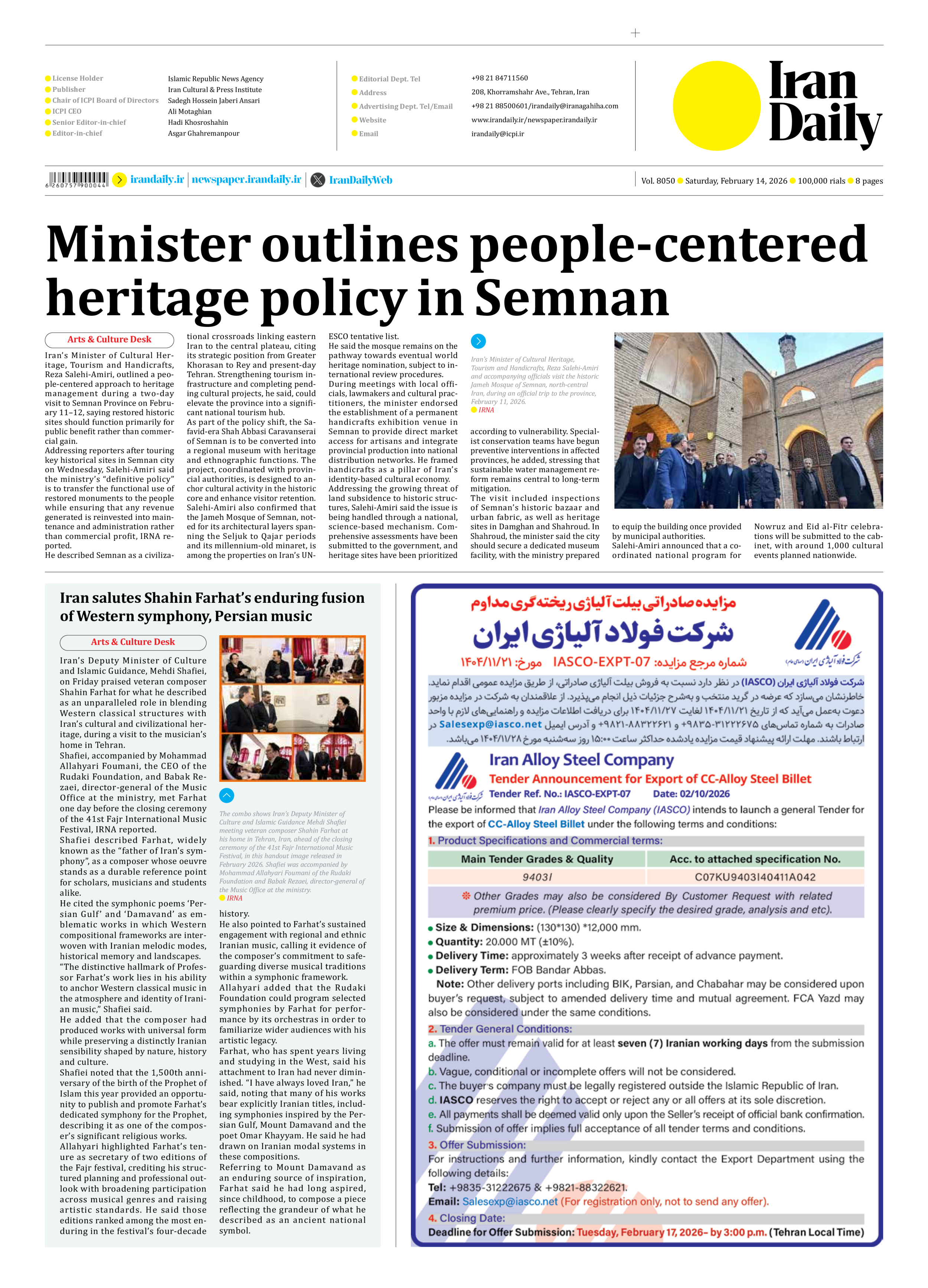
Shafiei, accompanied by Mohammad Allahyari Foumani, the CEO of the Rudaki Foundation, and Babak Rezaei, director-general of the Music Office at the ministry, met Farhat one day before the closing ceremony of the 41st Fajr International Music Festival, IRNA reported.
Shafiei described Farhat, widely known as the “father of Iran’s symphony”, as a composer whose oeuvre stands as a durable reference point for scholars, musicians and students alike.
He cited the symphonic poems ‘Persian Gulf’ and ‘Damavand’ as emblematic works in which Western compositional frameworks are interwoven with Iranian melodic modes, historical memory and landscapes.
“The distinctive hallmark of Professor Farhat’s work lies in his ability to anchor Western classical music in the atmosphere and identity of Iranian music,” Shafiei said.
He added that the composer had produced works with universal form while preserving a distinctly Iranian sensibility shaped by nature, history and culture.
Shafiei noted that the 1,500th anniversary of the birth of the Prophet of Islam this year provided an opportunity to publish and promote Farhat’s dedicated symphony for the Prophet, describing it as one of the composer’s significant religious works.
Allahyari highlighted Farhat’s tenure as secretary of two editions of the Fajr festival, crediting his structured planning and professional outlook with broadening participation across musical genres and raising artistic standards. He said those editions ranked among the most enduring in the festival’s four-decade history.
He also pointed to Farhat’s sustained engagement with regional and ethnic Iranian music, calling it evidence of the composer’s commitment to safeguarding diverse musical traditions within a symphonic framework.
Allahyari added that the Rudaki Foundation could program selected symphonies by Farhat for performance by its orchestras in order to familiarize wider audiences with his artistic legacy.
Farhat, who has spent years living and studying in the West, said his attachment to Iran had never diminished. “I have always loved Iran,” he said, noting that many of his works bear explicitly Iranian titles, including symphonies inspired by the Persian Gulf, Mount Damavand and the poet Omar Khayyam. He said he had drawn on Iranian modal systems in these compositions.
Referring to Mount Damavand as an enduring source of inspiration, Farhat said he had long aspired, since childhood, to compose a piece reflecting the grandeur of what he described as an ancient national symbol.