







Copy in clipboard...
Iran puts ‘Jam‑e Jam 1’ satellite into orbit
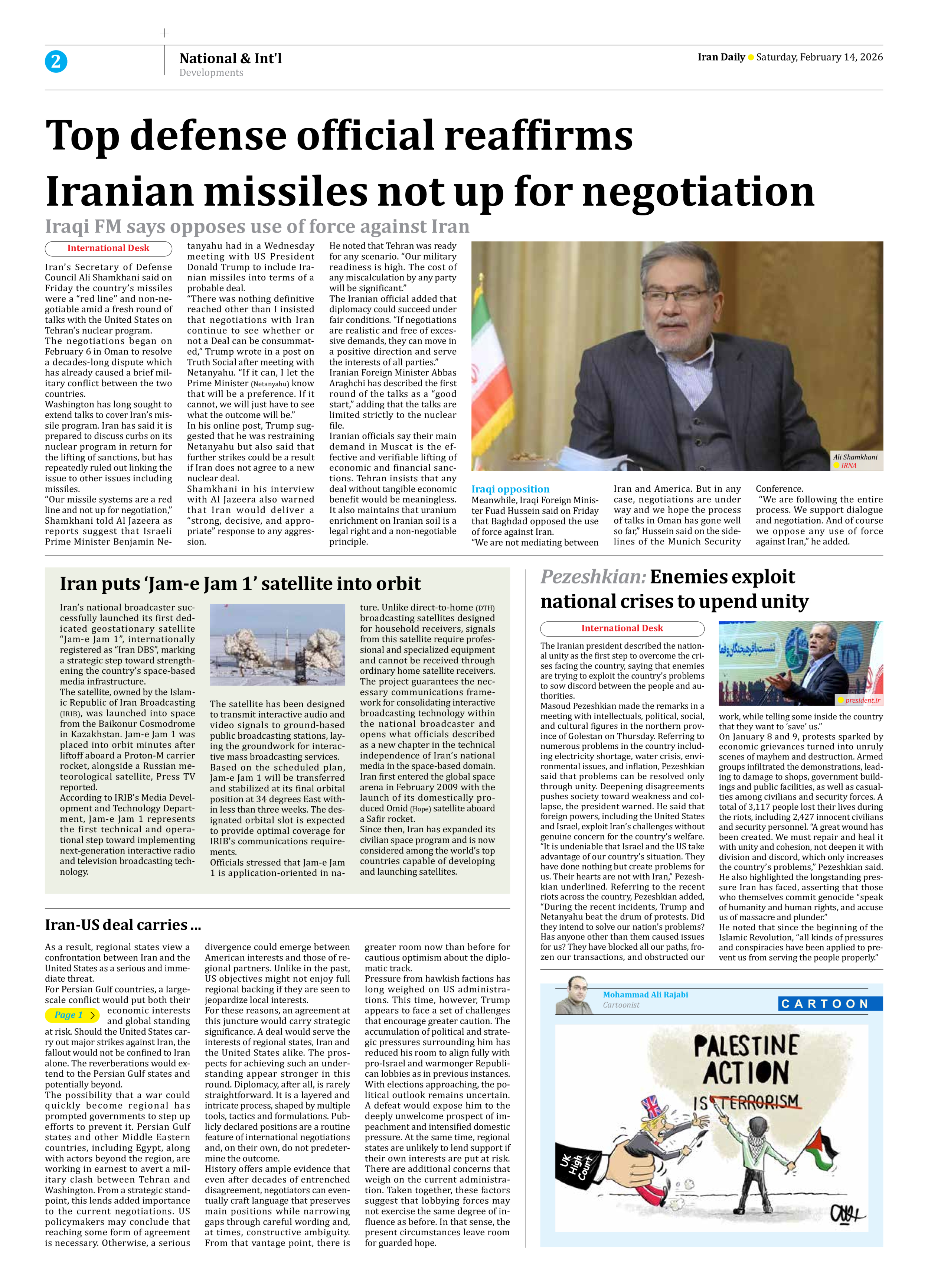
The satellite, owned by the Islamic Republic of Iran Broadcasting (IRIB), was launched into space from the Baikonur Cosmodrome in Kazakhstan. Jam-e Jam 1 was placed into orbit minutes after liftoff aboard a Proton-M carrier rocket, alongside a Russian meteorological satellite, Press TV reported.
According to IRIB’s Media Development and Technology Department, Jam-e Jam 1 represents the first technical and operational step toward implementing next-generation interactive radio and television broadcasting technology.
The satellite has been designed to transmit interactive audio and video signals to ground-based public broadcasting stations, laying the groundwork for interactive mass broadcasting services.
Based on the scheduled plan, Jam-e Jam 1 will be transferred and stabilized at its final orbital position at 34 degrees East within less than three weeks. The designated orbital slot is expected to provide optimal coverage for IRIB’s communications requirements.
Officials stressed that Jam-e Jam 1 is application-oriented in nature. Unlike direct-to-home (DTH) broadcasting satellites designed for household receivers, signals from this satellite require professional and specialized equipment and cannot be received through ordinary home satellite receivers.
The project guarantees the necessary communications framework for consolidating interactive broadcasting technology within the national broadcaster and opens what officials described as a new chapter in the technical independence of Iran’s national media in the space-based domain.
Iran first entered the global space arena in February 2009 with the launch of its domestically produced Omid (Hope) satellite aboard a Safir rocket.
Since then, Iran has expanded its civilian space program and is now considered among the world’s top countries capable of developing and launching satellites.