







Copy in clipboard...
Top defense official reaffirms Iranian missiles not up for negotiation
Iraqi FM says opposes use of force against Iran
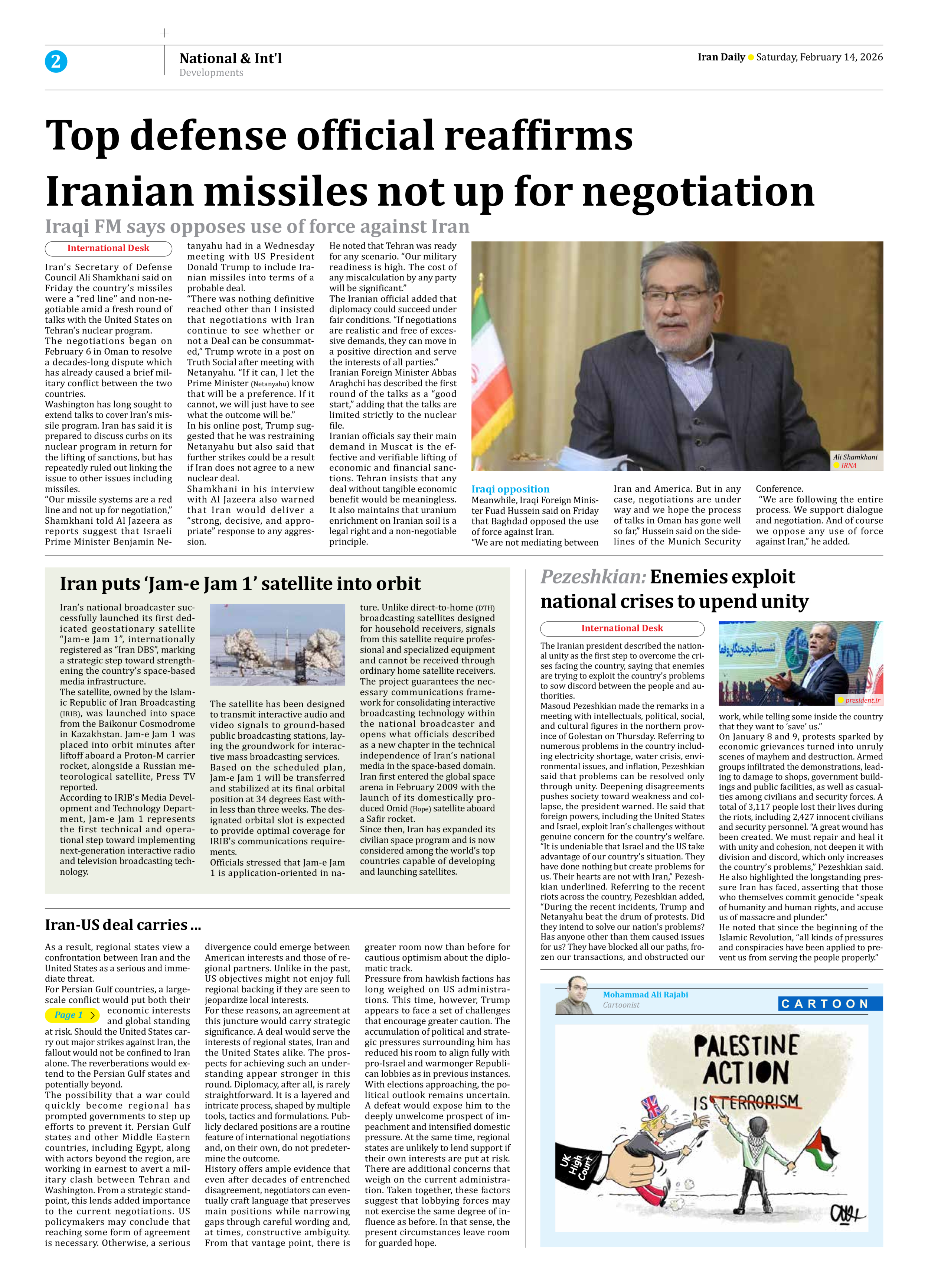
Iran’s Secretary of Defense Council Ali Shamkhani said on Friday the country’s missiles were a “red line” and non-negotiable amid a fresh round of talks with the United States on Tehran’s nuclear program.
The negotiations began on February 6 in Oman to resolve a decades-long dispute which has already caused a brief military conflict between the two countries.
Washington has long sought to extend talks to cover Iran’s missile program. Iran has said it is prepared to discuss curbs on its nuclear program in return for the lifting of sanctions, but has repeatedly ruled out linking the issue to other issues including missiles.
“Our missile systems are a red line and not up for negotiation,” Shamkhani told Al Jazeera as reports suggest that Israeli Prime Minister Benjamin Netanyahu had in a Wednesday meeting with US President Donald Trump to include Iranian missiles into terms of a probable deal.
“There was nothing definitive reached other than I insisted that negotiations with Iran continue to see whether or not a Deal can be consummated,” Trump wrote in a post on Truth Social after meeting with Netanyahu. “If it can, I let the Prime Minister (Netanyahu) know that will be a preference. If it cannot, we will just have to see what the outcome will be.”
In his online post, Trump suggested that he was restraining Netanyahu but also said that further strikes could be a result if Iran does not agree to a new nuclear deal.
Shamkhani in his interview with Al Jazeera also warned that Iran would deliver a “strong, decisive, and appropriate” response to any aggression.
He noted that Tehran was ready for any scenario. “Our military readiness is high. The cost of any miscalculation by any party will be significant.”
The Iranian official added that diplomacy could succeed under fair conditions. “If negotiations are realistic and free of excessive demands, they can move in a positive direction and serve the interests of all parties.”
Iranian Foreign Minister Abbas Araghchi has described the first round of the talks as a “good start,” adding that the talks are limited strictly to the nuclear file.
Iranian officials say their main demand in Muscat is the effective and verifiable lifting of economic and financial sanctions. Tehran insists that any deal without tangible economic benefit would be meaningless. It also maintains that uranium enrichment on Iranian soil is a legal right and a non-negotiable principle.
Iraqi opposition
Meanwhile, Iraqi Foreign Minister Fuad Hussein said on Friday that Baghdad opposed the use of force against Iran.
“We are not mediating between Iran and America. But in any case, negotiations are under way and we hope the process of talks in Oman has gone well so far,” Hussein said on the sidelines of the Munich Security Conference.
“We are following the entire process. We support dialogue and negotiation. And of course we oppose any use of force against Iran,” he added.