







Marnan Bridge; silent chronicle of Isfahan’s living past
Marnan Bridge stands among the understated yet historically rich attractions of Isfahan, resting quietly within the flow of centuries on the bed of the Zayandeh Rud River. Over long ages, it has borne witness to movement, daily life, and the enduring connection between the two sides of the city. With its graceful architecture and authentic character, this historic structure remains a valuable reminder of the grandeur of Isfahan’s bygone eras. Located in the western part of the city, far from the crowds and commotion of major tourist routes, Marnan Bridge offers visitors a distinctive opportunity to uncover the lesser-seen and more intimate beauty of Isfahan.
The bridge is situated in western Isfahan, spanning the Zayandeh Rud River. It lies along Khayyam Street, on the axis connecting it to Vahid Street, and is geographically close to Sa’di Park and Vahid Park, according to kojaro.com.
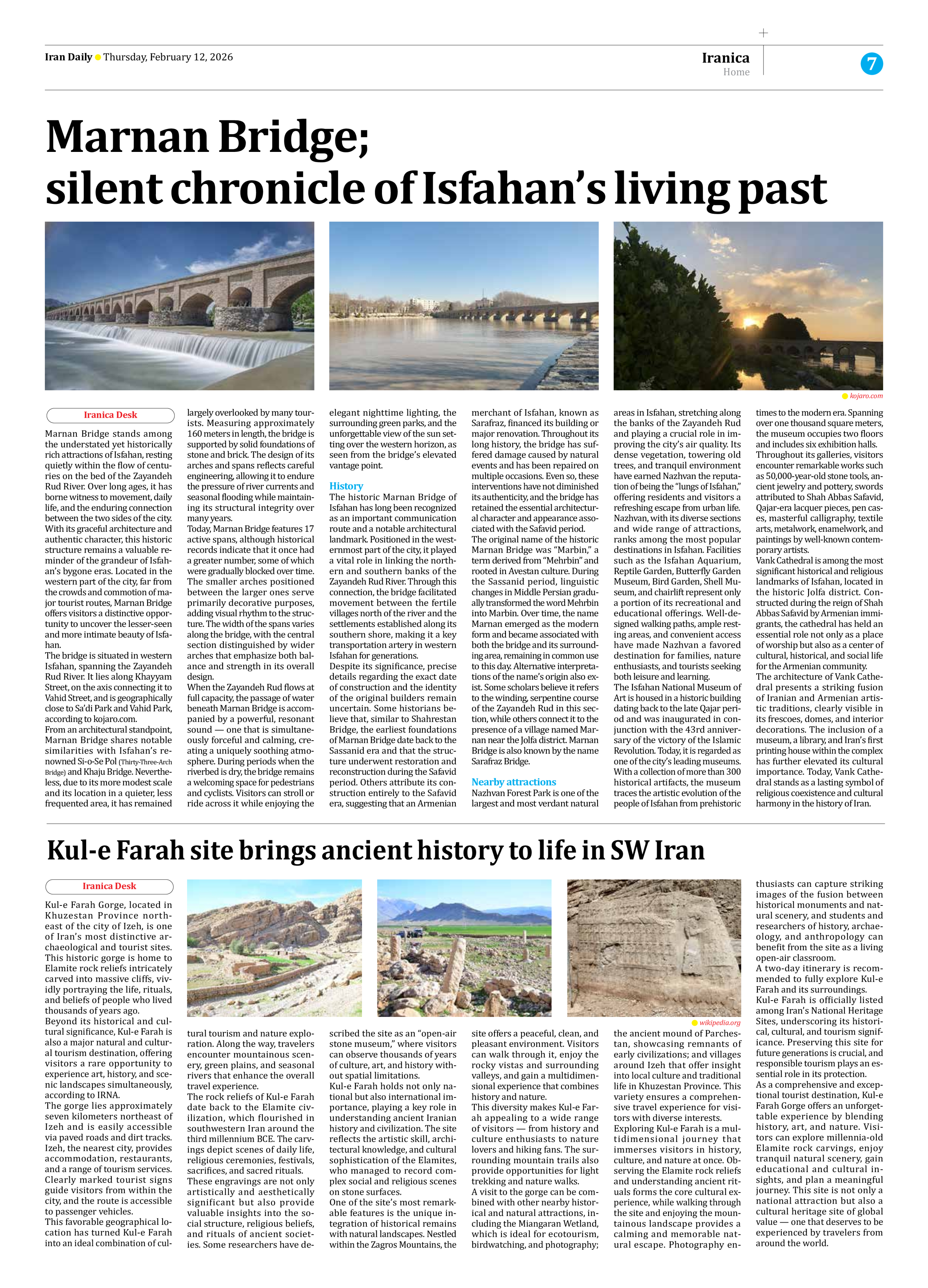
From an architectural standpoint, Marnan Bridge shares notable similarities with Isfahan’s renowned Si-o-Se Pol (Thirty-Three-Arch Bridge) and Khaju Bridge. Nevertheless, due to its more modest scale and its location in a quieter, less frequented area, it has remained largely overlooked by many tourists. Measuring approximately 160 meters in length, the bridge is supported by solid foundations of stone and brick. The design of its arches and spans reflects careful engineering, allowing it to endure the pressure of river currents and seasonal flooding while maintaining its structural integrity over many years.
Today, Marnan Bridge features 17 active spans, although historical records indicate that it once had a greater number, some of which were gradually blocked over time. The smaller arches positioned between the larger ones serve primarily decorative purposes, adding visual rhythm to the structure. The width of the spans varies along the bridge, with the central section distinguished by wider arches that emphasize both balance and strength in its overall design.
When the Zayandeh Rud flows at full capacity, the passage of water beneath Marnan Bridge is accompanied by a powerful, resonant sound — one that is simultaneously forceful and calming, creating a uniquely soothing atmosphere. During periods when the riverbed is dry, the bridge remains a welcoming space for pedestrians and cyclists. Visitors can stroll or ride across it while enjoying the elegant nighttime lighting, the surrounding green parks, and the unforgettable view of the sun setting over the western horizon, as seen from the bridge’s elevated vantage point.
History
The historic Marnan Bridge of Isfahan has long been recognized as an important communication route and a notable architectural landmark. Positioned in the westernmost part of the city, it played a vital role in linking the northern and southern banks of the Zayandeh Rud River. Through this connection, the bridge facilitated movement between the fertile villages north of the river and the settlements established along its southern shore, making it a key transportation artery in western Isfahan for generations.
Despite its significance, precise details regarding the exact date of construction and the identity of the original builders remain uncertain. Some historians believe that, similar to Shahrestan Bridge, the earliest foundations of Marnan Bridge date back to the Sassanid era and that the structure underwent restoration and reconstruction during the Safavid period. Others attribute its construction entirely to the Safavid era, suggesting that an Armenian merchant of Isfahan, known as Sarafraz, financed its building or major renovation. Throughout its long history, the bridge has suffered damage caused by natural events and has been repaired on multiple occasions. Even so, these interventions have not diminished its authenticity, and the bridge has retained the essential architectural character and appearance associated with the Safavid period.
The original name of the historic Marnan Bridge was “Marbin,” a term derived from “Mehrbin” and rooted in Avestan culture. During the Sassanid period, linguistic changes in Middle Persian gradually transformed the word Mehrbin into Marbin. Over time, the name Marnan emerged as the modern form and became associated with both the bridge and its surrounding area, remaining in common use to this day. Alternative interpretations of the name’s origin also exist. Some scholars believe it refers to the winding, serpentine course of the Zayandeh Rud in this section, while others connect it to the presence of a village named Marnan near the Jolfa district. Marnan Bridge is also known by the name Sarafraz Bridge.
Nearby attractions
Nazhvan Forest Park is one of the largest and most verdant natural areas in Isfahan, stretching along the banks of the Zayandeh Rud and playing a crucial role in improving the city’s air quality. Its dense vegetation, towering old trees, and tranquil environment have earned Nazhvan the reputation of being the “lungs of Isfahan,” offering residents and visitors a refreshing escape from urban life.
Nazhvan, with its diverse sections and wide range of attractions, ranks among the most popular destinations in Isfahan. Facilities such as the Isfahan Aquarium, Reptile Garden, Butterfly Garden Museum, Bird Garden, Shell Museum, and chairlift represent only a portion of its recreational and educational offerings. Well-designed walking paths, ample resting areas, and convenient access have made Nazhvan a favored destination for families, nature enthusiasts, and tourists seeking both leisure and learning.
The Isfahan National Museum of Art is housed in a historic building dating back to the late Qajar period and was inaugurated in conjunction with the 43rd anniversary of the victory of the Islamic Revolution. Today, it is regarded as one of the city’s leading museums. With a collection of more than 300 historical artifacts, the museum traces the artistic evolution of the people of Isfahan from prehistoric times to the modern era. Spanning over one thousand square meters, the museum occupies two floors and includes six exhibition halls.
Throughout its galleries, visitors encounter remarkable works such as 50,000-year-old stone tools, ancient jewelry and pottery, swords attributed to Shah Abbas Safavid, Qajar-era lacquer pieces, pen cases, masterful calligraphy, textile arts, metalwork, enamelwork, and paintings by well-known contemporary artists.
Vank Cathedral is among the most significant historical and religious landmarks of Isfahan, located in the historic Jolfa district. Constructed during the reign of Shah Abbas Safavid by Armenian immigrants, the cathedral has held an essential role not only as a place of worship but also as a center of cultural, historical, and social life for the Armenian community.
The architecture of Vank Cathedral presents a striking fusion of Iranian and Armenian artistic traditions, clearly visible in its frescoes, domes, and interior decorations. The inclusion of a museum, a library, and Iran’s first printing house within the complex has further elevated its cultural importance. Today, Vank Cathedral stands as a lasting symbol of religious coexistence and cultural harmony in the history of Iran.