







When memorization replaces meaningful learning
By Babak Kazemi
Public policy researcher
The education system is the backbone of any society’s development. A country’s system of education not only plays a decisive role in its scientific and economic advancement, but also shapes the cultural, social, and moral identity of future generations.
In Iran, the education system has unfortunately been grappling with a wide range of challenges for years, largely as a result of misguided or flawed policymaking by ineffective administrators. These challenges stem from weak policy design, short-term and ad hoc decision-making, and the poor execution of reform agendas, all of which have inflicted serious quantitative and qualitative damage. That said, the government under President Masoud Pezeshkian, and given his stated commitment to education and educational equity, a critical window of opportunity has opened up to undertake a fundamental reassessment and steer the education system toward a brighter future.
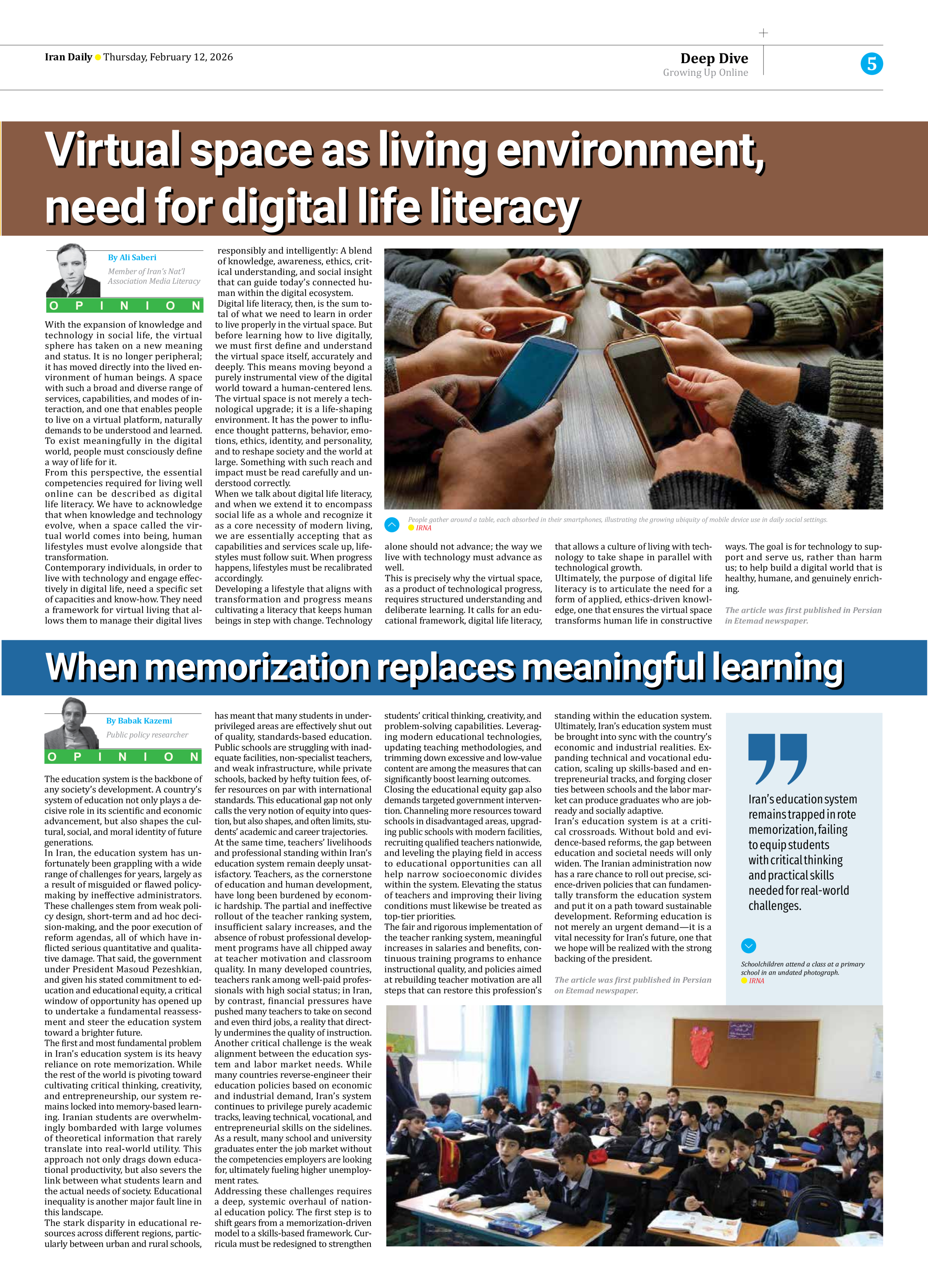
The first and most fundamental problem in Iran’s education system is its heavy reliance on rote memorization. While the rest of the world is pivoting toward cultivating critical thinking, creativity, and entrepreneurship, our system remains locked into memory-based learning. Iranian students are overwhelmingly bombarded with large volumes of theoretical information that rarely translate into real-world utility. This approach not only drags down educational productivity, but also severs the link between what students learn and the actual needs of society. Educational inequality is another major fault line in this landscape.
The stark disparity in educational resources across different regions, particularly between urban and rural schools, has meant that many students in underprivileged areas are effectively shut out of quality, standards-based education. Public schools are struggling with inadequate facilities, non-specialist teachers, and weak infrastructure, while private schools, backed by hefty tuition fees, offer resources on par with international standards. This educational gap not only calls the very notion of equity into question, but also shapes, and often limits, students’ academic and career trajectories.
At the same time, teachers’ livelihoods and professional standing within Iran’s education system remain deeply unsatisfactory. Teachers, as the cornerstone of education and human development, have long been burdened by economic hardship. The partial and ineffective rollout of the teacher ranking system, insufficient salary increases, and the absence of robust professional development programs have all chipped away at teacher motivation and classroom quality. In many developed countries, teachers rank among well-paid professionals with high social status; in Iran, by contrast, financial pressures have pushed many teachers to take on second and even third jobs, a reality that directly undermines the quality of instruction.
Another critical challenge is the weak alignment between the education system and labor market needs. While many countries reverse-engineer their education policies based on economic and industrial demand, Iran’s system continues to privilege purely academic tracks, leaving technical, vocational, and entrepreneurial skills on the sidelines. As a result, many school and university graduates enter the job market without the competencies employers are looking for, ultimately fueling higher unemployment rates.
Addressing these challenges requires a deep, systemic overhaul of national education policy. The first step is to shift gears from a memorization-driven model to a skills-based framework. Curricula must be redesigned to strengthen students’ critical thinking, creativity, and problem-solving capabilities. Leveraging modern educational technologies, updating teaching methodologies, and trimming down excessive and low-value content are among the measures that can significantly boost learning outcomes.
Closing the educational equity gap also demands targeted government intervention. Channeling more resources toward schools in disadvantaged areas, upgrading public schools with modern facilities, recruiting qualified teachers nationwide, and leveling the playing field in access to educational opportunities can all help narrow socioeconomic divides within the system. Elevating the status of teachers and improving their living conditions must likewise be treated as top-tier priorities.
The fair and rigorous implementation of the teacher ranking system, meaningful increases in salaries and benefits, continuous training programs to enhance instructional quality, and policies aimed at rebuilding teacher motivation are all steps that can restore this profession’s standing within the education system. Ultimately, Iran’s education system must be brought into sync with the country’s economic and industrial realities. Expanding technical and vocational education, scaling up skills-based and entrepreneurial tracks, and forging closer ties between schools and the labor market can produce graduates who are job-ready and socially adaptive.
Iran’s education system is at a critical crossroads. Without bold and evidence-based reforms, the gap between education and societal needs will only widen. The Iranian administration now has a rare chance to roll out precise, science-driven policies that can fundamentally transform the education system and put it on a path toward sustainable development. Reforming education is not merely an urgent demand—it is a vital necessity for Iran’s future, one that we hope will be realized with the strong backing of the president.
The article was first published in Persian on Etemad newspaper.