







Copy in clipboard...
Fajr Int’l Music Festival opens in Tehran
The festival’s formal opening ceremony was held in the Artists’ Section of Tehran’s main cemetery, attended by cultural officials and artists, where participants paid tribute to deceased musical figures.
Although Minister of Culture and Islamic Guidance Abbas Salehi did not attend the ceremony in person, he issued a message addressed to the 41st Fajr Music Festival. In his message, Salehi said music today requires a responsible approach and serious dialogue with society, stressing that the Fajr Music Festival can and should serve as one of the central platforms for such dialogue.
“Music is not merely the art of sound, but the auditory memory of a nation,” Salehi wrote.
He noted that over more than four decades, the festival has sought to provide a platform in which tradition and innovation are not in opposition but find meaning through dialogue, allowing different generations of Iranian music to be seen and heard.
Salehi emphasized that now more than ever, music needs a responsible perspective, conscious support, and meaningful engagement with society, an approach that views music not as a decorative margin, but as an integral part of the country’s cultural life and social capital.
Speaking at the opening ceremony, the director general of the Music Office at the Ministry of Culture highlighted the unifying role of the festival, saying that the works and programs of the 41st edition have been designed around the theme of national unity.
He expressed hope that the Fajr Music Festival would contribute to strengthening national cohesion and to a more effective role for people and artists in the country’s path toward development and progress.
Arash Amini, secretary of the 41st Fajr Music Festival, addressed the structural changes introduced this year, including the removal of the competitive section. He explained that competitions should be separated from festivals as they detract from a focus on deep, authentic, and high-quality music.
“The Fajr Music Festival should be the place for the best—both talented young artists and experienced, professional musicians,” he said. “I do not believe it is right to judge and rank these figures. Each of these artists is number one in their own field.”
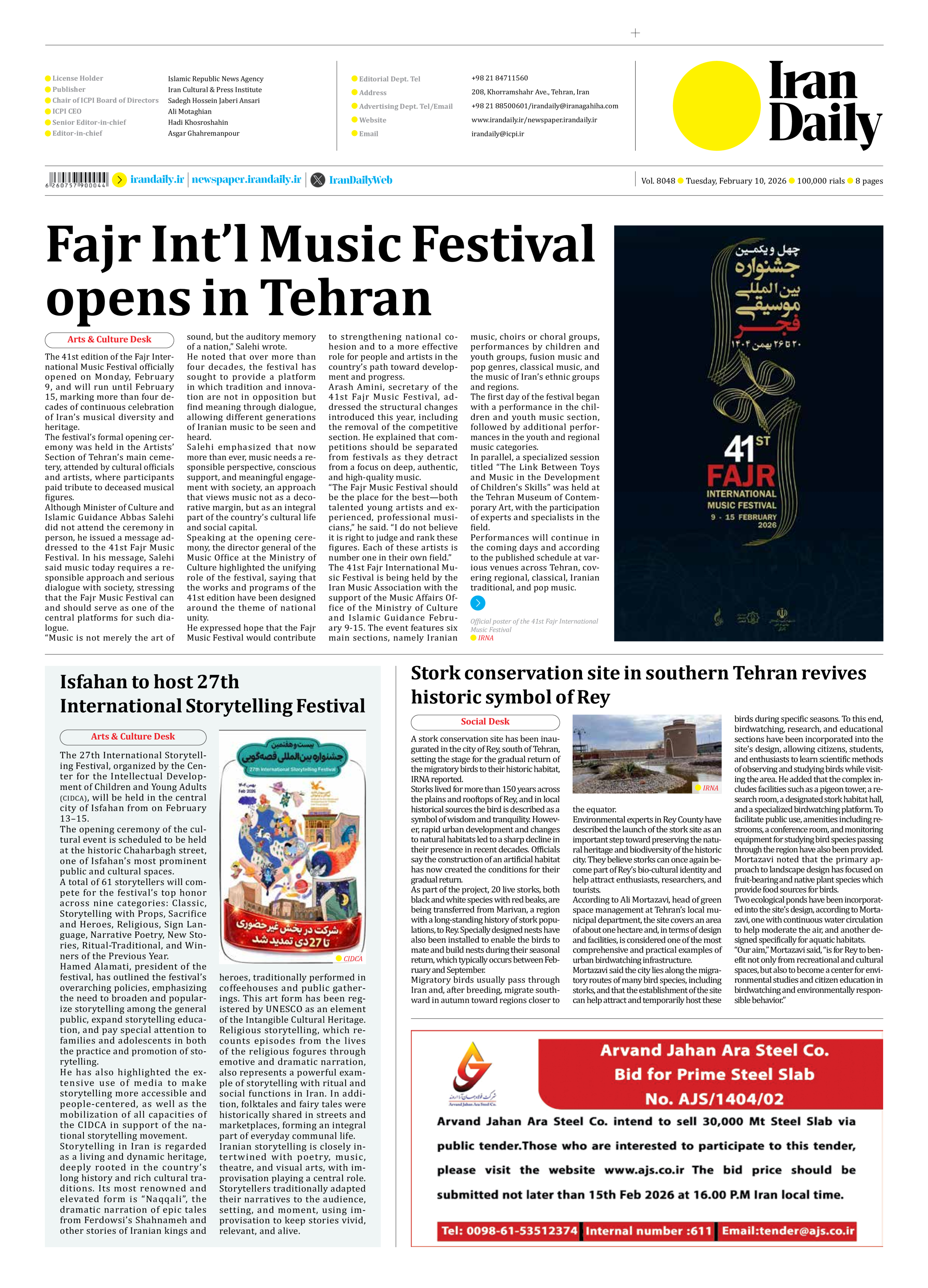
The 41st Fajr International Music Festival is being held by the Iran Music Association with the support of the Music Affairs Office of the Ministry of Culture and Islamic Guidance February 9-15. The event features six main sections, namely Iranian music, choirs or choral groups, performances by children and youth groups, fusion music and pop genres, classical music, and the music of Iran’s ethnic groups and regions.
The first day of the festival began with a performance in the children and youth music section, followed by additional performances in the youth and regional music categories.
In parallel, a specialized session titled “The Link Between Toys and Music in the Development of Children’s Skills” was held at the Tehran Museum of Contemporary Art, with the participation of experts and specialists in the field.
Performances will continue in the coming days and according to the published schedule at various venues across Tehran, covering regional, classical, Iranian traditional, and pop music.