







‘Somewhere at the End of the Street’, portrait of Iran’s first martyred nuclear scientist
From European classrooms to Lebanese battle lines on the stage
By Sadeq Dehqan
Staff writer
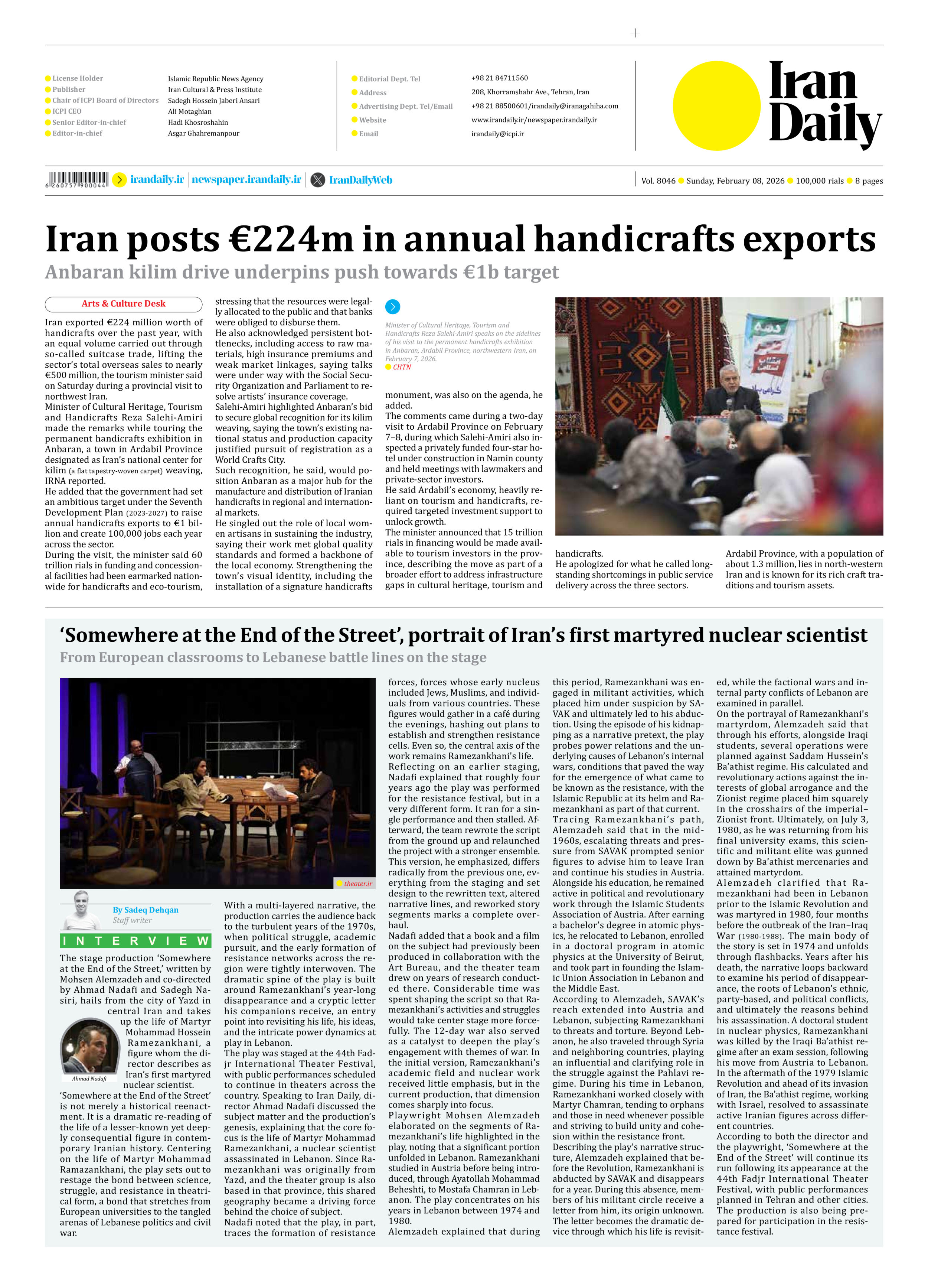
The stage production ‘Somewhere at the End of the Street,’ written by Mohsen Alemzadeh and co-directed by Ahmad Nadafi and Sadegh Nasiri, hails from the city of Yazd in central Iran and takes up the life of Martyr Mohammad Hossein Ramezankhani, a figure whom the director describes as Iran’s first martyred nuclear scientist.
‘Somewhere at the End of the Street’ is not merely a historical reenactment. It is a dramatic re-reading of the life of a lesser-known yet deeply consequential figure in contemporary Iranian history. Centering on the life of Martyr Mohammad Ramazankhani, the play sets out to restage the bond between science, struggle, and resistance in theatrical form, a bond that stretches from European universities to the tangled arenas of Lebanese politics and civil war.
With a multi-layered narrative, the production carries the audience back to the turbulent years of the 1970s, when political struggle, academic pursuit, and the early formation of resistance networks across the region were tightly interwoven. The dramatic spine of the play is built around Ramezankhani’s year-long disappearance and a cryptic letter his companions receive, an entry point into revisiting his life, his ideas, and the intricate power dynamics at play in Lebanon.
The play was staged at the 44th Fadjr International Theater Festival, with public performances scheduled to continue in theaters across the country. Speaking to Iran Daily, director Ahmad Nadafi discussed the subject matter and the production’s genesis, explaining that the core focus is the life of Martyr Mohammad Ramezankhani, a nuclear scientist assassinated in Lebanon. Since Ramezankhani was originally from Yazd, and the theater group is also based in that province, this shared geography became a driving force behind the choice of subject.
Nadafi noted that the play, in part, traces the formation of resistance forces, forces whose early nucleus included Jews, Muslims, and individuals from various countries. These figures would gather in a café during the evenings, hashing out plans to establish and strengthen resistance cells. Even so, the central axis of the work remains Ramezankhani’s life.
Reflecting on an earlier staging, Nadafi explained that roughly four years ago the play was performed for the resistance festival, but in a very different form. It ran for a single performance and then stalled. Afterward, the team rewrote the script from the ground up and relaunched the project with a stronger ensemble.
This version, he emphasized, differs radically from the previous one, everything from the staging and set design to the rewritten text, altered narrative lines, and reworked story segments marks a complete overhaul.
Nadafi added that a book and a film on the subject had previously been produced in collaboration with the Art Bureau, and the theater team drew on years of research conducted there. Considerable time was spent shaping the script so that Ramezankhani’s activities and struggles would take center stage more forcefully. The 12-day war also served as a catalyst to deepen the play’s engagement with themes of war. In the initial version, Ramezankhani’s academic field and nuclear work received little emphasis, but in the current production, that dimension comes sharply into focus.
Playwright Mohsen Alemzadeh elaborated on the segments of Ramezankhani’s life highlighted in the play, noting that a significant portion unfolded in Lebanon. Ramezankhani studied in Austria before being introduced, through Ayatollah Mohammad Beheshti, to Mostafa Chamran in Lebanon. The play concentrates on his years in Lebanon between 1974 and 1980.
Alemzadeh explained that during this period, Ramezankhani was engaged in militant activities, which placed him under suspicion by SAVAK and ultimately led to his abduction. Using the episode of his kidnapping as a narrative pretext, the play probes power relations and the underlying causes of Lebanon’s internal wars, conditions that paved the way for the emergence of what came to be known as the resistance, with the Islamic Republic at its helm and Ramezankhani as part of that current.
Tracing Ramezankhani’s path, Alemzadeh said that in the mid-1960s, escalating threats and pressure from SAVAK prompted senior figures to advise him to leave Iran and continue his studies in Austria. Alongside his education, he remained active in political and revolutionary work through the Islamic Students Association of Austria. After earning a bachelor’s degree in atomic physics, he relocated to Lebanon, enrolled in a doctoral program in atomic physics at the University of Beirut, and took part in founding the Islamic Union Association in Lebanon and the Middle East.
According to Alemzadeh, SAVAK’s reach extended into Austria and Lebanon, subjecting Ramezankhani to threats and torture. Beyond Lebanon, he also traveled through Syria and neighboring countries, playing an influential and clarifying role in the struggle against the Pahlavi regime. During his time in Lebanon, Ramezankhani worked closely with Martyr Chamran, tending to orphans and those in need whenever possible and striving to build unity and cohesion within the resistance front.
Describing the play’s narrative structure, Alemzadeh explained that before the Revolution, Ramezankhani is abducted by SAVAK and disappears for a year. During this absence, members of his militant circle receive a letter from him, its origin unknown. The letter becomes the dramatic device through which his life is revisited, while the factional wars and internal party conflicts of Lebanon are examined in parallel.
On the portrayal of Ramezankhani’s martyrdom, Alemzadeh said that through his efforts, alongside Iraqi students, several operations were planned against Saddam Hussein’s Ba’athist regime. His calculated and revolutionary actions against the interests of global arrogance and the Zionist regime placed him squarely in the crosshairs of the imperial–Zionist front. Ultimately, on July 3, 1980, as he was returning from his final university exams, this scientific and militant elite was gunned down by Ba’athist mercenaries and attained martyrdom.
Alemzadeh clarified that Ramezankhani had been in Lebanon prior to the Islamic Revolution and was martyred in 1980, four months before the outbreak of the Iran–Iraq War (1980-1988). The main body of the story is set in 1974 and unfolds through flashbacks. Years after his death, the narrative loops backward to examine his period of disappearance, the roots of Lebanon’s ethnic, party-based, and political conflicts, and ultimately the reasons behind his assassination. A doctoral student in nuclear physics, Ramezankhani was killed by the Iraqi Ba’athist regime after an exam session, following his move from Austria to Lebanon. In the aftermath of the 1979 Islamic Revolution and ahead of its invasion of Iran, the Ba’athist regime, working with Israel, resolved to assassinate active Iranian figures across different countries.
According to both the director and the playwright, ‘Somewhere at the End of the Street’ will continue its run following its appearance at the 44th Fadjr International Theater Festival, with public performances planned in Tehran and other cities. The production is also being prepared for participation in the resistance festival.