







Traditional ponds shape comfort, culture in Khorasan Razavi Province
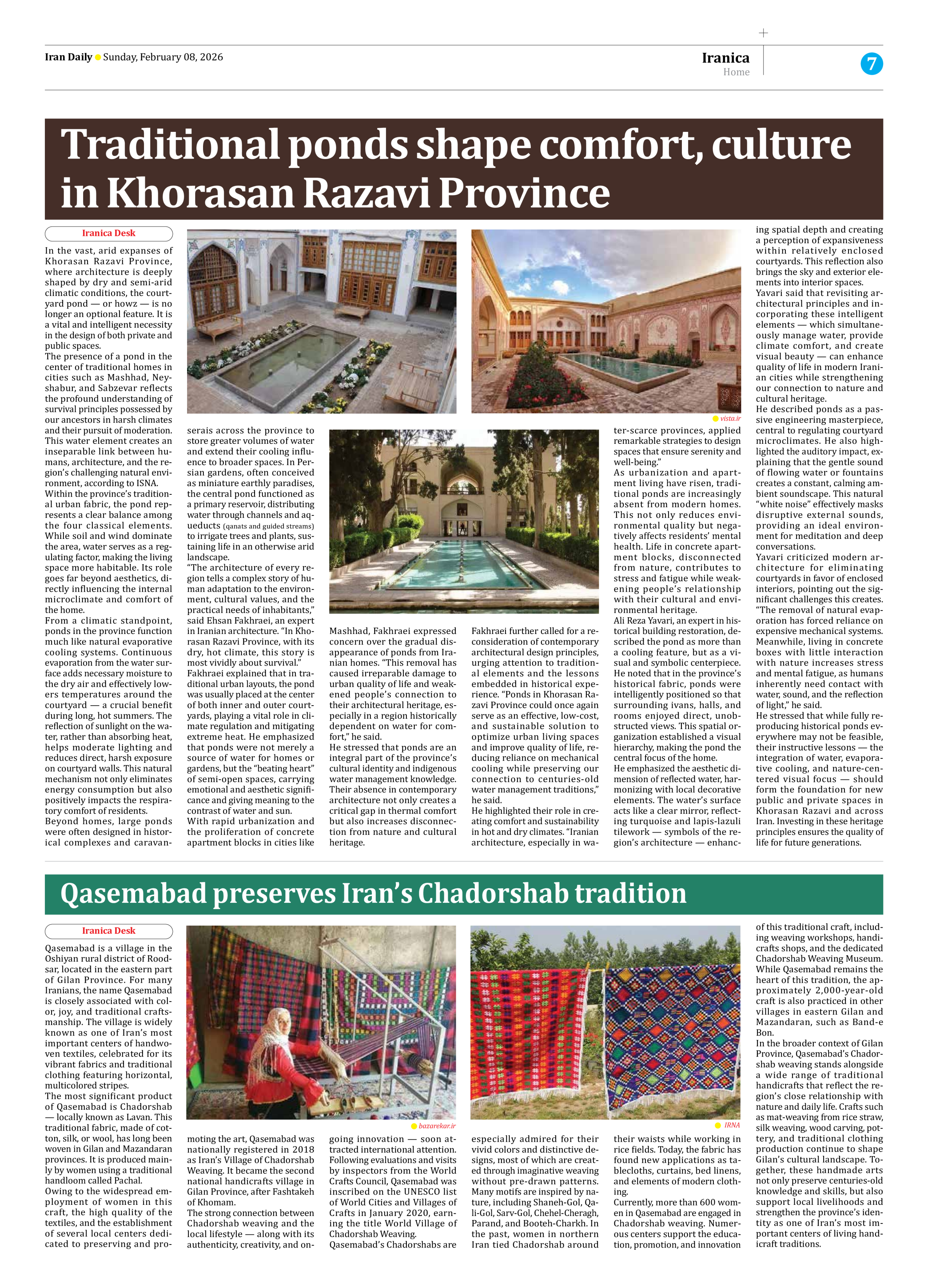
In the vast, arid expanses of Khorasan Razavi Province, where architecture is deeply shaped by dry and semi-arid climatic conditions, the courtyard pond — or howz — is no longer an optional feature. It is a vital and intelligent necessity in the design of both private and public spaces.
The presence of a pond in the center of traditional homes in cities such as Mashhad, Neyshabur, and Sabzevar reflects the profound understanding of survival principles possessed by our ancestors in harsh climates and their pursuit of moderation. This water element creates an inseparable link between humans, architecture, and the region’s challenging natural environment, according to ISNA.
Within the province’s traditional urban fabric, the pond represents a clear balance among the four classical elements. While soil and wind dominate the area, water serves as a regulating factor, making the living space more habitable. Its role goes far beyond aesthetics, directly influencing the internal microclimate and comfort of the home.
From a climatic standpoint, ponds in the province function much like natural evaporative cooling systems. Continuous evaporation from the water surface adds necessary moisture to the dry air and effectively lowers temperatures around the courtyard — a crucial benefit during long, hot summers. The reflection of sunlight on the water, rather than absorbing heat, helps moderate lighting and reduces direct, harsh exposure on courtyard walls. This natural mechanism not only eliminates energy consumption but also positively impacts the respiratory comfort of residents.
Beyond homes, large ponds were often designed in historical complexes and caravanserais across the province to store greater volumes of water and extend their cooling influence to broader spaces. In Persian gardens, often conceived as miniature earthly paradises, the central pond functioned as a primary reservoir, distributing water through channels and aqueducts (qanats and guided streams) to irrigate trees and plants, sustaining life in an otherwise arid landscape.
“The architecture of every region tells a complex story of human adaptation to the environment, cultural values, and the practical needs of inhabitants,” said Ehsan Fakhraei, an expert in Iranian architecture. “In Khorasan Razavi Province, with its dry, hot climate, this story is most vividly about survival.”
Fakhraei explained that in traditional urban layouts, the pond was usually placed at the center of both inner and outer courtyards, playing a vital role in climate regulation and mitigating extreme heat. He emphasized that ponds were not merely a source of water for homes or gardens, but the “beating heart” of semi-open spaces, carrying emotional and aesthetic significance and giving meaning to the contrast of water and sun.
With rapid urbanization and the proliferation of concrete apartment blocks in cities like Mashhad, Fakhraei expressed concern over the gradual disappearance of ponds from Iranian homes. “This removal has caused irreparable damage to urban quality of life and weakened people’s connection to their architectural heritage, especially in a region historically dependent on water for comfort,” he said.
He stressed that ponds are an integral part of the province’s cultural identity and indigenous water management knowledge. Their absence in contemporary architecture not only creates a critical gap in thermal comfort but also increases disconnection from nature and cultural heritage.
Fakhraei further called for a reconsideration of contemporary architectural design principles, urging attention to traditional elements and the lessons embedded in historical experience. “Ponds in Khorasan Razavi Province could once again serve as an effective, low-cost, and sustainable solution to optimize urban living spaces and improve quality of life, reducing reliance on mechanical cooling while preserving our connection to centuries-old water management traditions,” he said.
He highlighted their role in creating comfort and sustainability in hot and dry climates. “Iranian architecture, especially in water-scarce provinces, applied remarkable strategies to design spaces that ensure serenity and well-being.”
As urbanization and apartment living have risen, traditional ponds are increasingly absent from modern homes. This not only reduces environmental quality but negatively affects residents’ mental health. Life in concrete apartment blocks, disconnected from nature, contributes to stress and fatigue while weakening people’s relationship with their cultural and environmental heritage.
Ali Reza Yavari, an expert in historical building restoration, described the pond as more than a cooling feature, but as a visual and symbolic centerpiece. He noted that in the province’s historical fabric, ponds were intelligently positioned so that surrounding ivans, halls, and rooms enjoyed direct, unobstructed views. This spatial organization established a visual hierarchy, making the pond the central focus of the home.
He emphasized the aesthetic dimension of reflected water, harmonizing with local decorative elements. The water’s surface acts like a clear mirror, reflecting turquoise and lapis-lazuli tilework — symbols of the region’s architecture — enhancing spatial depth and creating a perception of expansiveness within relatively enclosed courtyards. This reflection also brings the sky and exterior elements into interior spaces.
Yavari said that revisiting architectural principles and incorporating these intelligent elements — which simultaneously manage water, provide climate comfort, and create visual beauty — can enhance quality of life in modern Iranian cities while strengthening our connection to nature and cultural heritage.
He described ponds as a passive engineering masterpiece, central to regulating courtyard microclimates. He also highlighted the auditory impact, explaining that the gentle sound of flowing water or fountains creates a constant, calming ambient soundscape. This natural “white noise” effectively masks disruptive external sounds, providing an ideal environment for meditation and deep conversations.
Yavari criticized modern architecture for eliminating courtyards in favor of enclosed interiors, pointing out the significant challenges this creates. “The removal of natural evaporation has forced reliance on expensive mechanical systems. Meanwhile, living in concrete boxes with little interaction with nature increases stress and mental fatigue, as humans inherently need contact with water, sound, and the reflection of light,” he said.
He stressed that while fully reproducing historical ponds everywhere may not be feasible, their instructive lessons — the integration of water, evaporative cooling, and nature-centered visual focus — should form the foundation for new public and private spaces in Khorasan Razavi and across Iran. Investing in these heritage principles ensures the quality of life for future generations.