







President calls for science-based agriculture reforms amid water stress
President Masoud Pezeshkian on Tuesday urged Iranian farmers and officials to adopt expert-driven planning to confront severe water shortages and climate change impacts, while announcing structural reforms aimed at eliminating rent-seeking practices that have long distorted agricultural markets.
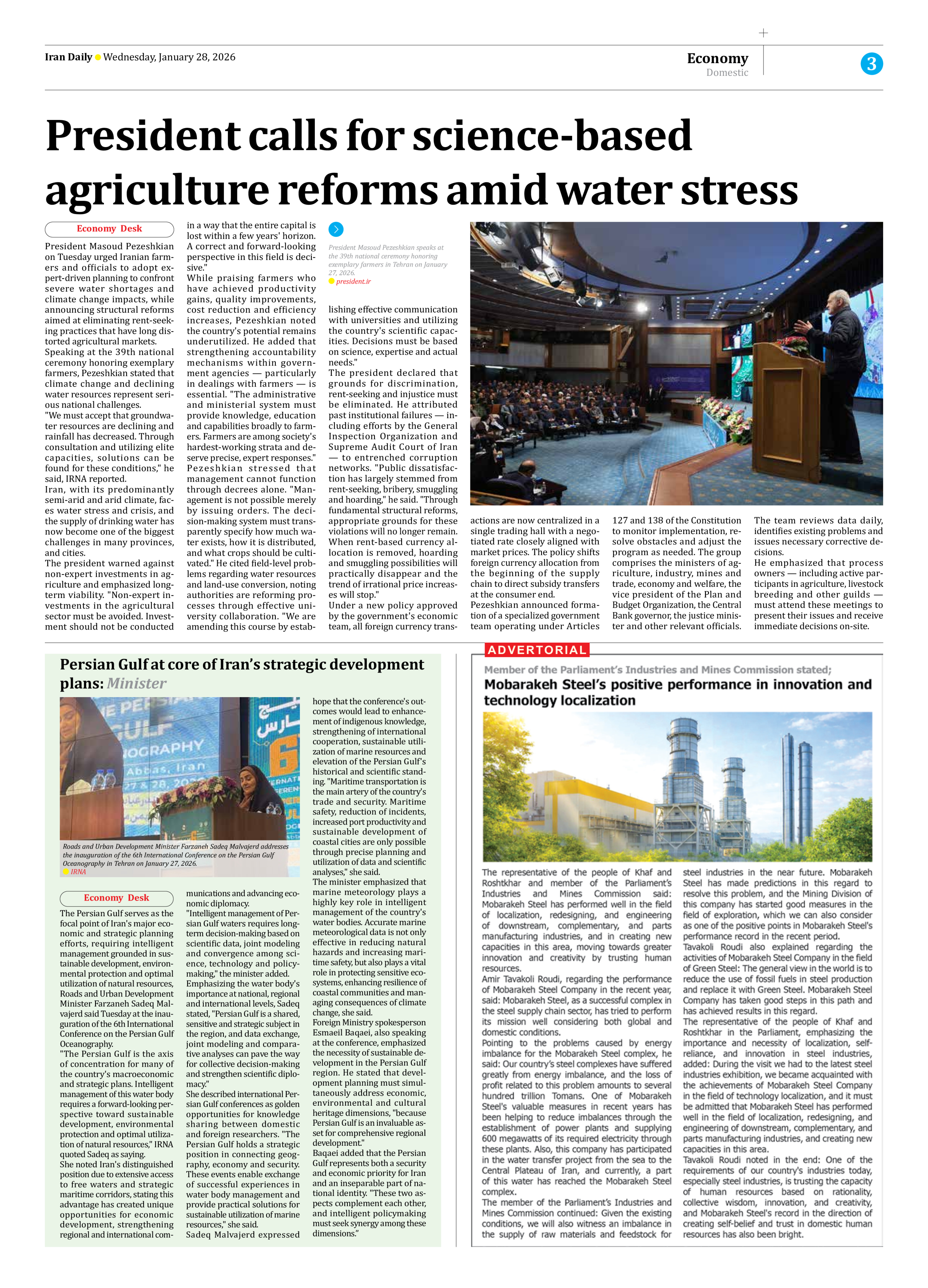
Speaking at the 39th national ceremony honoring exemplary farmers, Pezeshkian stated that climate change and declining water resources represent serious national challenges.
"We must accept that groundwater resources are declining and rainfall has decreased. Through consultation and utilizing elite capacities, solutions can be found for these conditions," he said, IRNA reported.
Iran, with its predominantly semi-arid and arid climate, faces water stress and crisis, and the supply of drinking water has now become one of the biggest challenges in many provinces, and cities.
The president warned against non-expert investments in agriculture and emphasized long-term viability. "Non-expert investments in the agricultural sector must be avoided. Investment should not be conducted in a way that the entire capital is lost within a few years' horizon. A correct and forward-looking perspective in this field is decisive."
While praising farmers who have achieved productivity gains, quality improvements, cost reduction and efficiency increases, Pezeshkian noted the country's potential remains underutilized. He added that strengthening accountability mechanisms within government agencies — particularly in dealings with farmers — is essential. "The administrative and ministerial system must provide knowledge, education and capabilities broadly to farmers. Farmers are among society's hardest-working strata and deserve precise, expert responses."
Pezeshkian stressed that management cannot function through decrees alone. "Management is not possible merely by issuing orders. The decision-making system must transparently specify how much water exists, how it is distributed, and what crops should be cultivated." He cited field-level problems regarding water resources and land-use conversion, noting authorities are reforming processes through effective university collaboration. "We are amending this course by establishing effective communication with universities and utilizing the country's scientific capacities. Decisions must be based on science, expertise and actual needs."
The president declared that grounds for discrimination, rent-seeking and injustice must be eliminated. He attributed past institutional failures — including efforts by the General Inspection Organization and Supreme Audit Court of Iran — to entrenched corruption networks. "Public dissatisfaction has largely stemmed from rent-seeking, bribery, smuggling and hoarding," he said. "Through fundamental structural reforms, appropriate grounds for these violations will no longer remain. When rent-based currency allocation is removed, hoarding and smuggling possibilities will practically disappear and the trend of irrational price increases will stop."
Under a new policy approved by the government's economic team, all foreign currency transactions are now centralized in a single trading hall with a negotiated rate closely aligned with market prices. The policy shifts foreign currency allocation from the beginning of the supply chain to direct subsidy transfers at the consumer end.
Pezeshkian announced formation of a specialized government team operating under Articles 127 and 138 of the Constitution to monitor implementation, resolve obstacles and adjust the program as needed. The group comprises the ministers of agriculture, industry, mines and trade, economy and welfare, the vice president of the Plan and Budget Organization, the Central Bank governor, the justice minister and other relevant officials. The team reviews data daily, identifies existing problems and issues necessary corrective decisions.
He emphasized that process owners — including active participants in agriculture, livestock breeding and other guilds — must attend these meetings to present their issues and receive immediate decisions on-site.