







Copy in clipboard...
How Korsi shaped family life in traditional Iranian homes
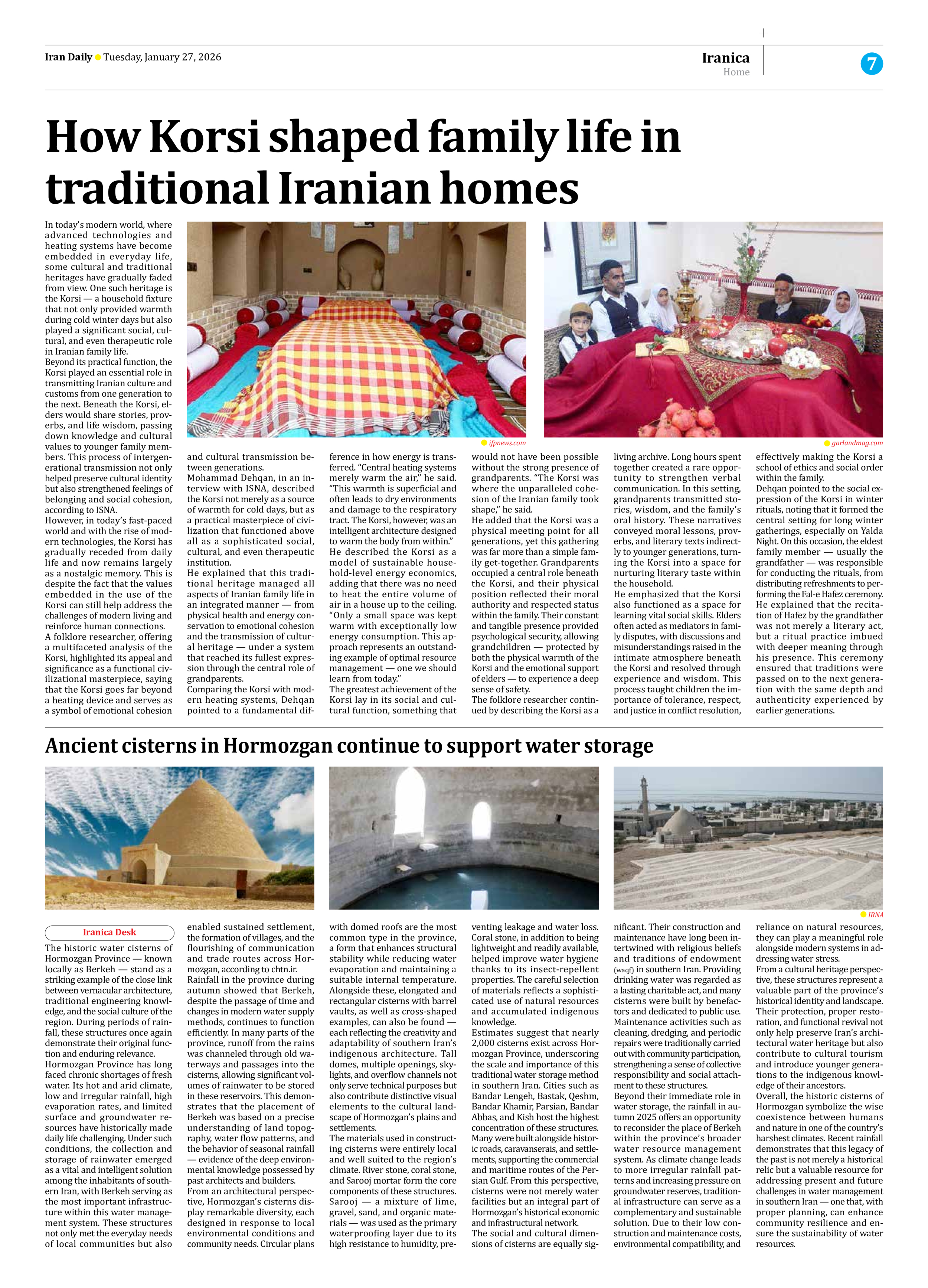
Beyond its practical function, the Korsi played an essential role in transmitting Iranian culture and customs from one generation to the next. Beneath the Korsi, elders would share stories, proverbs, and life wisdom, passing down knowledge and cultural values to younger family members. This process of intergenerational transmission not only helped preserve cultural identity but also strengthened feelings of belonging and social cohesion, according to ISNA.
However, in today’s fast-paced world and with the rise of modern technologies, the Korsi has gradually receded from daily life and now remains largely as a nostalgic memory. This is despite the fact that the values embedded in the use of the Korsi can still help address the challenges of modern living and reinforce human connections.
A folklore researcher, offering a multifaceted analysis of the Korsi, highlighted its appeal and significance as a functional civilizational masterpiece, saying that the Korsi goes far beyond a heating device and serves as a symbol of emotional cohesion and cultural transmission between generations.
Mohammad Dehqan, in an interview with ISNA, described the Korsi not merely as a source of warmth for cold days, but as a practical masterpiece of civilization that functioned above all as a sophisticated social, cultural, and even therapeutic institution.
He explained that this traditional heritage managed all aspects of Iranian family life in an integrated manner — from physical health and energy conservation to emotional cohesion and the transmission of cultural heritage — under a system that reached its fullest expression through the central role of grandparents.
Comparing the Korsi with modern heating systems, Dehqan pointed to a fundamental difference in how energy is transferred. “Central heating systems merely warm the air,” he said. “This warmth is superficial and often leads to dry environments and damage to the respiratory tract. The Korsi, however, was an intelligent architecture designed to warm the body from within.”
He described the Korsi as a model of sustainable household-level energy economics, adding that there was no need to heat the entire volume of air in a house up to the ceiling. “Only a small space was kept warm with exceptionally low energy consumption. This approach represents an outstanding example of optimal resource management — one we should learn from today.”
The greatest achievement of the Korsi lay in its social and cultural function, something that would not have been possible without the strong presence of grandparents. “The Korsi was where the unparalleled cohesion of the Iranian family took shape,” he said.
He added that the Korsi was a physical meeting point for all generations, yet this gathering was far more than a simple family get-together. Grandparents occupied a central role beneath the Korsi, and their physical position reflected their moral authority and respected status within the family. Their constant and tangible presence provided psychological security, allowing grandchildren — protected by both the physical warmth of the Korsi and the emotional support of elders — to experience a deep sense of safety.
The folklore researcher continued by describing the Korsi as a living archive. Long hours spent together created a rare opportunity to strengthen verbal communication. In this setting, grandparents transmitted stories, wisdom, and the family’s oral history. These narratives conveyed moral lessons, proverbs, and literary texts indirectly to younger generations, turning the Korsi into a space for nurturing literary taste within the household.
He emphasized that the Korsi also functioned as a space for learning vital social skills. Elders often acted as mediators in family disputes, with discussions and misunderstandings raised in the intimate atmosphere beneath the Korsi and resolved through experience and wisdom. This process taught children the importance of tolerance, respect, and justice in conflict resolution, effectively making the Korsi a school of ethics and social order within the family.
Dehqan pointed to the social expression of the Korsi in winter rituals, noting that it formed the central setting for long winter gatherings, especially on Yalda Night. On this occasion, the eldest family member — usually the grandfather — was responsible for conducting the rituals, from distributing refreshments to performing the Fal-e Hafez ceremony.
He explained that the recitation of Hafez by the grandfather was not merely a literary act, but a ritual practice imbued with deeper meaning through his presence. This ceremony ensured that traditions were passed on to the next generation with the same depth and authenticity experienced by earlier generations.