







Desalination capacity in southeastern Iran rises by 20,000 m³/day
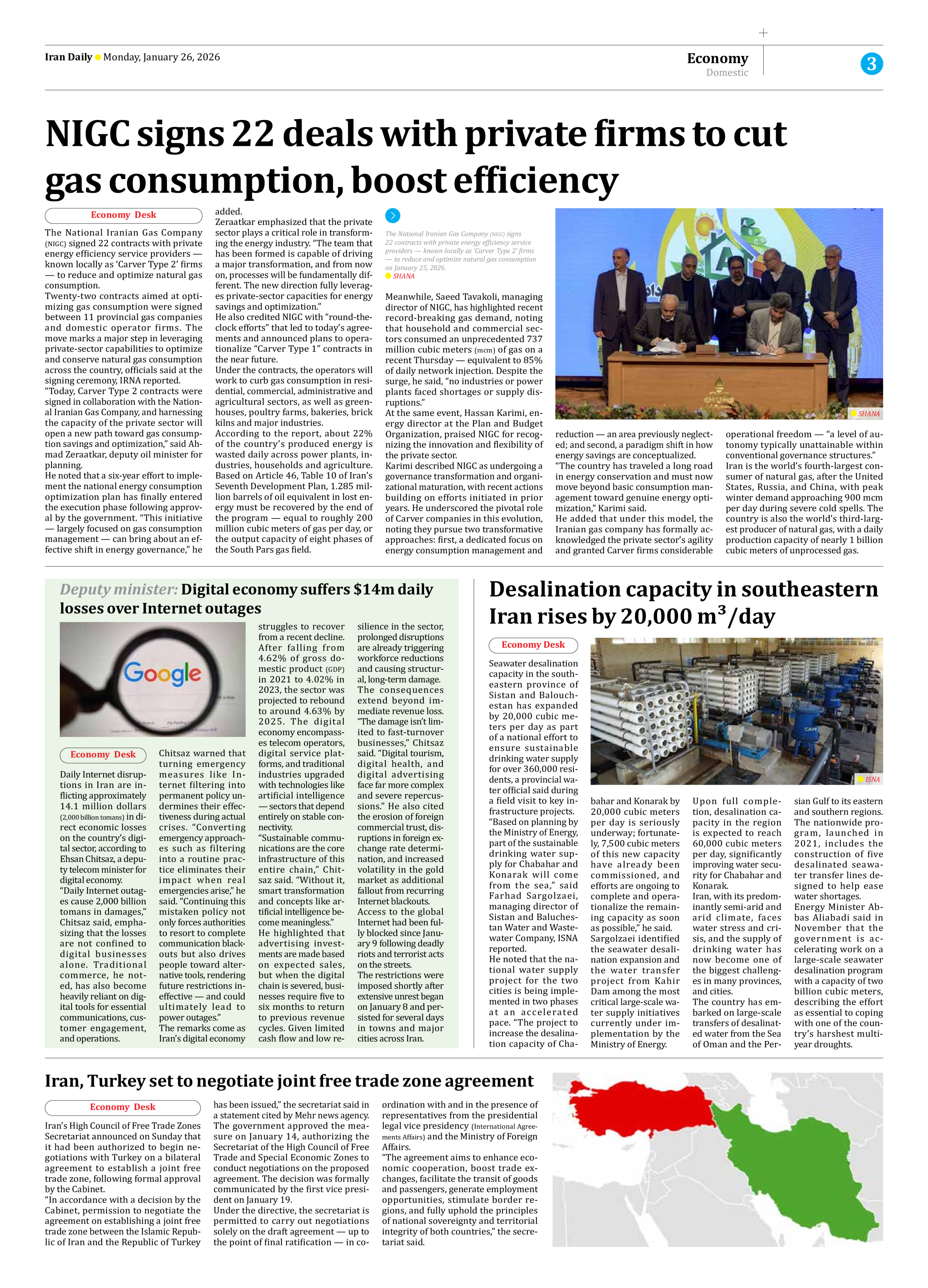
Seawater desalination capacity in the southeastern province of Sistan and Balouchestan has expanded by 20,000 cubic meters per day as part of a national effort to ensure sustainable drinking water supply for over 360,000 residents, a provincial water official said during a field visit to key infrastructure projects.
“Based on planning by the Ministry of Energy, part of the sustainable drinking water supply for Chabahar and Konarak will come from the sea,” said Farhad Sargolzaei, managing director of Sistan and Baluchestan Water and Wastewater Company, ISNA reported.
He noted that the national water supply project for the two cities is being implemented in two phases at an accelerated pace. “The project to increase the desalination capacity of Chabahar and Konarak by 20,000 cubic meters per day is seriously underway; fortunately, 7,500 cubic meters of this new capacity have already been commissioned, and efforts are ongoing to complete and operationalize the remaining capacity as soon as possible,” he said.
Sargolzaei identified the seawater desalination expansion and the water transfer project from Kahir Dam among the most critical large-scale water supply initiatives currently under implementation by the Ministry of Energy.
Upon full completion, desalination capacity in the region is expected to reach 60,000 cubic meters per day, significantly improving water security for Chabahar and Konarak.
Iran, with its predominantly semi-arid and arid climate, faces water stress and crisis, and the supply of drinking water has now become one of the biggest challenges in many provinces, and cities.
The country has embarked on large-scale transfers of desalinated water from the Sea of Oman and the Persian Gulf to its eastern and southern regions. The nationwide program, launched in 2021, includes the construction of five desalinated seawater transfer lines designed to help ease water shortages.
Energy Minister Abbas Aliabadi said in November that the government is accelerating work on a large-scale seawater desalination program with a capacity of two billion cubic meters, describing the effort as essential to coping with one of the country’s harshest multi-year droughts.