







NIGC signs 22 deals with private firms to cut gas consumption, boost efficiency
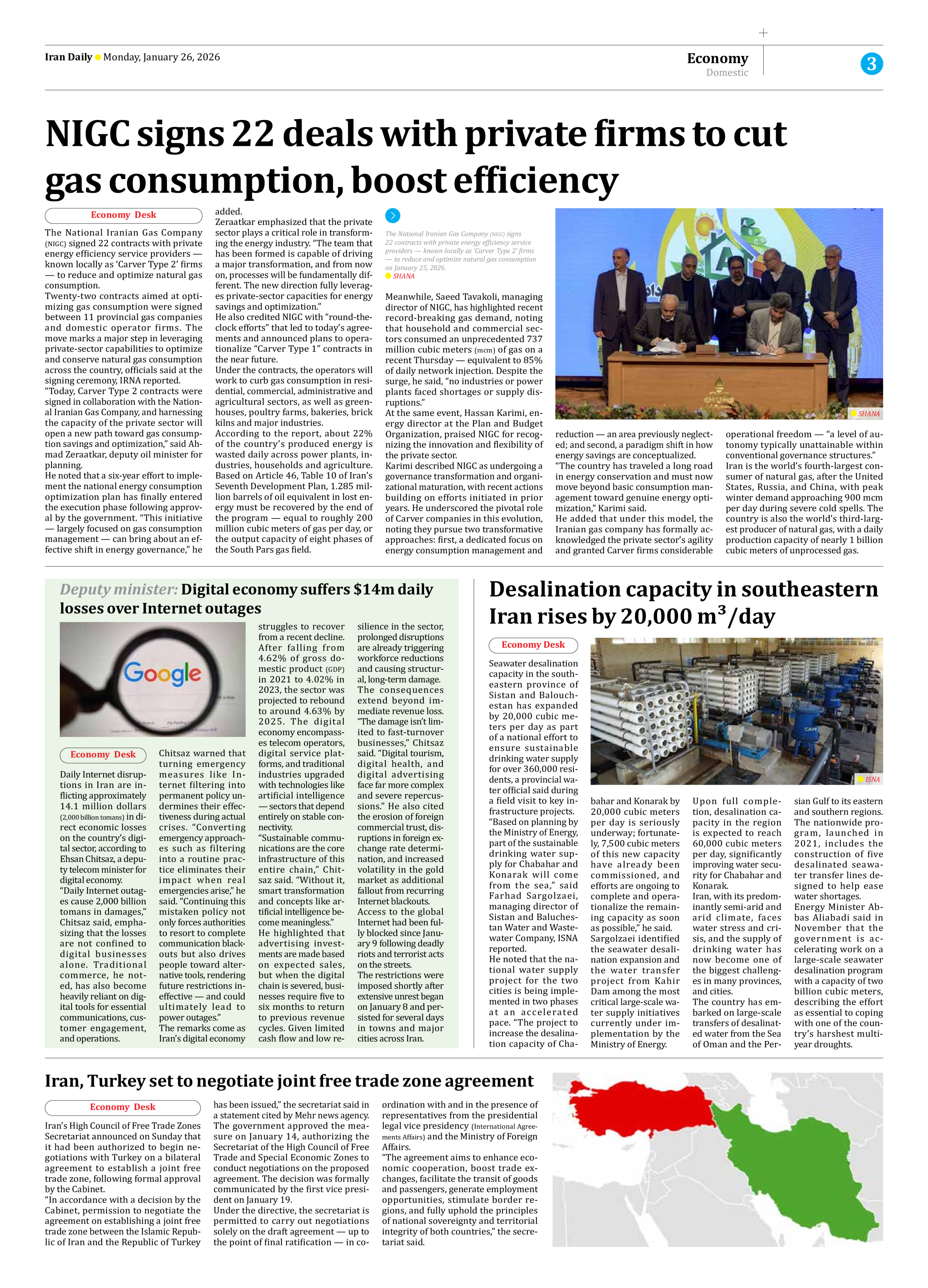
The National Iranian Gas Company (NIGC) signed 22 contracts with private energy efficiency service providers — known locally as ‘Carver Type 2’ firms — to reduce and optimize natural gas consumption.
Twenty-two contracts aimed at optimizing gas consumption were signed between 11 provincial gas companies and domestic operator firms. The move marks a major step in leveraging private-sector capabilities to optimize and conserve natural gas consumption across the country, officials said at the signing ceremony, IRNA reported.
“Today, Carver Type 2 contracts were signed in collaboration with the National Iranian Gas Company, and harnessing the capacity of the private sector will open a new path toward gas consumption savings and optimization,” said Ahmad Zeraatkar, deputy oil minister for planning.
He noted that a six-year effort to implement the national energy consumption optimization plan has finally entered the execution phase following approval by the government. “This initiative — largely focused on gas consumption management — can bring about an effective shift in energy governance,” he added.
Zeraatkar emphasized that the private sector plays a critical role in transforming the energy industry. “The team that has been formed is capable of driving a major transformation, and from now on, processes will be fundamentally different. The new direction fully leverages private-sector capacities for energy savings and optimization.”
He also credited NIGC with “round-the-clock efforts” that led to today’s agreements and announced plans to operationalize “Carver Type 1” contracts in the near future.
Under the contracts, the operators will work to curb gas consumption in residential, commercial, administrative and agricultural sectors, as well as greenhouses, poultry farms, bakeries, brick kilns and major industries.
According to the report, about 22% of the country’s produced energy is wasted daily across power plants, industries, households and agriculture. Based on Article 46, Table 10 of Iran’s Seventh Development Plan, 1.285 million barrels of oil equivalent in lost energy must be recovered by the end of the program — equal to roughly 200 million cubic meters of gas per day, or the output capacity of eight phases of the South Pars gas field.
Meanwhile, Saeed Tavakoli, managing director of NIGC, has highlighted recent record-breaking gas demand, noting that household and commercial sectors consumed an unprecedented 737 million cubic meters (mcm) of gas on a recent Thursday — equivalent to 85% of daily network injection. Despite the surge, he said, “no industries or power plants faced shortages or supply disruptions.”
At the same event, Hassan Karimi, energy director at the Plan and Budget Organization, praised NIGC for recognizing the innovation and flexibility of the private sector.
Karimi described NIGC as undergoing a governance transformation and organizational maturation, with recent actions building on efforts initiated in prior years. He underscored the pivotal role of Carver companies in this evolution, noting they pursue two transformative approaches: first, a dedicated focus on energy consumption management and reduction — an area previously neglected; and second, a paradigm shift in how energy savings are conceptualized.
“The country has traveled a long road in energy conservation and must now move beyond basic consumption management toward genuine energy optimization,” Karimi said.
He added that under this model, the Iranian gas company has formally acknowledged the private sector’s agility and granted Carver firms considerable operational freedom — “a level of autonomy typically unattainable within conventional governance structures.”
Iran is the world’s fourth-largest consumer of natural gas, after the United States, Russia, and China, with peak winter demand approaching 900 mcm per day during severe cold spells. The country is also the world’s third-largest producer of natural gas, with a daily production capacity of nearly 1 billion cubic meters of unprocessed gas.