





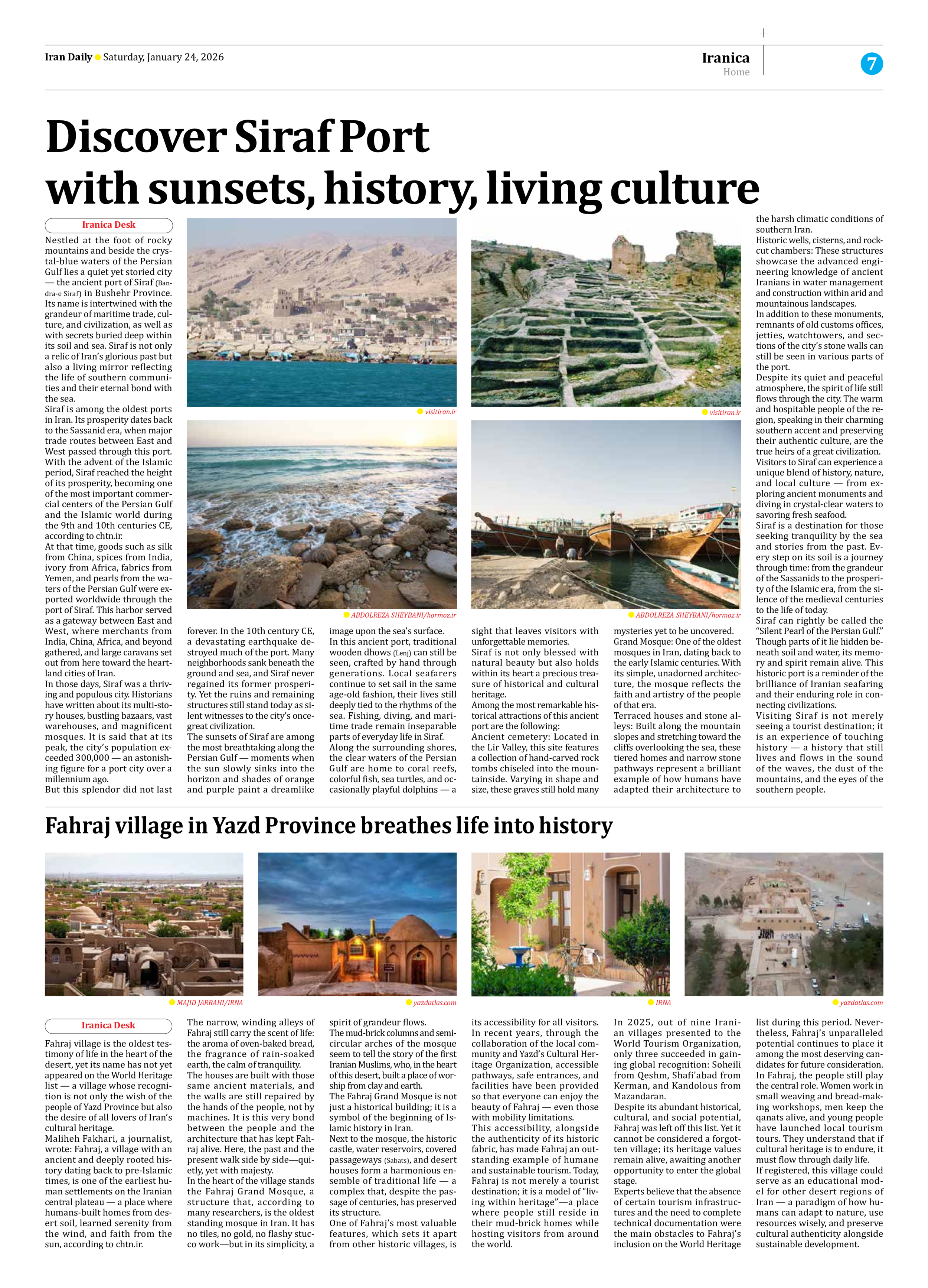


Fahraj village in Yazd Province breathes life into history
Fahraj village is the oldest testimony of life in the heart of the desert, yet its name has not yet appeared on the World Heritage list — a village whose recognition is not only the wish of the people of Yazd Province but also the desire of all lovers of Iran’s cultural heritage.
Maliheh Fakhari, a journalist, wrote: Fahraj, a village with an ancient and deeply rooted history dating back to pre-Islamic times, is one of the earliest human settlements on the Iranian central plateau — a place where humans-built homes from desert soil, learned serenity from the wind, and faith from the sun, according to chtn.ir.
The narrow, winding alleys of Fahraj still carry the scent of life: the aroma of oven-baked bread, the fragrance of rain-soaked earth, the calm of tranquility.
The houses are built with those same ancient materials, and the walls are still repaired by the hands of the people, not by machines. It is this very bond between the people and the architecture that has kept Fahraj alive. Here, the past and the present walk side by side—quietly, yet with majesty.
In the heart of the village stands the Fahraj Grand Mosque, a structure that, according to many researchers, is the oldest standing mosque in Iran. It has no tiles, no gold, no flashy stucco work—but in its simplicity, a spirit of grandeur flows.
The mud-brick columns and semicircular arches of the mosque seem to tell the story of the first Iranian Muslims, who, in the heart of this desert, built a place of worship from clay and earth.
The Fahraj Grand Mosque is not just a historical building; it is a symbol of the beginning of Islamic history in Iran.
Next to the mosque, the historic castle, water reservoirs, covered passageways (Sabats), and desert houses form a harmonious ensemble of traditional life — a complex that, despite the passage of centuries, has preserved its structure.
One of Fahraj’s most valuable features, which sets it apart from other historic villages, is its accessibility for all visitors. In recent years, through the collaboration of the local community and Yazd’s Cultural Heritage Organization, accessible pathways, safe entrances, and facilities have been provided so that everyone can enjoy the beauty of Fahraj — even those with mobility limitations.
This accessibility, alongside the authenticity of its historic fabric, has made Fahraj an outstanding example of humane and sustainable tourism. Today, Fahraj is not merely a tourist destination; it is a model of “living within heritage”—a place where people still reside in their mud-brick homes while hosting visitors from around the world.
In 2025, out of nine Iranian villages presented to the World Tourism Organization, only three succeeded in gaining global recognition: Soheili from Qeshm, Shafi'abad from Kerman, and Kandolous from Mazandaran.
Despite its abundant historical, cultural, and social potential, Fahraj was left off this list. Yet it cannot be considered a forgotten village; its heritage values remain alive, awaiting another opportunity to enter the global stage.
Experts believe that the absence of certain tourism infrastructures and the need to complete technical documentation were the main obstacles to Fahraj’s inclusion on the World Heritage list during this period. Nevertheless, Fahraj’s unparalleled potential continues to place it among the most deserving candidates for future consideration.
In Fahraj, the people still play the central role. Women work in small weaving and bread-making workshops, men keep the qanats alive, and young people have launched local tourism tours. They understand that if cultural heritage is to endure, it must flow through daily life.
If registered, this village could serve as an educational model for other desert regions of Iran — a paradigm of how humans can adapt to nature, use resources wisely, and preserve cultural authenticity alongside sustainable development.