







Discover Siraf Port with sunsets, history, living culture
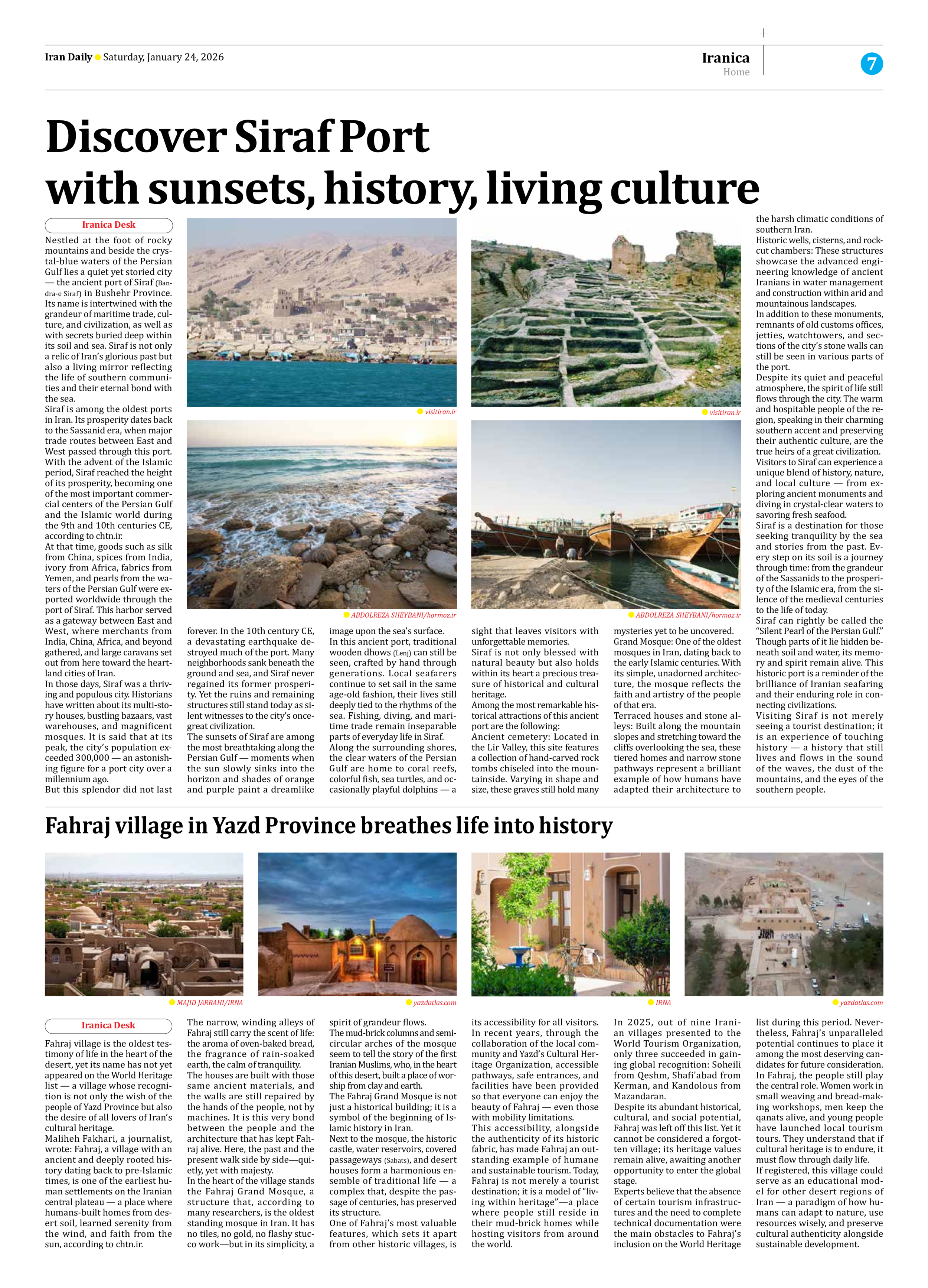
Nestled at the foot of rocky mountains and beside the crystal-blue waters of the Persian Gulf lies a quiet yet storied city — the ancient port of Siraf (Bandra-e Siraf) in Bushehr Province. Its name is intertwined with the grandeur of maritime trade, culture, and civilization, as well as with secrets buried deep within its soil and sea. Siraf is not only a relic of Iran’s glorious past but also a living mirror reflecting the life of southern communities and their eternal bond with the sea.
Siraf is among the oldest ports in Iran. Its prosperity dates back to the Sassanid era, when major trade routes between East and West passed through this port. With the advent of the Islamic period, Siraf reached the height of its prosperity, becoming one of the most important commercial centers of the Persian Gulf and the Islamic world during the 9th and 10th centuries CE, according to chtn.ir.
At that time, goods such as silk from China, spices from India, ivory from Africa, fabrics from Yemen, and pearls from the waters of the Persian Gulf were exported worldwide through the port of Siraf. This harbor served as a gateway between East and West, where merchants from India, China, Africa, and beyond gathered, and large caravans set out from here toward the heartland cities of Iran.
In those days, Siraf was a thriving and populous city. Historians have written about its multi-story houses, bustling bazaars, vast warehouses, and magnificent mosques. It is said that at its peak, the city’s population exceeded 300,000 — an astonishing figure for a port city over a millennium ago.
But this splendor did not last forever. In the 10th century CE, a devastating earthquake destroyed much of the port. Many neighborhoods sank beneath the ground and sea, and Siraf never regained its former prosperity. Yet the ruins and remaining structures still stand today as silent witnesses to the city’s once-great civilization.
The sunsets of Siraf are among the most breathtaking along the Persian Gulf — moments when the sun slowly sinks into the horizon and shades of orange and purple paint a dreamlike image upon the sea’s surface.
In this ancient port, traditional wooden dhows (Lenj) can still be seen, crafted by hand through generations. Local seafarers continue to set sail in the same age-old fashion, their lives still deeply tied to the rhythms of the sea. Fishing, diving, and maritime trade remain inseparable parts of everyday life in Siraf.
Along the surrounding shores, the clear waters of the Persian Gulf are home to coral reefs, colorful fish, sea turtles, and occasionally playful dolphins — a sight that leaves visitors with unforgettable memories.
Siraf is not only blessed with natural beauty but also holds within its heart a precious treasure of historical and cultural heritage.
Among the most remarkable historical attractions of this ancient port are the following:
Ancient cemetery: Located in the Lir Valley, this site features a collection of hand-carved rock tombs chiseled into the mountainside. Varying in shape and size, these graves still hold many mysteries yet to be uncovered.
Grand Mosque: One of the oldest mosques in Iran, dating back to the early Islamic centuries. With its simple, unadorned architecture, the mosque reflects the faith and artistry of the people of that era.
Terraced houses and stone alleys: Built along the mountain slopes and stretching toward the cliffs overlooking the sea, these tiered homes and narrow stone pathways represent a brilliant example of how humans have adapted their architecture to the harsh climatic conditions of southern Iran.
Historic wells, cisterns, and rock-cut chambers: These structures showcase the advanced engineering knowledge of ancient Iranians in water management and construction within arid and mountainous landscapes.
In addition to these monuments, remnants of old customs offices, jetties, watchtowers, and sections of the city’s stone walls can still be seen in various parts of the port.
Despite its quiet and peaceful atmosphere, the spirit of life still flows through the city. The warm and hospitable people of the region, speaking in their charming southern accent and preserving their authentic culture, are the true heirs of a great civilization.
Visitors to Siraf can experience a unique blend of history, nature, and local culture — from exploring ancient monuments and diving in crystal-clear waters to savoring fresh seafood.
Siraf is a destination for those seeking tranquility by the sea and stories from the past. Every step on its soil is a journey through time: from the grandeur of the Sassanids to the prosperity of the Islamic era, from the silence of the medieval centuries to the life of today.
Siraf can rightly be called the “Silent Pearl of the Persian Gulf.” Though parts of it lie hidden beneath soil and water, its memory and spirit remain alive. This historic port is a reminder of the brilliance of Iranian seafaring and their enduring role in connecting civilizations.
Visiting Siraf is not merely seeing a tourist destination; it is an experience of touching history — a history that still lives and flows in the sound of the waves, the dust of the mountains, and the eyes of the southern people.