







Saryazd Castle depicts stunning coexistence of humans with desert
As one drives along the ancient road from Yazd to Kerman and gaze upon the serene, golden desert surrounding us, it might seem less obvious that within this silence and simplicity, treasures of history lie hidden.
One such treasure is the Saryazd Castle; a mud-brick structure built centuries ago not only as a shelter for people but also, ingeniously, as a large, secure safe. This castle is a unique example of the fusion of economic and security needs in ancient Iran, and today it is recognized as one of the beautiful manifestations of this land’s cultural heritage, according to IRNA.
Saryazd Castle is located in a village of the same name, near the city of Mehriz in Yazd Province. This area was once a hub for caravan routes and important trade roads, and its strategic location gave the castle a significant position. It is said that the castle’s initial core dates back to the Sassanian era, a period when the Iranian Empire was at its peak and road security and the transportation of goods were of utmost importance. Over different historical periods, additions were made to the structure, gradually shaping its final form.
Many of Iran’s historical castles were built for military defense, but Saryazd Castle has a different story. This structure was primarily constructed for the protection of property, grains, money, precious objects, and commercial goods. When the threat of attack, insecurity, or banditry loomed, people and caravans would entrust their belongings to this castle, where they would be stored in secure chambers.
Architecture
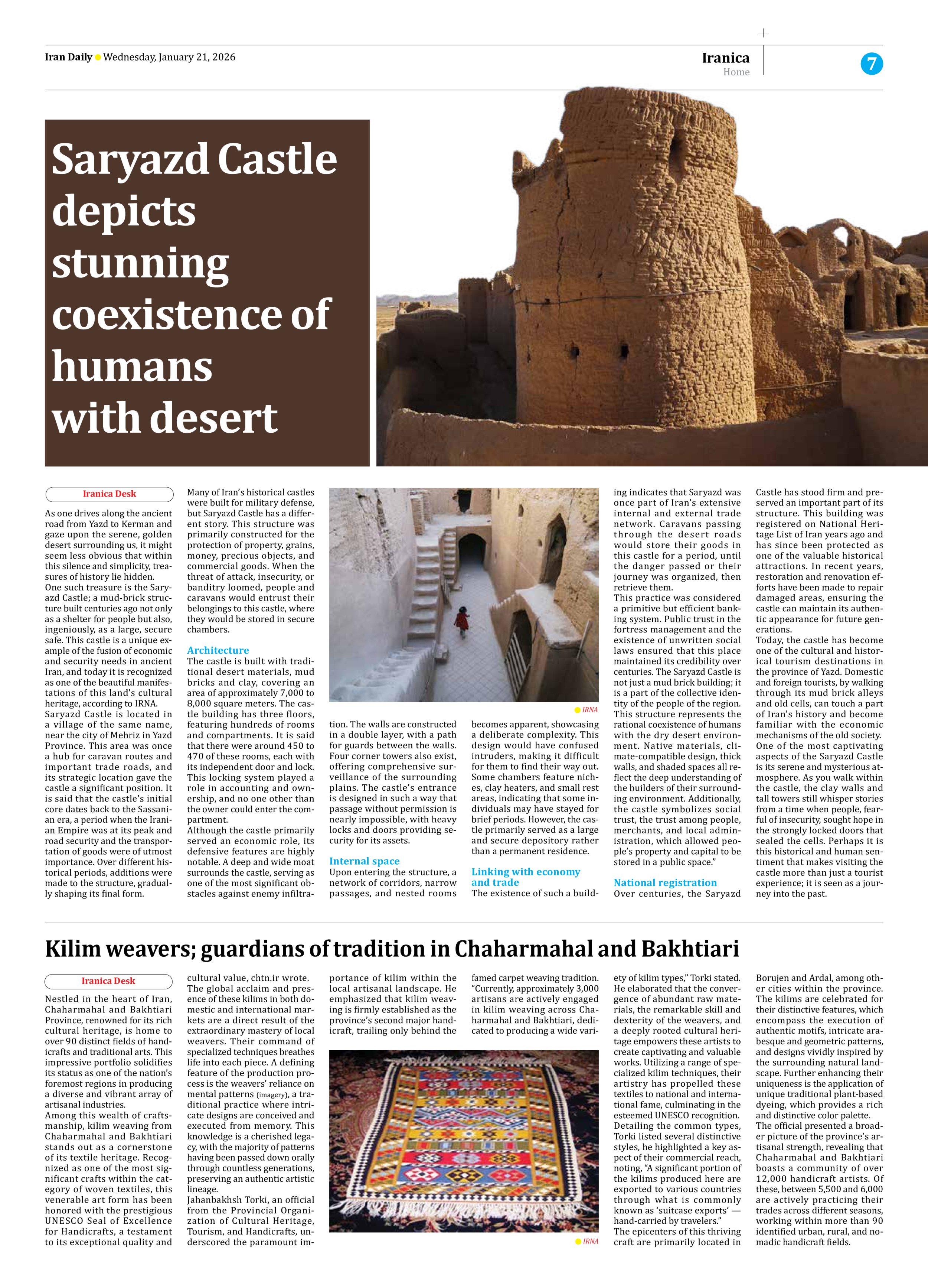
The castle is built with traditional desert materials, mud bricks and clay, covering an area of approximately 7,000 to 8,000 square meters. The castle building has three floors, featuring hundreds of rooms and compartments. It is said that there were around 450 to 470 of these rooms, each with its independent door and lock. This locking system played a role in accounting and ownership, and no one other than the owner could enter the compartment.
Although the castle primarily served an economic role, its defensive features are highly notable. A deep and wide moat surrounds the castle, serving as one of the most significant obstacles against enemy infiltration. The walls are constructed in a double layer, with a path for guards between the walls. Four corner towers also exist, offering comprehensive surveillance of the surrounding plains. The castle’s entrance is designed in such a way that passage without permission is nearly impossible, with heavy locks and doors providing security for its assets.
Internal space
Upon entering the structure, a network of corridors, narrow passages, and nested rooms becomes apparent, showcasing a deliberate complexity. This design would have confused intruders, making it difficult for them to find their way out. Some chambers feature niches, clay heaters, and small rest areas, indicating that some individuals may have stayed for brief periods. However, the castle primarily served as a large and secure depository rather than a permanent residence.
Linking with economy and trade
The existence of such a building indicates that Saryazd was once part of Iran’s extensive internal and external trade network. Caravans passing through the desert roads would store their goods in this castle for a period, until the danger passed or their journey was organized, then retrieve them.
This practice was considered a primitive but efficient banking system. Public trust in the fortress management and the existence of unwritten social laws ensured that this place maintained its credibility over centuries. The Saryazd Castle is not just a mud brick building; it is a part of the collective identity of the people of the region. This structure represents the rational coexistence of humans with the dry desert environment. Native materials, climate-compatible design, thick walls, and shaded spaces all reflect the deep understanding of the builders of their surrounding environment. Additionally, the castle symbolizes social trust, the trust among people, merchants, and local administration, which allowed people’s property and capital to be stored in a public space.”
National registration
Over centuries, the Saryazd Castle has stood firm and preserved an important part of its structure. This building was registered on National Heritage List of Iran years ago and has since been protected as one of the valuable historical attractions. In recent years, restoration and renovation efforts have been made to repair damaged areas, ensuring the castle can maintain its authentic appearance for future generations.
Today, the castle has become one of the cultural and historical tourism destinations in the province of Yazd. Domestic and foreign tourists, by walking through its mud brick alleys and old cells, can touch a part of Iran’s history and become familiar with the economic mechanisms of the old society.
One of the most captivating aspects of the Saryazd Castle is its serene and mysterious atmosphere. As you walk within the castle, the clay walls and tall towers still whisper stories from a time when people, fearful of insecurity, sought hope in the strongly locked doors that sealed the cells. Perhaps it is this historical and human sentiment that makes visiting the castle more than just a tourist experience; it is seen as a journey into the past.