







Jalal Al-e Ahmad Literary Awards
Culture minister calls nation ‘land of stories’
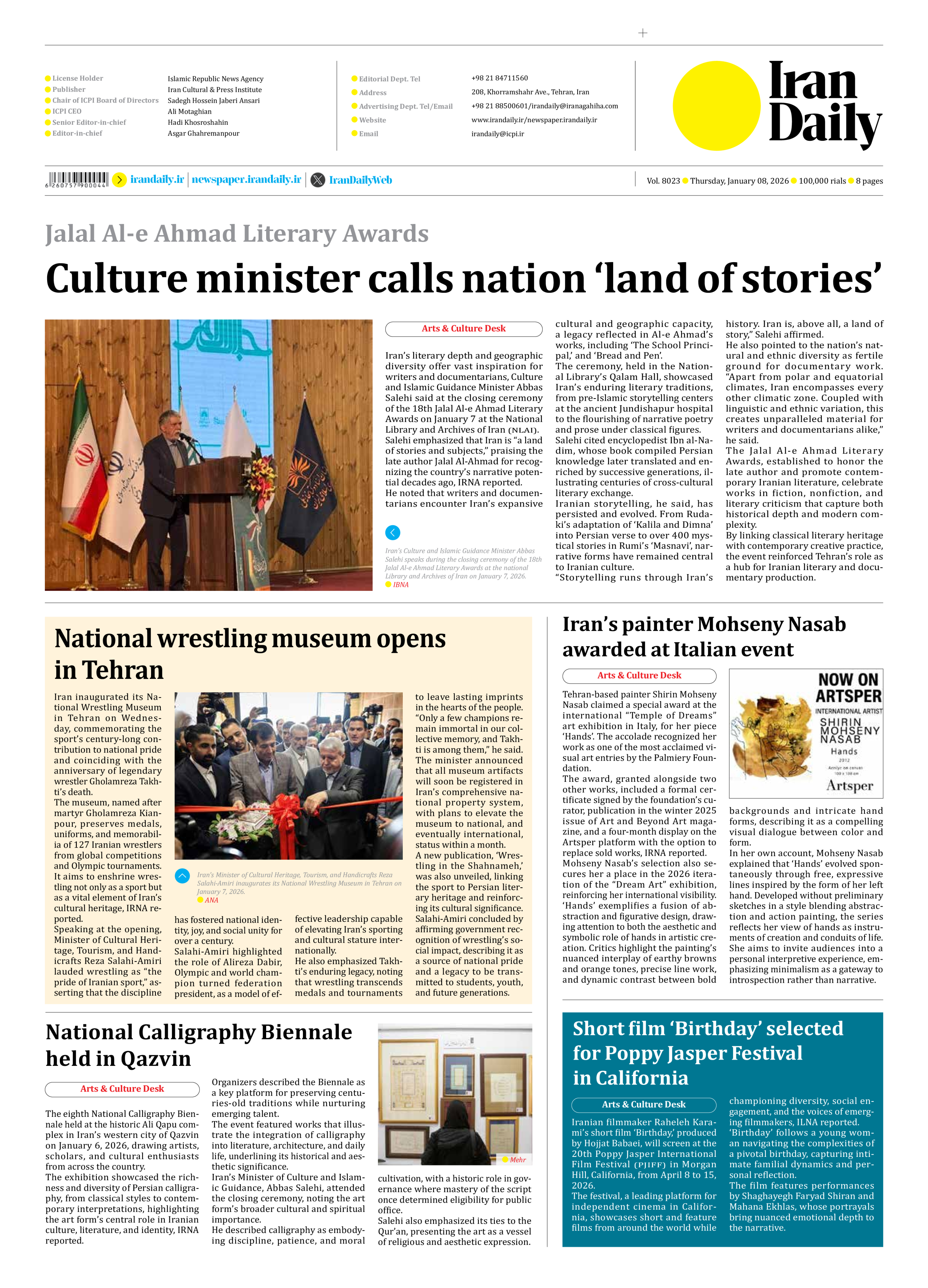
Iran’s literary depth and geographic diversity offer vast inspiration for writers and documentarians, Culture and Islamic Guidance Minister Abbas Salehi said at the closing ceremony of the 18th Jalal Al-e Ahmad Literary Awards on January 7 at the National Library and Archives of Iran (NLAI).
Salehi emphasized that Iran is “a land of stories and subjects,” praising the late author Jalal Al-Ahmad for recognizing the country’s narrative potential decades ago, IRNA reported.
He noted that writers and documentarians encounter Iran’s expansive cultural and geographic capacity, a legacy reflected in Al-e Ahmad’s works, including ‘The School Principal,’ and ‘Bread and Pen’.
The ceremony, held in the National Library’s Qalam Hall, showcased Iran’s enduring literary traditions, from pre-Islamic storytelling centers at the ancient Jundishapur hospital to the flourishing of narrative poetry and prose under classical figures.
Salehi cited encyclopedist Ibn al-Nadim, whose book compiled Persian knowledge later translated and enriched by successive generations, illustrating centuries of cross-cultural literary exchange.
Iranian storytelling, he said, has persisted and evolved. From Rudaki’s adaptation of ‘Kalila and Dimna’ into Persian verse to over 400 mystical stories in Rumi’s ‘Masnavi’, narrative forms have remained central to Iranian culture.
“Storytelling runs through Iran’s history. Iran is, above all, a land of story,” Salehi affirmed.
He also pointed to the nation’s natural and ethnic diversity as fertile ground for documentary work. “Apart from polar and equatorial climates, Iran encompasses every other climatic zone. Coupled with linguistic and ethnic variation, this creates unparalleled material for writers and documentarians alike,” he said.
The Jalal Al-e Ahmad Literary Awards, established to honor the late author and promote contemporary Iranian literature, celebrate works in fiction, nonfiction, and literary criticism that capture both historical depth and modern complexity.
By linking classical literary heritage with contemporary creative practice, the event reinforced Tehran’s role as a hub for Iranian literary and documentary production.