







Pezeshkian urges review of gov’t economic reforms, vows crackdown on corruption
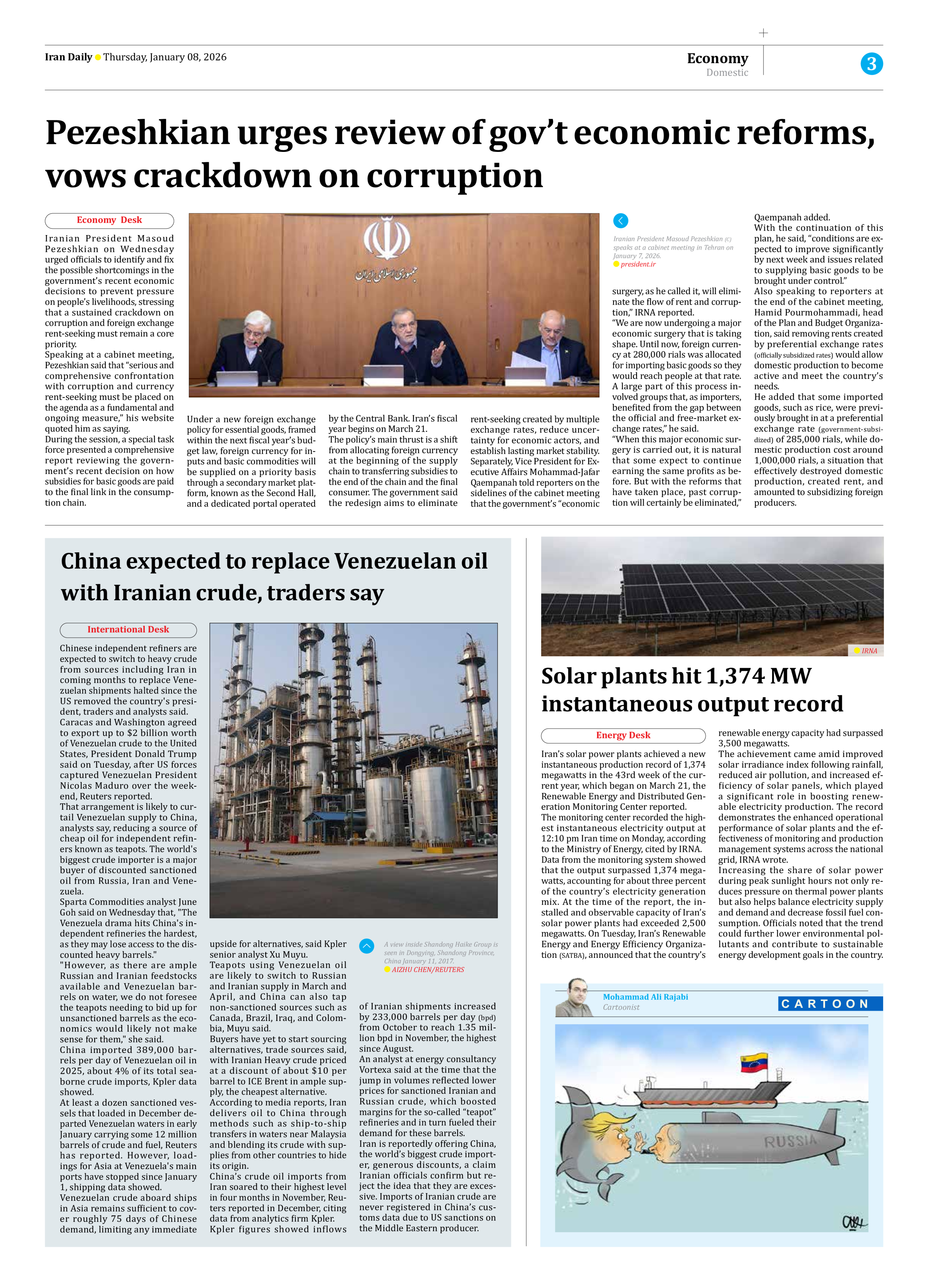
Iranian President Masoud Pezeshkian on Wednesday urged officials to identify and fix the possible shortcomings in the government’s recent economic decisions to prevent pressure on people’s livelihoods, stressing that a sustained crackdown on corruption and foreign exchange rent-seeking must remain a core priority.
Speaking at a cabinet meeting, Pezeshkian said that “serious and comprehensive confrontation with corruption and currency rent-seeking must be placed on the agenda as a fundamental and ongoing measure,” his website quoted him as saying.
During the session, a special task force presented a comprehensive report reviewing the government’s recent decision on how subsidies for basic goods are paid to the final link in the consumption chain.
Under a new foreign exchange policy for essential goods, framed within the next fiscal year’s budget law, foreign currency for inputs and basic commodities will be supplied on a priority basis through a secondary market platform, known as the Second Hall, and a dedicated portal operated by the Central Bank. Iran’s fiscal year begins on March 21.
The policy’s main thrust is a shift from allocating foreign currency at the beginning of the supply chain to transferring subsidies to the end of the chain and the final consumer. The government said the redesign aims to eliminate rent-seeking created by multiple exchange rates, reduce uncertainty for economic actors, and establish lasting market stability.
Separately, Vice President for Executive Affairs Mohammad-Jafar Qaempanah told reporters on the sidelines of the cabinet meeting that the government’s “economic surgery, as he called it, will eliminate the flow of rent and corruption,” IRNA reported.
“We are now undergoing a major economic surgery that is taking shape. Until now, foreign currency at 280,000 rials was allocated for importing basic goods so they would reach people at that rate. A large part of this process involved groups that, as importers, benefited from the gap between the official and free-market exchange rates,” he said.
“When this major economic surgery is carried out, it is natural that some expect to continue earning the same profits as before. But with the reforms that have taken place, past corruption will certainly be eliminated,”
Qaempanah added.
With the continuation of this plan, he said, “conditions are expected to improve significantly by next week and issues related to supplying basic goods to be brought under control.”
Also speaking to reporters at the end of the cabinet meeting, Hamid Pourmohammadi, head of the Plan and Budget Organization, said removing rents created by preferential exchange rates (officially subsidized rates) would allow domestic production to become active and meet the country’s needs.
He added that some imported goods, such as rice, were previously brought in at a preferential exchange rate (government-subsidized) of 285,000 rials, while domestic production cost around 1,000,000 rials, a situation that effectively destroyed domestic production, created rent, and amounted to subsidizing foreign producers.