





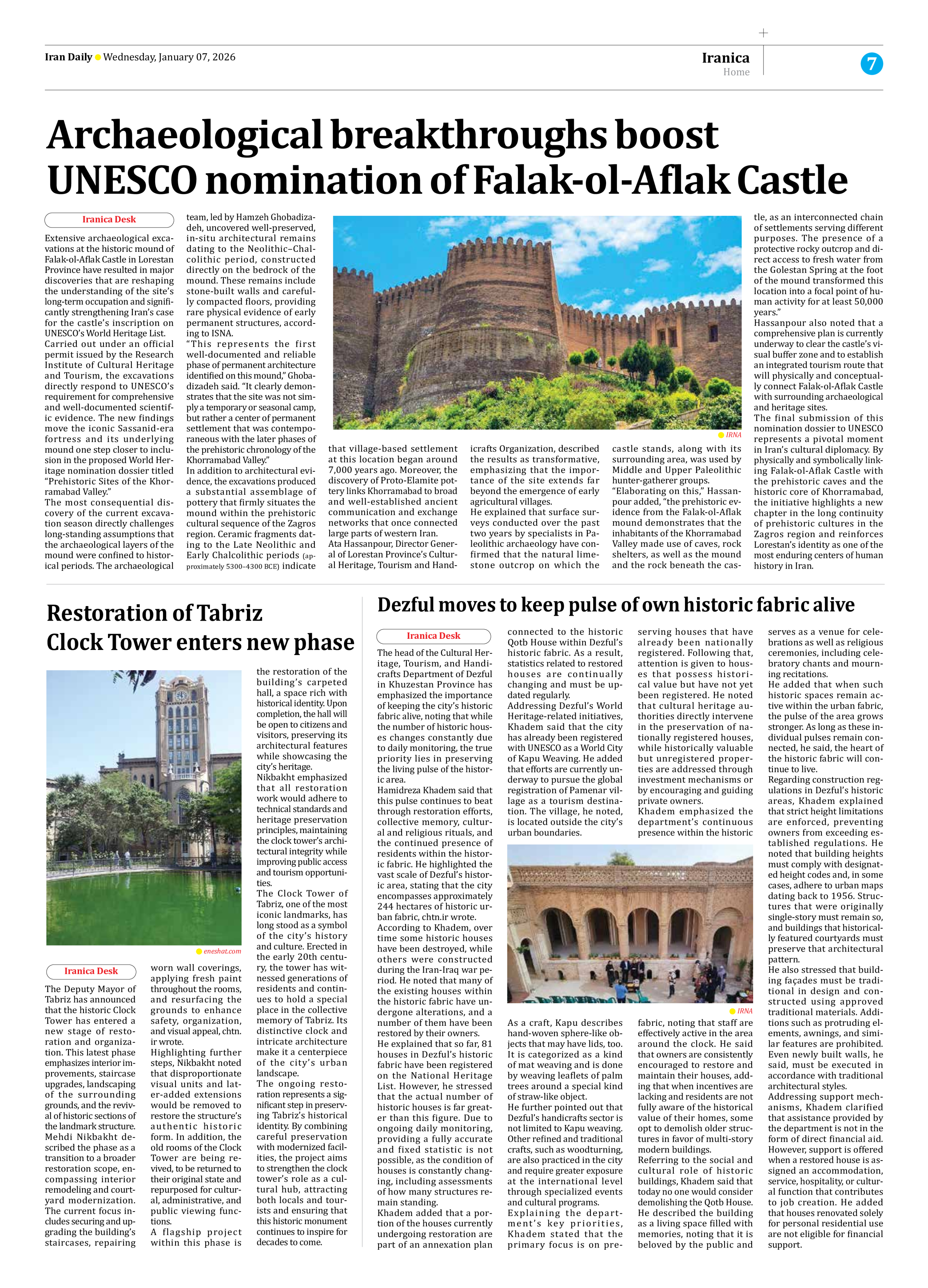


Dezful moves to keep pulse of own historic fabric alive
The head of the Cultural Heritage, Tourism, and Handicrafts Department of Dezful in Khuzestan Province has emphasized the importance of keeping the city’s historic fabric alive, noting that while the number of historic houses changes constantly due to daily monitoring, the true priority lies in preserving the living pulse of the historic area.
Hamidreza Khadem said that this pulse continues to beat through restoration efforts, collective memory, cultural and religious rituals, and the continued presence of residents within the historic fabric. He highlighted the vast scale of Dezful’s historic area, stating that the city encompasses approximately 244 hectares of historic urban fabric, chtn.ir wrote.
According to Khadem, over time some historic houses have been destroyed, while others were constructed during the Iran-Iraq war period. He noted that many of the existing houses within the historic fabric have undergone alterations, and a number of them have been restored by their owners.
He explained that so far, 81 houses in Dezful’s historic fabric have been registered on the National Heritage List. However, he stressed that the actual number of historic houses is far greater than this figure. Due to ongoing daily monitoring, providing a fully accurate and fixed statistic is not possible, as the condition of houses is constantly changing, including assessments of how many structures remain standing.
Khadem added that a portion of the houses currently undergoing restoration are part of an annexation plan connected to the historic Qotb House within Dezful’s historic fabric. As a result, statistics related to restored houses are continually changing and must be updated regularly.
Addressing Dezful’s World Heritage-related initiatives, Khadem said that the city has already been registered with UNESCO as a World City of Kapu Weaving. He added that efforts are currently underway to pursue the global registration of Pamenar village as a tourism destination. The village, he noted, is located outside the city’s urban boundaries.
As a craft, Kapu describes hand-woven sphere-like objects that may have lids, too. It is categorized as a kind of mat weaving and is done by weaving leaflets of palm trees around a special kind of straw-like object.
He further pointed out that Dezful’s handicrafts sector is not limited to Kapu weaving. Other refined and traditional crafts, such as woodturning, are also practiced in the city and require greater exposure at the international level through specialized events and cultural programs.
Explaining the department’s key priorities, Khadem stated that the primary focus is on preserving houses that have already been nationally registered. Following that, attention is given to houses that possess historical value but have not yet been registered. He noted that cultural heritage authorities directly intervene in the preservation of nationally registered houses, while historically valuable but unregistered properties are addressed through investment mechanisms or by encouraging and guiding private owners.
Khadem emphasized the department’s continuous presence within the historic fabric, noting that staff are effectively active in the area around the clock. He said that owners are consistently encouraged to restore and maintain their houses, adding that when incentives are lacking and residents are not fully aware of the historical value of their homes, some opt to demolish older structures in favor of multi-story modern buildings.
Referring to the social and cultural role of historic buildings, Khadem said that today no one would consider demolishing the Qotb House. He described the building as a living space filled with memories, noting that it is beloved by the public and serves as a venue for celebrations as well as religious ceremonies, including celebratory chants and mourning recitations.
He added that when such historic spaces remain active within the urban fabric, the pulse of the area grows stronger. As long as these individual pulses remain connected, he said, the heart of the historic fabric will continue to live.
Regarding construction regulations in Dezful’s historic areas, Khadem explained that strict height limitations are enforced, preventing owners from exceeding established regulations. He noted that building heights must comply with designated height codes and, in some cases, adhere to urban maps dating back to 1956. Structures that were originally single-story must remain so, and buildings that historically featured courtyards must preserve that architectural pattern.
He also stressed that building façades must be traditional in design and constructed using approved traditional materials. Additions such as protruding elements, awnings, and similar features are prohibited. Even newly built walls, he said, must be executed in accordance with traditional architectural styles.
Addressing support mechanisms, Khadem clarified that assistance provided by the department is not in the form of direct financial aid. However, support is offered when a restored house is assigned an accommodation, service, hospitality, or cultural function that contributes to job creation. He added that houses renovated solely for personal residential use are not eligible for financial support.