





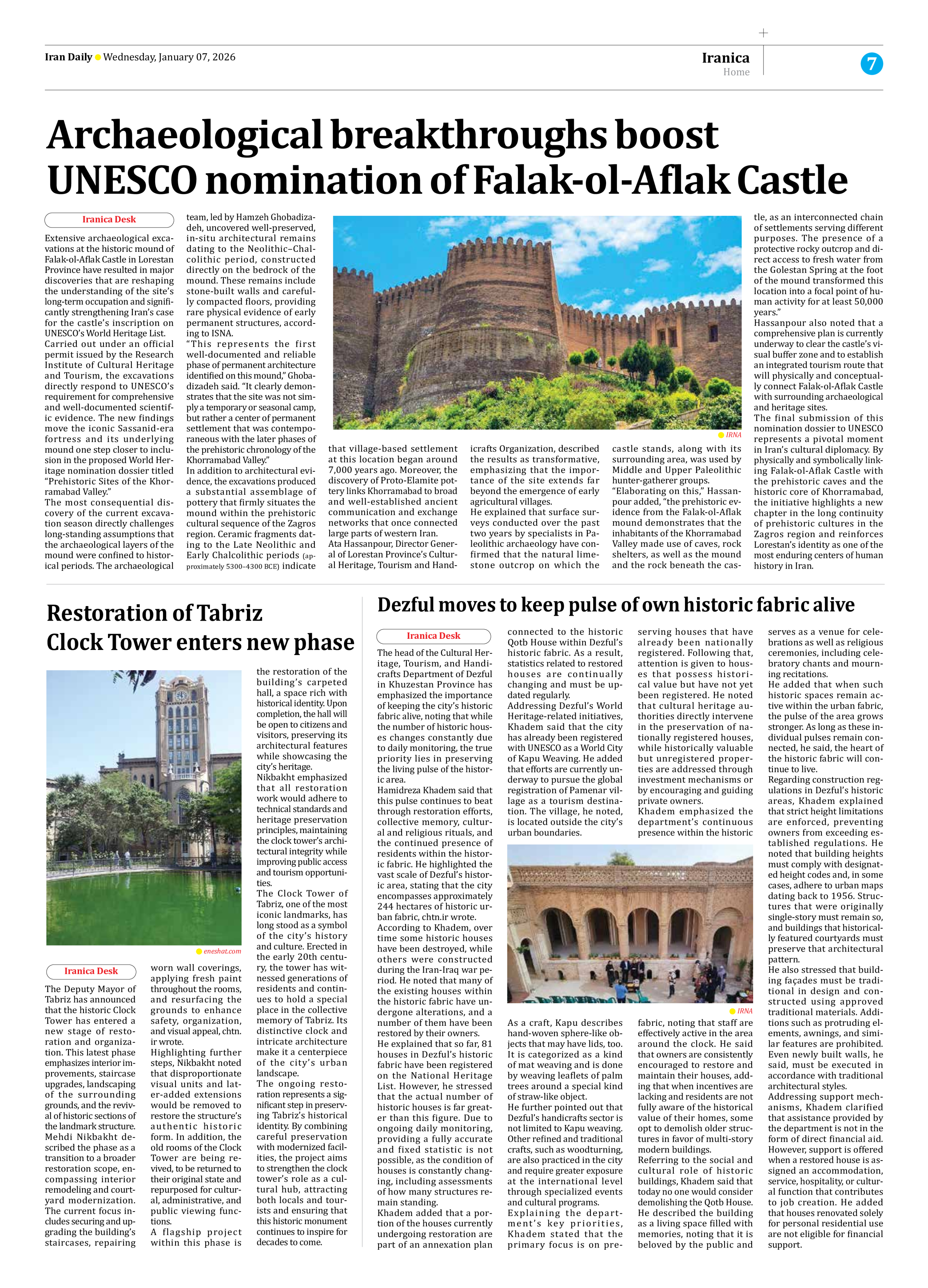


Archaeological breakthroughs boost UNESCO nomination of Falak-ol-Aflak Castle
Extensive archaeological excavations at the historic mound of Falak-ol-Aflak Castle in Lorestan Province have resulted in major discoveries that are reshaping the understanding of the site’s long-term occupation and significantly strengthening Iran’s case for the castle’s inscription on UNESCO’s World Heritage List.
Carried out under an official permit issued by the Research Institute of Cultural Heritage and Tourism, the excavations directly respond to UNESCO’s requirement for comprehensive and well-documented scientific evidence. The new findings move the iconic Sassanid-era fortress and its underlying mound one step closer to inclusion in the proposed World Heritage nomination dossier titled “Prehistoric Sites of the Khorramabad Valley.”
The most consequential discovery of the current excavation season directly challenges long-standing assumptions that the archaeological layers of the mound were confined to historical periods. The archaeological team, led by Hamzeh Ghobadizadeh, uncovered well-preserved, in-situ architectural remains dating to the Neolithic–Chalcolithic period, constructed directly on the bedrock of the mound. These remains include stone-built walls and carefully compacted floors, providing rare physical evidence of early permanent structures, according to ISNA.
“This represents the first well-documented and reliable phase of permanent architecture identified on this mound,” Ghobadizadeh said. “It clearly demonstrates that the site was not simply a temporary or seasonal camp, but rather a center of permanent settlement that was contemporaneous with the later phases of the prehistoric chronology of the Khorramabad Valley.”
In addition to architectural evidence, the excavations produced a substantial assemblage of pottery that firmly situates the mound within the prehistoric cultural sequence of the Zagros region. Ceramic fragments dating to the Late Neolithic and Early Chalcolithic periods (approximately 5300–4300 BCE) indicate that village-based settlement at this location began around 7,000 years ago. Moreover, the discovery of Proto-Elamite pottery links Khorramabad to broad and well-established ancient communication and exchange networks that once connected large parts of western Iran.
Ata Hassanpour, Director General of Lorestan Province’s Cultural Heritage, Tourism and Handicrafts Organization, described the results as transformative, emphasizing that the importance of the site extends far beyond the emergence of early agricultural villages.
He explained that surface surveys conducted over the past two years by specialists in Paleolithic archaeology have confirmed that the natural limestone outcrop on which the castle stands, along with its surrounding area, was used by Middle and Upper Paleolithic hunter-gatherer groups.
“Elaborating on this,” Hassanpour added, “the prehistoric evidence from the Falak-ol-Aflak mound demonstrates that the inhabitants of the Khorramabad Valley made use of caves, rock shelters, as well as the mound and the rock beneath the castle, as an interconnected chain of settlements serving different purposes. The presence of a protective rocky outcrop and direct access to fresh water from the Golestan Spring at the foot of the mound transformed this location into a focal point of human activity for at least 50,000 years.”
Hassanpour also noted that a comprehensive plan is currently underway to clear the castle’s visual buffer zone and to establish an integrated tourism route that will physically and conceptually connect Falak-ol-Aflak Castle with surrounding archaeological and heritage sites.
The final submission of this nomination dossier to UNESCO represents a pivotal moment in Iran’s cultural diplomacy. By physically and symbolically linking Falak-ol-Aflak Castle with the prehistoric caves and the historic core of Khorramabad, the initiative highlights a new chapter in the long continuity of prehistoric cultures in the Zagros region and reinforces Lorestan’s identity as one of the most enduring centers of human history in Iran.