







Gas sweetening unit damaged in Israeli strike restarted at Fajr refinery
A unit at Iran’s Fajr Jam gas refinery in the southern province of Bushehr was brought back online on Monday following repairs, months after the facility was hit during Israel’s aggression on Iran in June.
The refinery returned to production at a time when tensions between Iran and Israel continue to simmer, raising concern about a possible renewal of hostilities.
Oil Minister Mohsen Paknejad said the refinery suffered “serious damage” on two of its eight gas sweetening trains when it came under attack, according to Shana News Agency.
Iranian media reported at the time that the facility was hit by a drone on June 14, the second day of Israel’s assault on Iran, which caused a huge fire.
“During the 12-day war, conditions were very difficult,” Paknejad said, adding that the Oil Ministry had prepared itself for “many hardships.”
Now, one of the damaged trains has been repaired and brought back online under a six-month timetable, Paknejad said during a visit to the city of Jam to reopen the unit.
“In days when, due to energy imbalance and peak gas consumption, every million cubic meters of gas is of vital importance, bringing this train back into production provides very effective assistance to the country,” he said.
Fajr Jam is one of Iran’s largest gas refineries, processing feedstock from the Nar and Kangan gas fields and part of the natural gas from phases 6, 7 and 8 of the South Pars gas field, which Iran shares with Qatar in the Persian Gulf.
The facility has the capacity to process around 125 million cubic meters of natural gas per day and also produces gas condensate and liquefied petroleum gas (LPG).
The strike on Fajr Jam was part of a broader wave of Israeli attacks on Iranian energy infrastructure during the conflict.
Facilities at Phase 14 of the South Pars gas field in the coastal city of Kangan were also targeted, along with fuel storage tanks in Tehran.
Iran responded in kind with Iranian media reporting strikes on the Haifa refinery, facilities linked to military jet fuel production and other energy infrastructure in Israel.
Record high output
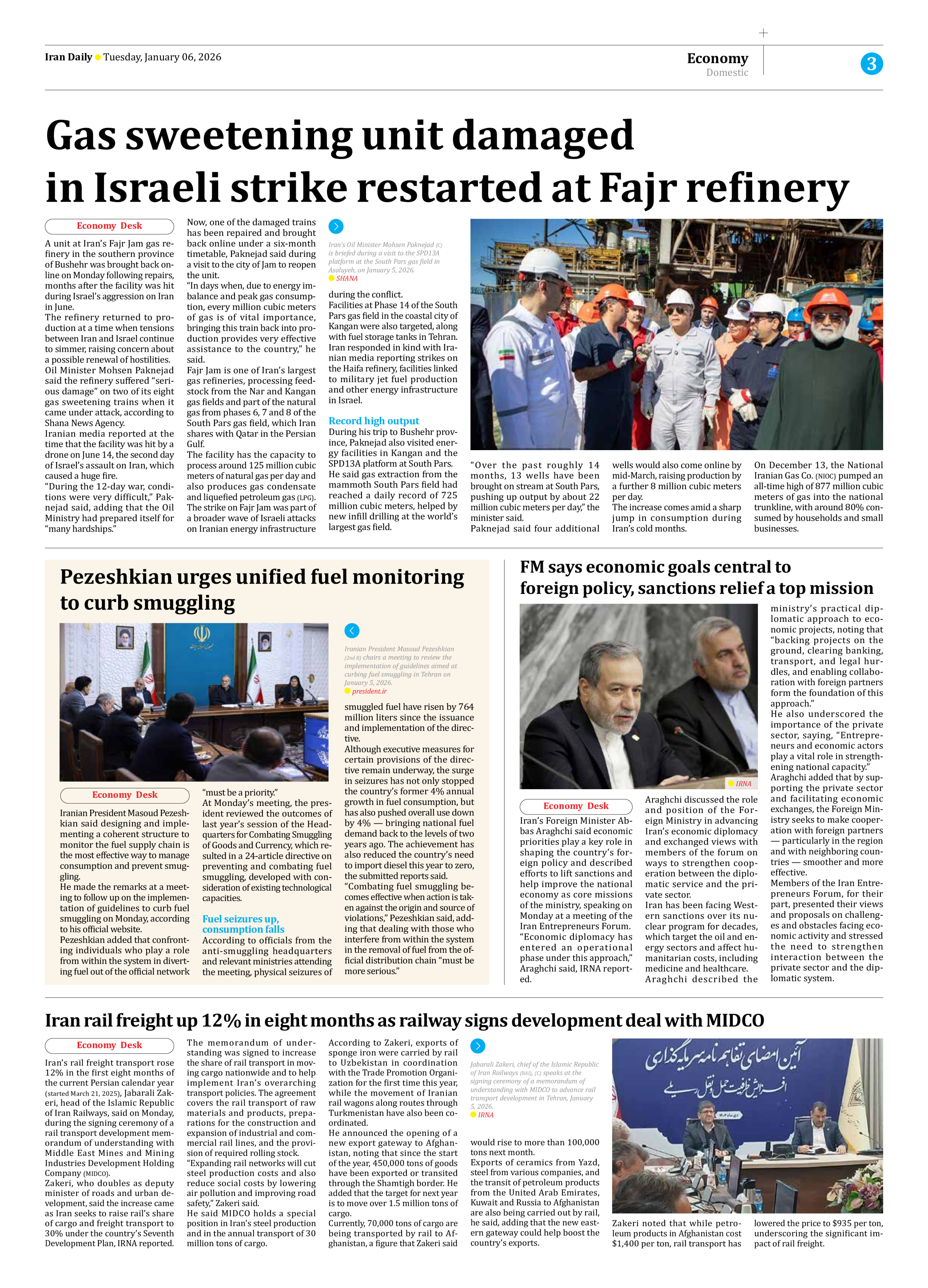
During his trip to Bushehr province, Paknejad also visited energy facilities in Kangan and the SPD13A platform at South Pars.
He said gas extraction from the mammoth South Pars field had reached a daily record of 725 million cubic meters, helped by new infill drilling at the world’s largest gas field.
“Over the past roughly 14 months, 13 wells have been brought on stream at South Pars, pushing up output by about 22 million cubic meters per day,” the minister said.
Paknejad said four additional wells would also come online by mid-March, raising production by a further 8 million cubic meters per day.
The increase comes amid a sharp jump in consumption during Iran’s cold months.
On December 13, the National Iranian Gas Co. (NIOC) pumped an all-time high of 877 million cubic meters of gas into the national trunkline, with around 80% consumed by households and small businesses.