







Chalab village is center of history, agriculture, traditional arts
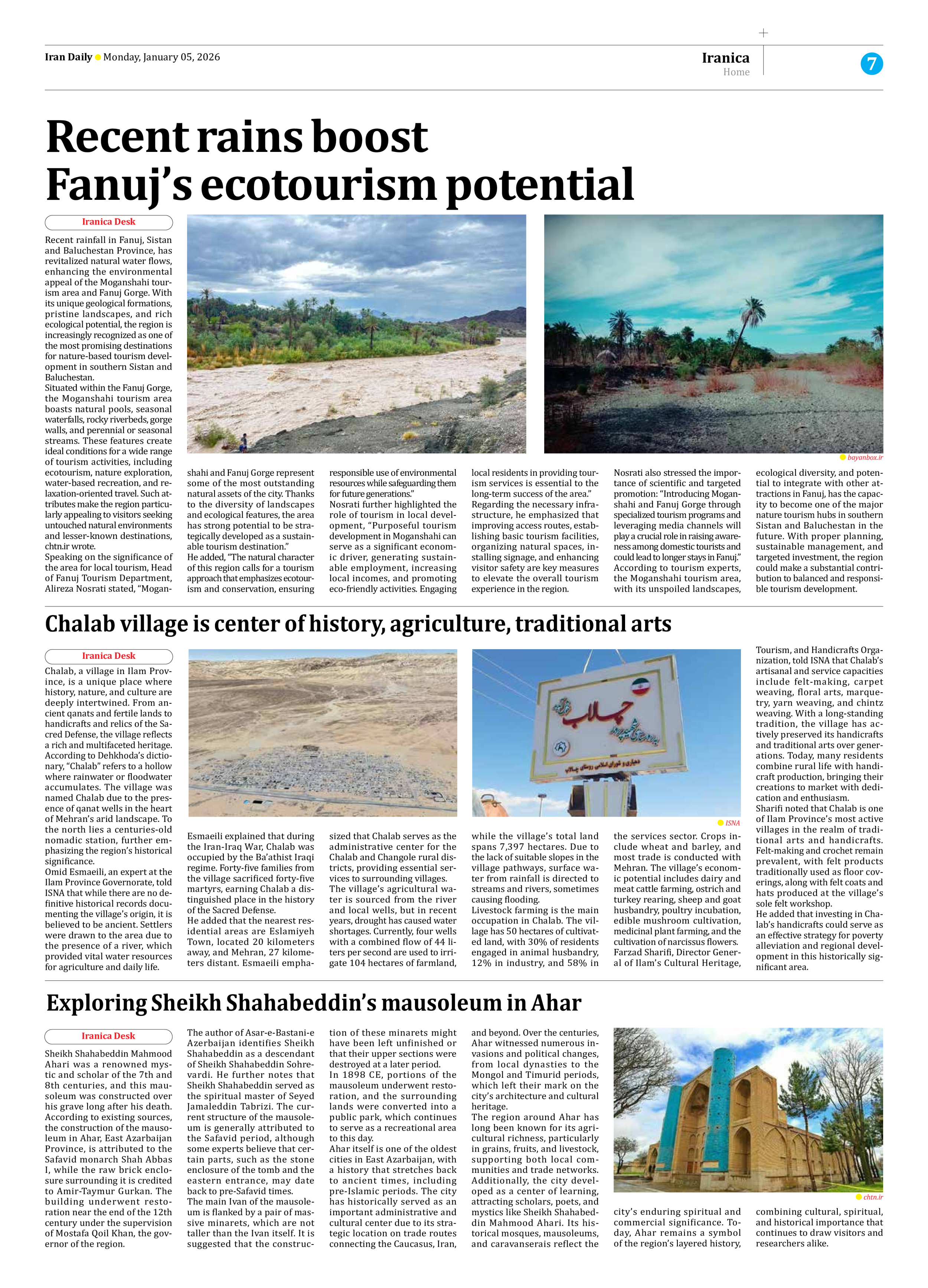
Chalab, a village in Ilam Province, is a unique place where history, nature, and culture are deeply intertwined. From ancient qanats and fertile lands to handicrafts and relics of the Sacred Defense, the village reflects a rich and multifaceted heritage.
According to Dehkhoda’s dictionary, “Chalab” refers to a hollow where rainwater or floodwater accumulates. The village was named Chalab due to the presence of qanat wells in the heart of Mehran’s arid landscape. To the north lies a centuries-old nomadic station, further emphasizing the region’s historical significance.
Omid Esmaeili, an expert at the Ilam Province Governorate, told ISNA that while there are no definitive historical records documenting the village’s origin, it is believed to be ancient. Settlers were drawn to the area due to the presence of a river, which provided vital water resources for agriculture and daily life.
Esmaeili explained that during the Iran-Iraq War, Chalab was occupied by the Ba’athist Iraqi regime. Forty-five families from the village sacrificed forty-five martyrs, earning Chalab a distinguished place in the history of the Sacred Defense.
He added that the nearest residential areas are Eslamiyeh Town, located 20 kilometers away, and Mehran, 27 kilometers distant. Esmaeili emphasized that Chalab serves as the administrative center for the Chalab and Changole rural districts, providing essential services to surrounding villages.
The village’s agricultural water is sourced from the river and local wells, but in recent years, drought has caused water shortages. Currently, four wells with a combined flow of 44 liters per second are used to irrigate 104 hectares of farmland, while the village’s total land spans 7,397 hectares. Due to the lack of suitable slopes in the village pathways, surface water from rainfall is directed to streams and rivers, sometimes causing flooding.
Livestock farming is the main occupation in Chalab. The village has 50 hectares of cultivated land, with 30% of residents engaged in animal husbandry, 12% in industry, and 58% in the services sector. Crops include wheat and barley, and most trade is conducted with Mehran. The village’s economic potential includes dairy and meat cattle farming, ostrich and turkey rearing, sheep and goat husbandry, poultry incubation, edible mushroom cultivation, medicinal plant farming, and the cultivation of narcissus flowers.
Farzad Sharifi, Director General of Ilam’s Cultural Heritage, Tourism, and Handicrafts Organization, told ISNA that Chalab’s artisanal and service capacities include felt-making, carpet weaving, floral arts, marquetry, yarn weaving, and chintz weaving. With a long-standing tradition, the village has actively preserved its handicrafts and traditional arts over generations. Today, many residents combine rural life with handicraft production, bringing their creations to market with dedication and enthusiasm.
Sharifi noted that Chalab is one of Ilam Province’s most active villages in the realm of traditional arts and handicrafts. Felt-making and crochet remain prevalent, with felt products traditionally used as floor coverings, along with felt coats and hats produced at the village’s sole felt workshop.
He added that investing in Chalab’s handicrafts could serve as an effective strategy for poverty alleviation and regional development in this historically significant area.