







On the eve of Christian New Year
Minister frames Armenians as ‘part of Iran’
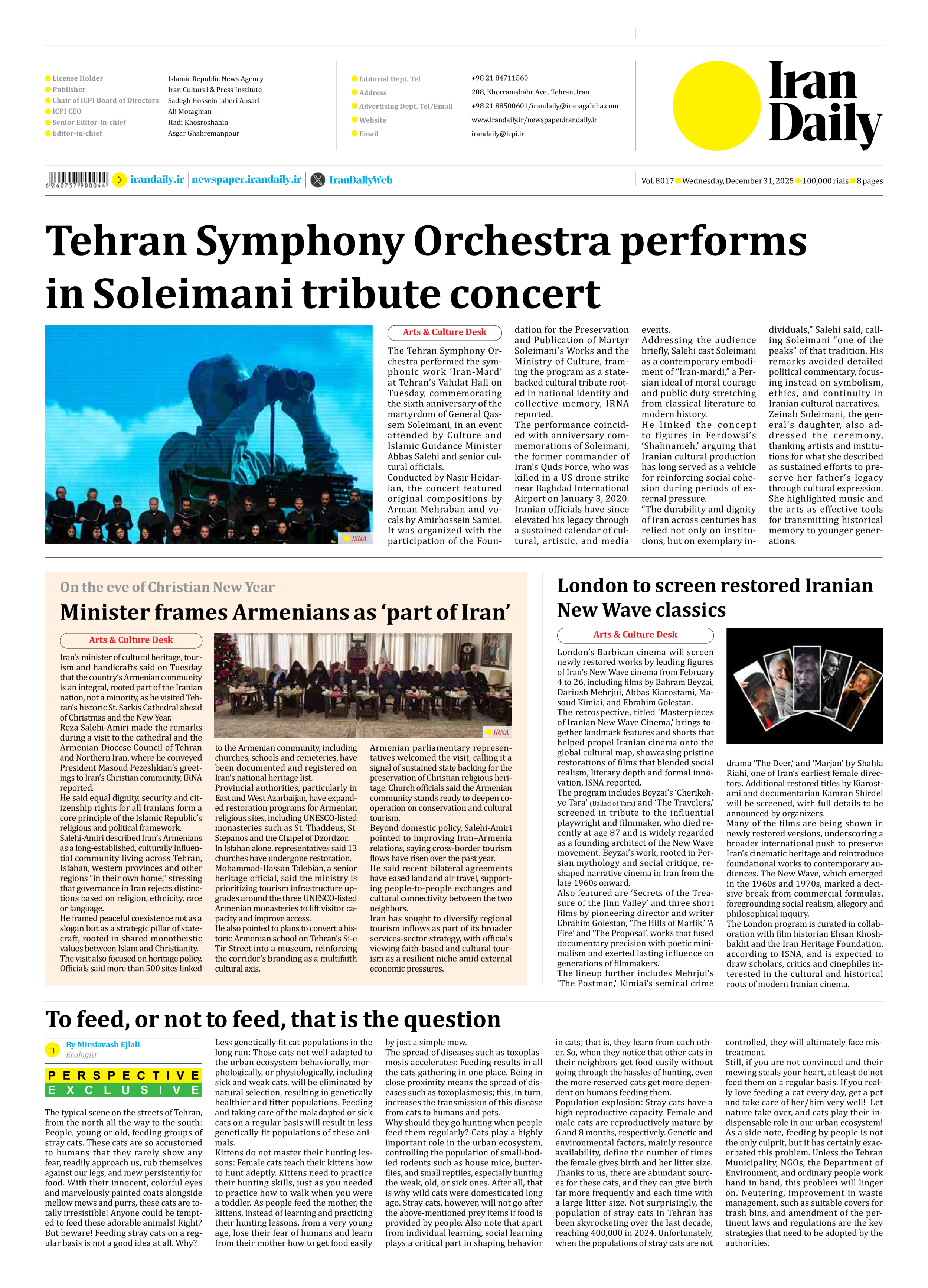
Iran’s minister of cultural heritage, tourism and handicrafts said on Tuesday that the country’s Armenian community is an integral, rooted part of the Iranian nation, not a minority, as he visited Tehran’s historic St. Sarkis Cathedral ahead of Christmas and the New Year.
Reza Salehi-Amiri made the remarks during a visit to the cathedral and the Armenian Diocese Council of Tehran and Northern Iran, where he conveyed President Masoud Pezeshkian’s greetings to Iran’s Christian community, IRNA reported.
He said equal dignity, security and citizenship rights for all Iranians form a core principle of the Islamic Republic’s religious and political framework.
Salehi-Amiri described Iran’s Armenians as a long-established, culturally influential community living across Tehran, Isfahan, western provinces and other regions “in their own home,” stressing that governance in Iran rejects distinctions based on religion, ethnicity, race or language.
He framed peaceful coexistence not as a slogan but as a strategic pillar of statecraft, rooted in shared monotheistic values between Islam and Christianity.
The visit also focused on heritage policy. Officials said more than 500 sites linked to the Armenian community, including churches, schools and cemeteries, have been documented and registered on Iran’s national heritage list.
Provincial authorities, particularly in East and West Azarbaijan, have expanded restoration programs for Armenian religious sites, including UNESCO-listed monasteries such as St. Thaddeus, St. Stepanos and the Chapel of Dzordzor.
In Isfahan alone, representatives said 13 churches have undergone restoration.
Mohammad-Hassan Talebian, a senior heritage official, said the ministry is prioritizing tourism infrastructure upgrades around the three UNESCO-listed Armenian monasteries to lift visitor capacity and improve access.
He also pointed to plans to convert a historic Armenian school on Tehran’s Si-e Tir Street into a museum, reinforcing the corridor’s branding as a multifaith cultural axis.
Armenian parliamentary representatives welcomed the visit, calling it a signal of sustained state backing for the preservation of Christian religious heritage. Church officials said the Armenian community stands ready to deepen cooperation on conservation and cultural tourism.
Beyond domestic policy, Salehi-Amiri pointed to improving Iran–Armenia relations, saying cross-border tourism flows have risen over the past year.
He said recent bilateral agreements have eased land and air travel, supporting people-to-people exchanges and cultural connectivity between the two neighbors.
Iran has sought to diversify regional tourism inflows as part of its broader services-sector strategy, with officials viewing faith-based and cultural tourism as a resilient niche amid external economic pressures.