







President defends ‘deficit-free’ budget in Parliament, vows inflation curb
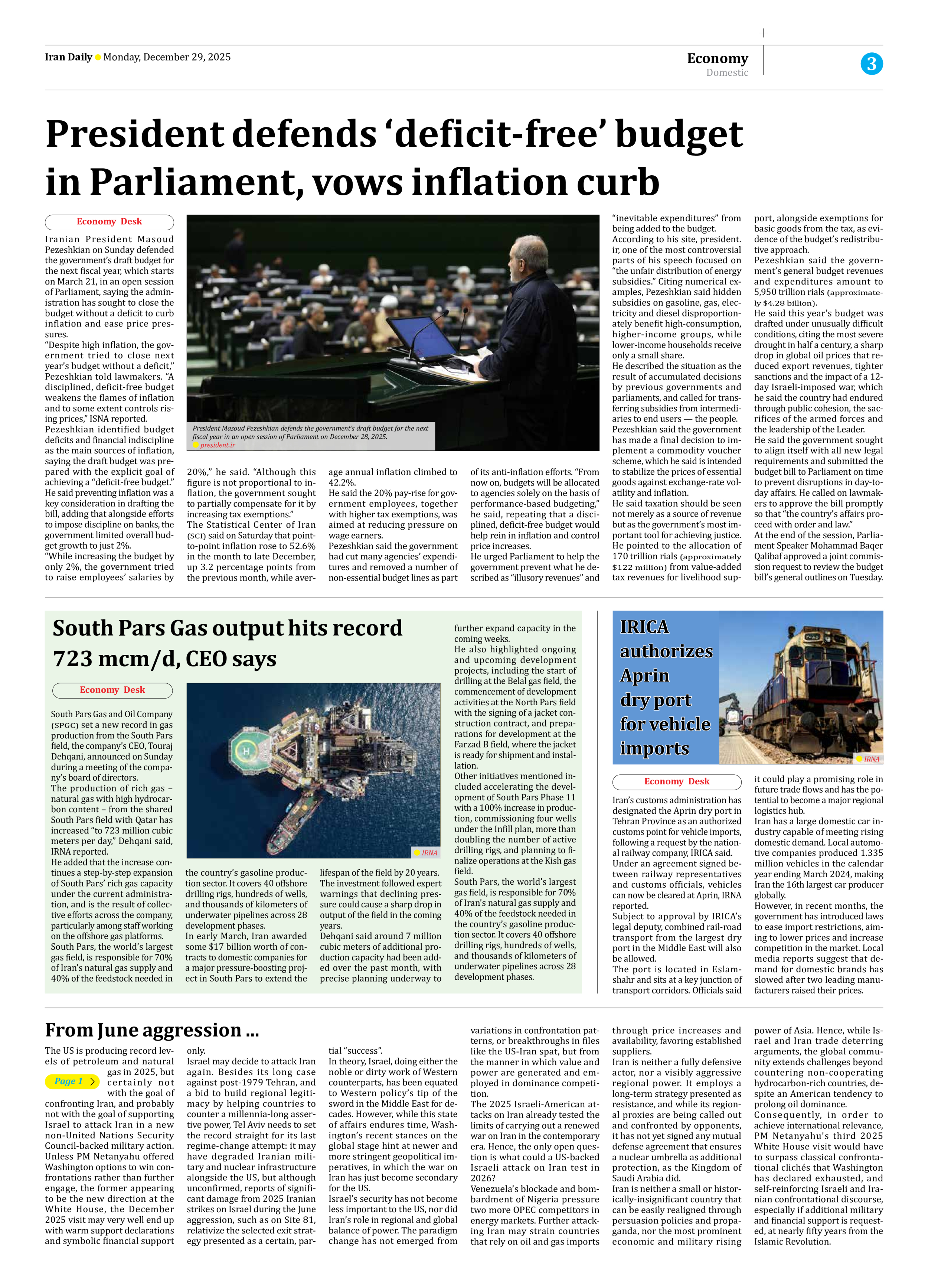
Iranian President Masoud Pezeshkian on Sunday defended the government’s draft budget for the next fiscal year, which starts on March 21, in an open session of Parliament, saying the administration has sought to close the budget without a deficit to curb inflation and ease price pressures.
“Despite high inflation, the government tried to close next year’s budget without a deficit,” Pezeshkian told lawmakers. “A disciplined, deficit-free budget weakens the flames of inflation and to some extent controls rising prices,” ISNA reported.
Pezeshkian identified budget deficits and financial indiscipline as the main sources of inflation, saying the draft budget was prepared with the explicit goal of achieving a “deficit-free budget.” He said preventing inflation was a key consideration in drafting the bill, adding that alongside efforts to impose discipline on banks, the government limited overall budget growth to just 2%.
“While increasing the budget by only 2%, the government tried to raise employees’ salaries by 20%,” he said. “Although this figure is not proportional to inflation, the government sought to partially compensate for it by increasing tax exemptions.”
The Statistical Center of Iran (SCI) said on Saturday that point-to-point inflation rose to 52.6% in the month to late December, up 3.2 percentage points from the previous month, while average annual inflation climbed to 42.2%.
He said the 20% pay-rise for government employees, together with higher tax exemptions, was aimed at reducing pressure on wage earners.
Pezeshkian said the government had cut many agencies’ expenditures and removed a number of non-essential budget lines as part of its anti-inflation efforts. “From now on, budgets will be allocated to agencies solely on the basis of performance-based budgeting,” he said, repeating that a disciplined, deficit-free budget would help rein in inflation and control price increases.
He urged Parliament to help the government prevent what he described as “illusory revenues” and “inevitable expenditures” from being added to the budget.
According to his site, president.ir, one of the most controversial parts of his speech focused on “the unfair distribution of energy subsidies.” Citing numerical examples, Pezeshkian said hidden subsidies on gasoline, gas, electricity and diesel disproportionately benefit high-consumption, higher-income groups, while lower-income households receive only a small share.
He described the situation as the result of accumulated decisions by previous governments and parliaments, and called for transferring subsidies from intermediaries to end users — the people.
Pezeshkian said the government has made a final decision to implement a commodity voucher scheme, which he said is intended to stabilize the prices of essential goods against exchange-rate volatility and inflation.
He said taxation should be seen not merely as a source of revenue but as the government’s most important tool for achieving justice. He pointed to the allocation of 170 trillion rials (approximately $122 million) from value-added tax revenues for livelihood support, alongside exemptions for basic goods from the tax, as evidence of the budget’s redistributive approach.
Pezeshkian said the government’s general budget revenues and expenditures amount to 5,950 trillion rials (approximately $4.28 billion).
He said this year’s budget was drafted under unusually difficult conditions, citing the most severe drought in half a century, a sharp drop in global oil prices that reduced export revenues, tighter sanctions and the impact of a 12-day Israeli-imposed war, which he said the country had endured through public cohesion, the sacrifices of the armed forces and the leadership of the Leader.
He said the government sought to align itself with all new legal requirements and submitted the budget bill to Parliament on time to prevent disruptions in day-to-day affairs. He called on lawmakers to approve the bill promptly so that “the country’s affairs proceed with order and law.”
At the end of the session, Parliament Speaker Mohammad Baqer Qalibaf approved a joint commission request to review the budget bill’s general outlines on Tuesday.