







SATBA expands clean energy push as investment incentives grow
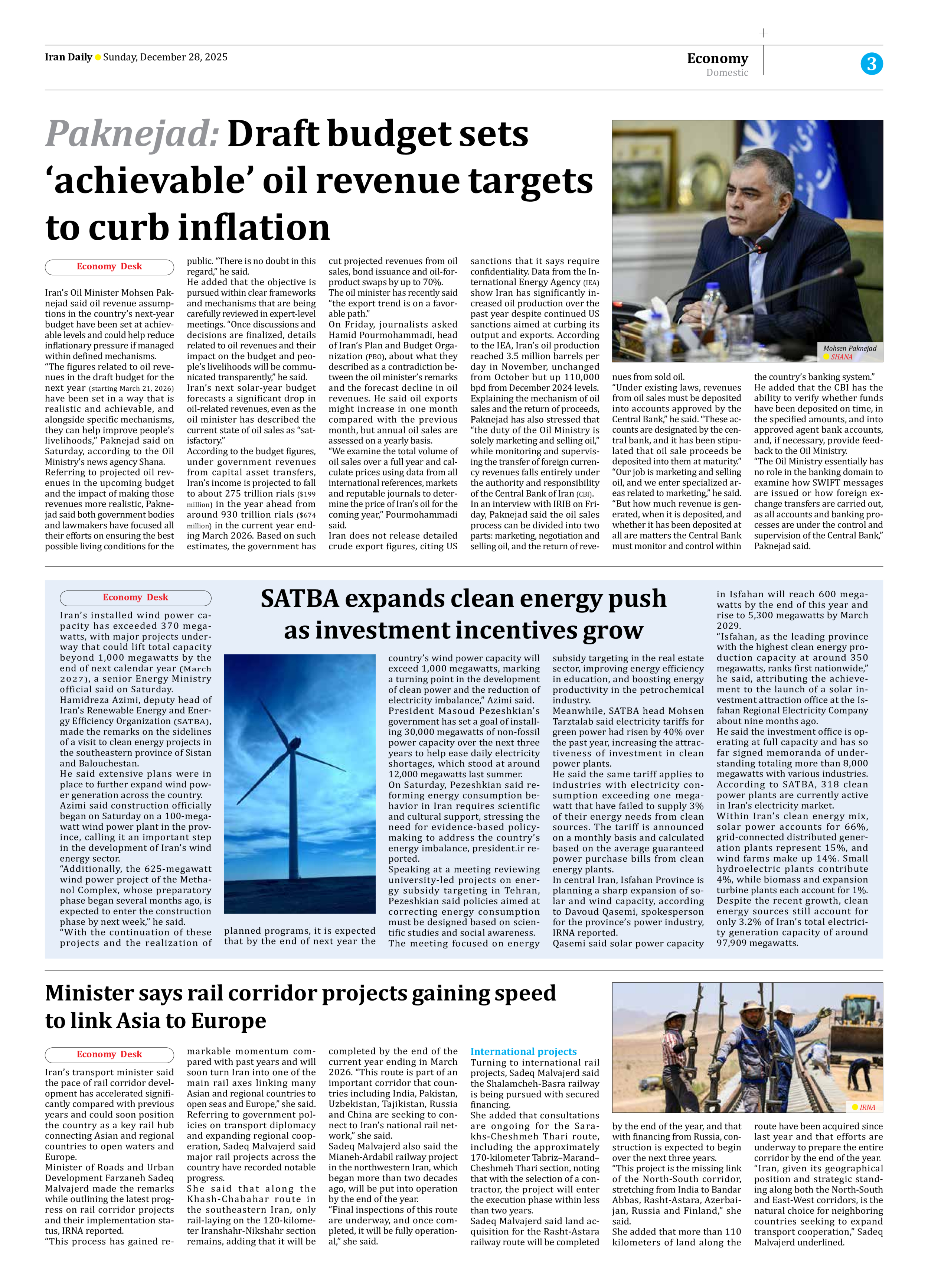
Iran’s installed wind power capacity has exceeded 370 megawatts, with major projects underway that could lift total capacity beyond 1,000 megawatts by the end of next calendar year (March 2027), a senior Energy Ministry official said on Saturday.
Hamidreza Azimi, deputy head of Iran’s Renewable Energy and Energy Efficiency Organization (SATBA), made the remarks on the sidelines of a visit to clean energy projects in the southeastern province of Sistan and Balouchestan.
He said extensive plans were in place to further expand wind power generation across the country.
Azimi said construction officially began on Saturday on a 100-megawatt wind power plant in the province, calling it an important step in the development of Iran’s wind energy sector.
“Additionally, the 625-megawatt wind power project of the Methanol Complex, whose preparatory phase began several months ago, is expected to enter the construction phase by next week,” he said.
“With the continuation of these projects and the realization of planned programs, it is expected that by the end of next year the country’s wind power capacity will exceed 1,000 megawatts, marking a turning point in the development of clean power and the reduction of electricity imbalance,” Azimi said.
President Masoud Pezeshkian’s government has set a goal of installing 30,000 megawatts of non-fossil power capacity over the next three years to help ease daily electricity shortages, which stood at around 12,000 megawatts last summer.
On Saturday, Pezeshkian said reforming energy consumption behavior in Iran requires scientific and cultural support, stressing the need for evidence-based policymaking to address the country’s energy imbalance, president.ir reported.
Speaking at a meeting reviewing university-led projects on energy subsidy targeting in Tehran, Pezeshkian said policies aimed at correcting energy consumption must be designed based on scientific studies and social awareness.
The meeting focused on energy subsidy targeting in the real estate sector, improving energy efficiency in education, and boosting energy productivity in the petrochemical industry.
Meanwhile, SATBA head Mohsen Tarztalab said electricity tariffs for green power had risen by 40% over the past year, increasing the attractiveness of investment in clean power plants.
He said the same tariff applies to industries with electricity consumption exceeding one megawatt that have failed to supply 3% of their energy needs from clean sources. The tariff is announced on a monthly basis and calculated based on the average guaranteed power purchase bills from clean energy plants.
In central Iran, Isfahan Province is planning a sharp expansion of solar and wind capacity, according to Davoud Qasemi, spokesperson for the province’s power industry, IRNA reported.
Qasemi said solar power capacity in Isfahan will reach 600 megawatts by the end of this year and rise to 5,300 megawatts by March 2029.
“Isfahan, as the leading province with the highest clean energy production capacity at around 350 megawatts, ranks first nationwide,” he said, attributing the achievement to the launch of a solar investment attraction office at the Isfahan Regional Electricity Company about nine months ago.
He said the investment office is operating at full capacity and has so far signed memoranda of understanding totaling more than 8,000 megawatts with various industries.
According to SATBA, 318 clean power plants are currently active in Iran’s electricity market.
Within Iran’s clean energy mix, solar power accounts for 66%, grid-connected distributed generation plants represent 15%, and wind farms make up 14%. Small hydroelectric plants contribute 4%, while biomass and expansion turbine plants each account for 1%.
Despite the recent growth, clean energy sources still account for only 3.2% of Iran’s total electricity generation capacity of around 97,909 megawatts.