







Paknejad: Draft budget sets ‘achievable’ oil revenue targets to curb inflation
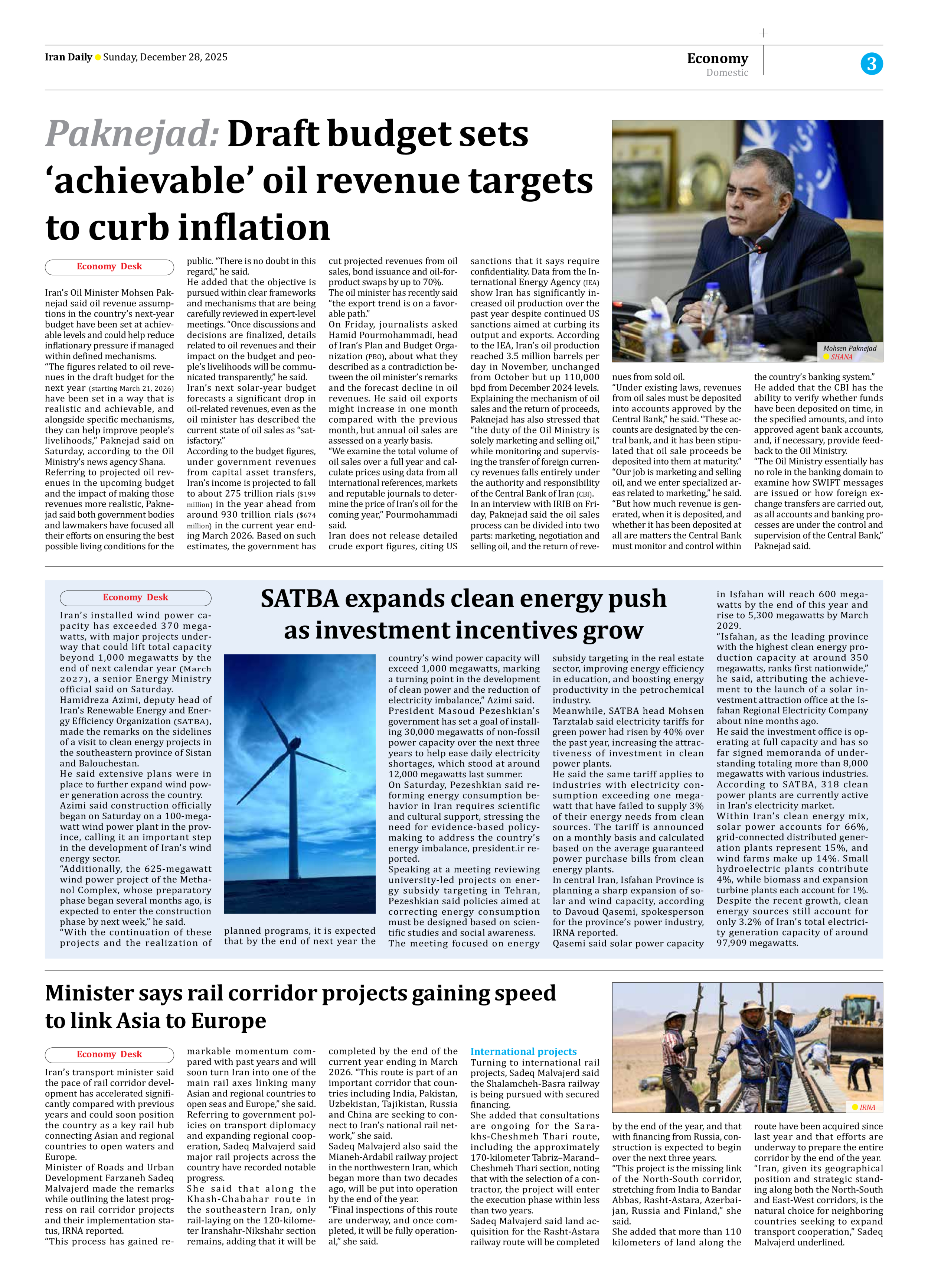
Iran’s Oil Minister Mohsen Paknejad said oil revenue assumptions in the country’s next-year budget have been set at achievable levels and could help reduce inflationary pressure if managed within defined mechanisms.
“The figures related to oil revenues in the draft budget for the next year (starting March 21, 2026) have been set in a way that is realistic and achievable, and alongside specific mechanisms, they can help improve people’s livelihoods,” Paknejad said on Saturday, according to the Oil Ministry’s news agency Shana.
Referring to projected oil revenues in the upcoming budget and the impact of making those revenues more realistic, Paknejad said both government bodies and lawmakers have focused all their efforts on ensuring the best possible living conditions for the public. “There is no doubt in this regard,” he said.
He added that the objective is pursued within clear frameworks and mechanisms that are being carefully reviewed in expert-level meetings. “Once discussions and decisions are finalized, details related to oil revenues and their impact on the budget and people’s livelihoods will be communicated transparently,” he said.
Iran’s next solar-year budget forecasts a significant drop in oil-related revenues, even as the oil minister has described the current state of oil sales as “satisfactory.”
According to the budget figures, under government revenues from capital asset transfers, Iran’s income is projected to fall to about 275 trillion rials ($199 million) in the year ahead from around 930 trillion rials ($674 million) in the current year ending March 2026. Based on such estimates, the government has cut projected revenues from oil sales, bond issuance and oil-for-product swaps by up to 70%.
The oil minister has recently said “the export trend is on a favorable path.”
On Friday, journalists asked Hamid Pourmohammadi, head of Iran’s Plan and Budget Organization (PBO), about what they described as a contradiction between the oil minister’s remarks and the forecast decline in oil revenues. He said oil exports might increase in one month compared with the previous month, but annual oil sales are assessed on a yearly basis.
“We examine the total volume of oil sales over a full year and calculate prices using data from all international references, markets and reputable journals to determine the price of Iran’s oil for the coming year,” Pourmohammadi said.
Iran does not release detailed crude export figures, citing US sanctions that it says require confidentiality. Data from the International Energy Agency (IEA) show Iran has significantly increased oil production over the past year despite continued US sanctions aimed at curbing its output and exports. According to the IEA, Iran’s oil production reached 3.5 million barrels per day in November, unchanged from October but up 110,000 bpd from December 2024 levels.
Explaining the mechanism of oil sales and the return of proceeds, Paknejad has also stressed that “the duty of the Oil Ministry is solely marketing and selling oil,” while monitoring and supervising the transfer of foreign currency revenues falls entirely under the authority and responsibility of the Central Bank of Iran (CBI).
In an interview with IRIB on Friday, Paknejad said the oil sales process can be divided into two parts: marketing, negotiation and selling oil, and the return of revenues from sold oil.
“Under existing laws, revenues from oil sales must be deposited into accounts approved by the Central Bank,” he said. “These accounts are designated by the central bank, and it has been stipulated that oil sale proceeds be deposited into them at maturity.”
“Our job is marketing and selling oil, and we enter specialized areas related to marketing,” he said. “But how much revenue is generated, when it is deposited, and whether it has been deposited at all are matters the Central Bank must monitor and control within the country’s banking system.”
He added that the CBI has the ability to verify whether funds have been deposited on time, in the specified amounts, and into approved agent bank accounts, and, if necessary, provide feedback to the Oil Ministry.
“The Oil Ministry essentially has no role in the banking domain to examine how SWIFT messages are issued or how foreign exchange transfers are carried out, as all accounts and banking processes are under the control and supervision of the Central Bank,” Paknejad said.