







Gilan’s Gisum village advances toward global tourism recognition
Gisum village, located in Talesh, Gilan Province, has been selected as one of 14 villages nationwide nominated for global registration, due to its unique natural and cultural capacities and the active participation of local residents in environmental protection. The village’s narrative is deeply rooted in the sustainable coexistence of humans and nature in the heart of the Hyrcanian forests.
Seyyed Mostafa Fatemi stated that the central story and narrative of the village must focus on environmental conservation. Emphasizing the role of public participation in protecting the surrounding environment, he said that educational workshops should be organized for local communities in cooperation with the Department of Environment, ISNA wrote.
He stressed that a key priority is the development of a village management plan based on environmental standards. Fatemi added that global registration should serve as a catalyst for preserving the village’s environment, noting that forest tourism has become a prominent global trend in which tourist presence not only avoids environmental degradation but can also contribute positively to the expansion of green spaces, carbon reduction, and the decrease of pollution.
Emphasizing the need to pilot this model in Gisum, he stated that the implementation of a “zero-waste” plan should also be considered, alongside efforts to increase public participation in such initiatives. Fatemi further underlined the crucial role of natural resources agencies, environmental authorities, and other stakeholders, calling for their active involvement in provincial and county committees to provide consultation on viable village-based initiatives.
Referring to the strong performance of the provincial tourism committee chaired by the Governor of Gilan Province, he said environmental institutions and non-governmental organizations must adopt an education-oriented approach to properly convey the village’s story — one centered on environmental conservation and ecological restoration.
He added that the continued planting of native trees by environmental and natural resources authorities, the establishment of a handicrafts market, support for villagers’ creative handicraft production, and the launch of a dedicated village website are among the necessary measures to be pursued.
Yousef Salmankhah, Director General of Cultural Heritage, Tourism and Handicrafts of Gilan Province, described Gisum as a pristine natural landscape nestled within the Hyrcanian forests. He said the village’s scenery captivates every observer, referring to its natural features as a divinely bestowed spectacle capable of hosting festivals such as coastal and foothill autumn foliage events.
Noting that Gisum is a four-season village, Salmankhah highlighted its majestic autumns, beautiful winters, and pleasant springs, adding that sand sculpture festivals could also be organized in line with the region’s climate. He stated that the village has a history of around 500 years and has long been one of the main settlements of the Talesh people, with a population structure that has seen no significant in-migration to date.
He described Gisum as a living heritage of human–nature interaction within the Hyrcanian forests, emphasizing that its residents have historically served as guardians of the natural environment. He added that the village’s narrative reflects attachment, solidarity, convergence, and alignment between local people and authorities, showcasing a distinctive model of local governance.
According to him, the criteria outlined by the World Tourism Organization are present in Gisum, qualifying the village for inclusion on the organization’s list of tourism villages.
Regarding tourism infrastructure, Salmankhah said Gisum includes three well-known forest sites hosting tourism complexes, 20 guesthouses, and two eco-lodges. He also pointed to the village’s distinctive architecture and layout, its historical values, settlement heritage, deep-rooted human–nature connections, historic routes and forest roads, as well as local culture and rituals, as key advantages.
He added that seasonal handicrafts and souvenir markets are among Gisum’s prominent cultural tourism assets. Supporting the local economy, he said, can further promote rural tourism, marine tourism, ecotourism, and handicrafts, including traditional crafts such as kilim weaving, woodcraft, and basket weaving. He also noted that traditional Taleshi clothing is another element that uniquely connects color, nature, and people in Gisum.
Reza Jamshidi, Governor of Talesh, noted Gisum village possesses exceptional cultural, economic, and tourism capacities. Covering more than 80 hectares, the village is located adjacent to the sea and alongside the young, lush Hyrcanian forests.
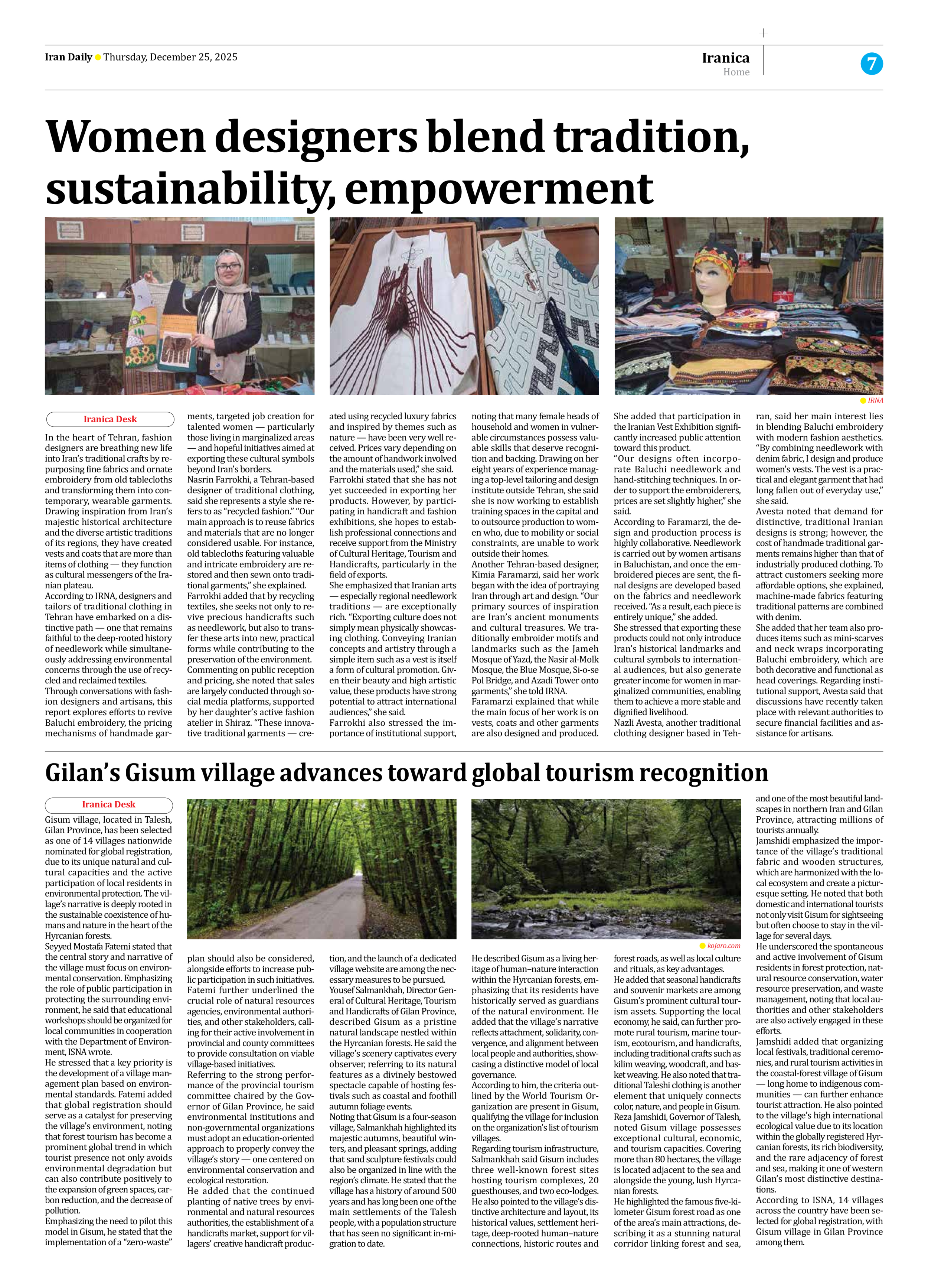
He highlighted the famous five-kilometer Gisum forest road as one of the area’s main attractions, describing it as a stunning natural corridor linking forest and sea, and one of the most beautiful landscapes in northern Iran and Gilan Province, attracting millions of tourists annually.
Jamshidi emphasized the importance of the village’s traditional fabric and wooden structures, which are harmonized with the local ecosystem and create a picturesque setting. He noted that both domestic and international tourists not only visit Gisum for sightseeing but often choose to stay in the village for several days.
He underscored the spontaneous and active involvement of Gisum residents in forest protection, natural resource conservation, water resource preservation, and waste management, noting that local authorities and other stakeholders are also actively engaged in these efforts.
Jamshidi added that organizing local festivals, traditional ceremonies, and rural tourism activities in the coastal-forest village of Gisum — long home to indigenous communities — can further enhance tourist attraction. He also pointed to the village’s high international ecological value due to its location within the globally registered Hyrcanian forests, its rich biodiversity, and the rare adjacency of forest and sea, making it one of western Gilan’s most distinctive destinations.
According to ISNA, 14 villages across the country have been selected for global registration, with Gisum village in Gilan Province among them.