







Women designers blend tradition, sustainability, empowerment
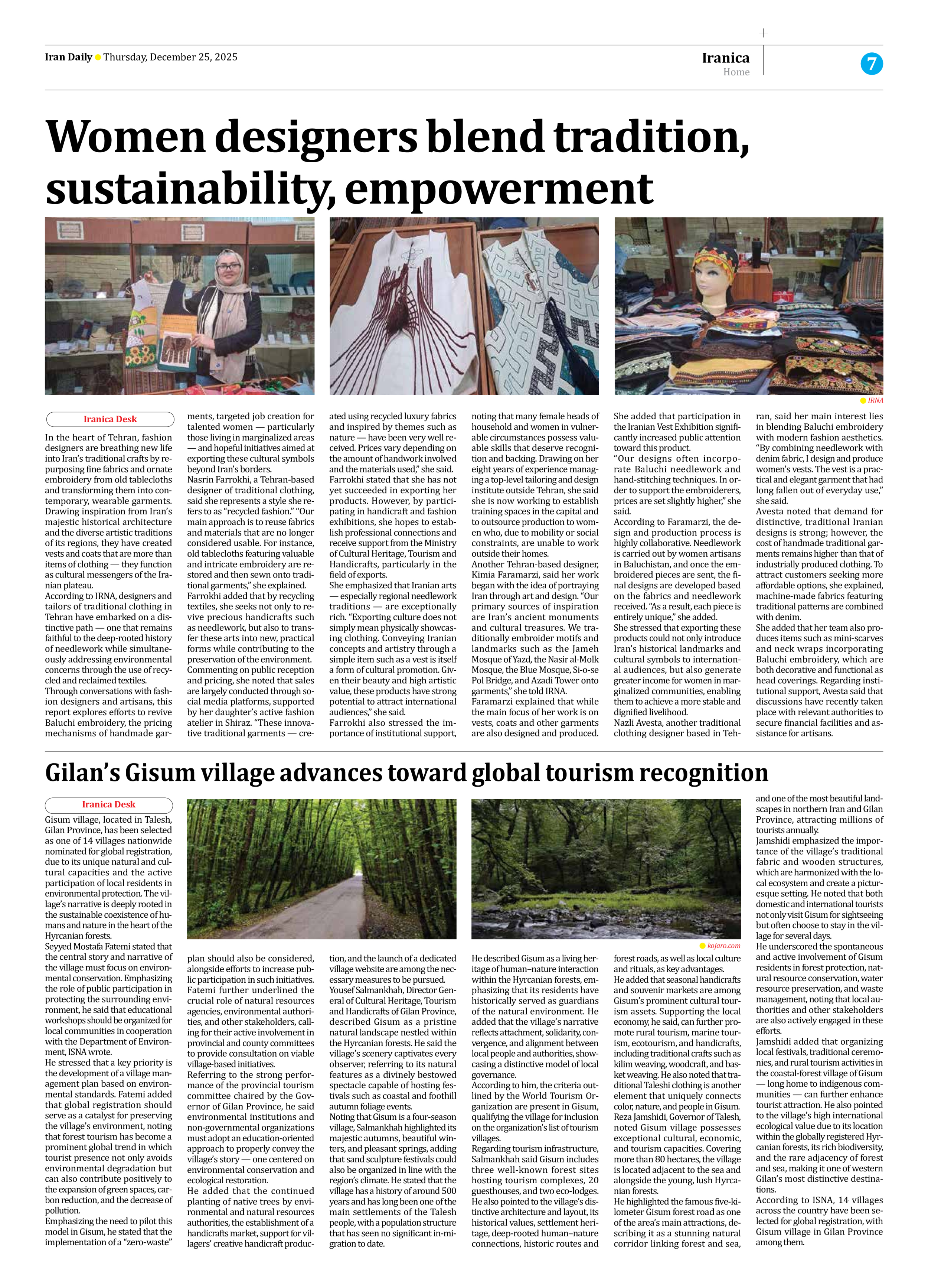
In the heart of Tehran, fashion designers are breathing new life into Iran’s traditional crafts by repurposing fine fabrics and ornate embroidery from old tablecloths and transforming them into contemporary, wearable garments. Drawing inspiration from Iran’s majestic historical architecture and the diverse artistic traditions of its regions, they have created vests and coats that are more than items of clothing — they function as cultural messengers of the Iranian plateau.
According to IRNA, designers and tailors of traditional clothing in Tehran have embarked on a distinctive path — one that remains faithful to the deep-rooted history of needlework while simultaneously addressing environmental concerns through the use of recycled and reclaimed textiles.
Through conversations with fashion designers and artisans, this report explores efforts to revive Baluchi embroidery, the pricing mechanisms of handmade garments, targeted job creation for talented women — particularly those living in marginalized areas — and hopeful initiatives aimed at exporting these cultural symbols beyond Iran’s borders.
Nasrin Farrokhi, a Tehran-based designer of traditional clothing, said she represents a style she refers to as “recycled fashion.” “Our main approach is to reuse fabrics and materials that are no longer considered usable. For instance, old tablecloths featuring valuable and intricate embroidery are restored and then sewn onto traditional garments,” she explained.
Farrokhi added that by recycling textiles, she seeks not only to revive precious handicrafts such as needlework, but also to transfer these arts into new, practical forms while contributing to the preservation of the environment.
Commenting on public reception and pricing, she noted that sales are largely conducted through social media platforms, supported by her daughter’s active fashion atelier in Shiraz. “These innovative traditional garments — created using recycled luxury fabrics and inspired by themes such as nature — have been very well received. Prices vary depending on the amount of handwork involved and the materials used,” she said.
Farrokhi stated that she has not yet succeeded in exporting her products. However, by participating in handicraft and fashion exhibitions, she hopes to establish professional connections and receive support from the Ministry of Cultural Heritage, Tourism and Handicrafts, particularly in the field of exports.
She emphasized that Iranian arts — especially regional needlework traditions — are exceptionally rich. “Exporting culture does not simply mean physically showcasing clothing. Conveying Iranian concepts and artistry through a simple item such as a vest is itself a form of cultural promotion. Given their beauty and high artistic value, these products have strong potential to attract international audiences,” she said.
Farrokhi also stressed the importance of institutional support, noting that many female heads of household and women in vulnerable circumstances possess valuable skills that deserve recognition and backing. Drawing on her eight years of experience managing a top-level tailoring and design institute outside Tehran, she said she is now working to establish training spaces in the capital and to outsource production to women who, due to mobility or social constraints, are unable to work outside their homes.
Another Tehran-based designer, Kimia Faramarzi, said her work began with the idea of portraying Iran through art and design. “Our primary sources of inspiration are Iran’s ancient monuments and cultural treasures. We traditionally embroider motifs and landmarks such as the Jameh Mosque of Yazd, the Nasir al-Molk Mosque, the Blue Mosque, Si-o-se Pol Bridge, and Azadi Tower onto garments,” she told IRNA.
Faramarzi explained that while the main focus of her work is on vests, coats and other garments are also designed and produced. She added that participation in the Iranian Vest Exhibition significantly increased public attention toward this product.
“Our designs often incorporate Baluchi needlework and hand-stitching techniques. In order to support the embroiderers, prices are set slightly higher,” she said.
According to Faramarzi, the design and production process is highly collaborative. Needlework is carried out by women artisans in Baluchistan, and once the embroidered pieces are sent, the final designs are developed based on the fabrics and needlework received. “As a result, each piece is entirely unique,” she added.
She stressed that exporting these products could not only introduce Iran’s historical landmarks and cultural symbols to international audiences, but also generate greater income for women in marginalized communities, enabling them to achieve a more stable and dignified livelihood.
Nazli Avesta, another traditional clothing designer based in Tehran, said her main interest lies in blending Baluchi embroidery with modern fashion aesthetics. “By combining needlework with denim fabric, I design and produce women’s vests. The vest is a practical and elegant garment that had long fallen out of everyday use,” she said.
Avesta noted that demand for distinctive, traditional Iranian designs is strong; however, the cost of handmade traditional garments remains higher than that of industrially produced clothing. To attract customers seeking more affordable options, she explained, machine-made fabrics featuring traditional patterns are combined with denim.
She added that her team also produces items such as mini-scarves and neck wraps incorporating Baluchi embroidery, which are both decorative and functional as head coverings. Regarding institutional support, Avesta said that discussions have recently taken place with relevant authorities to secure financial facilities and assistance for artisans.