





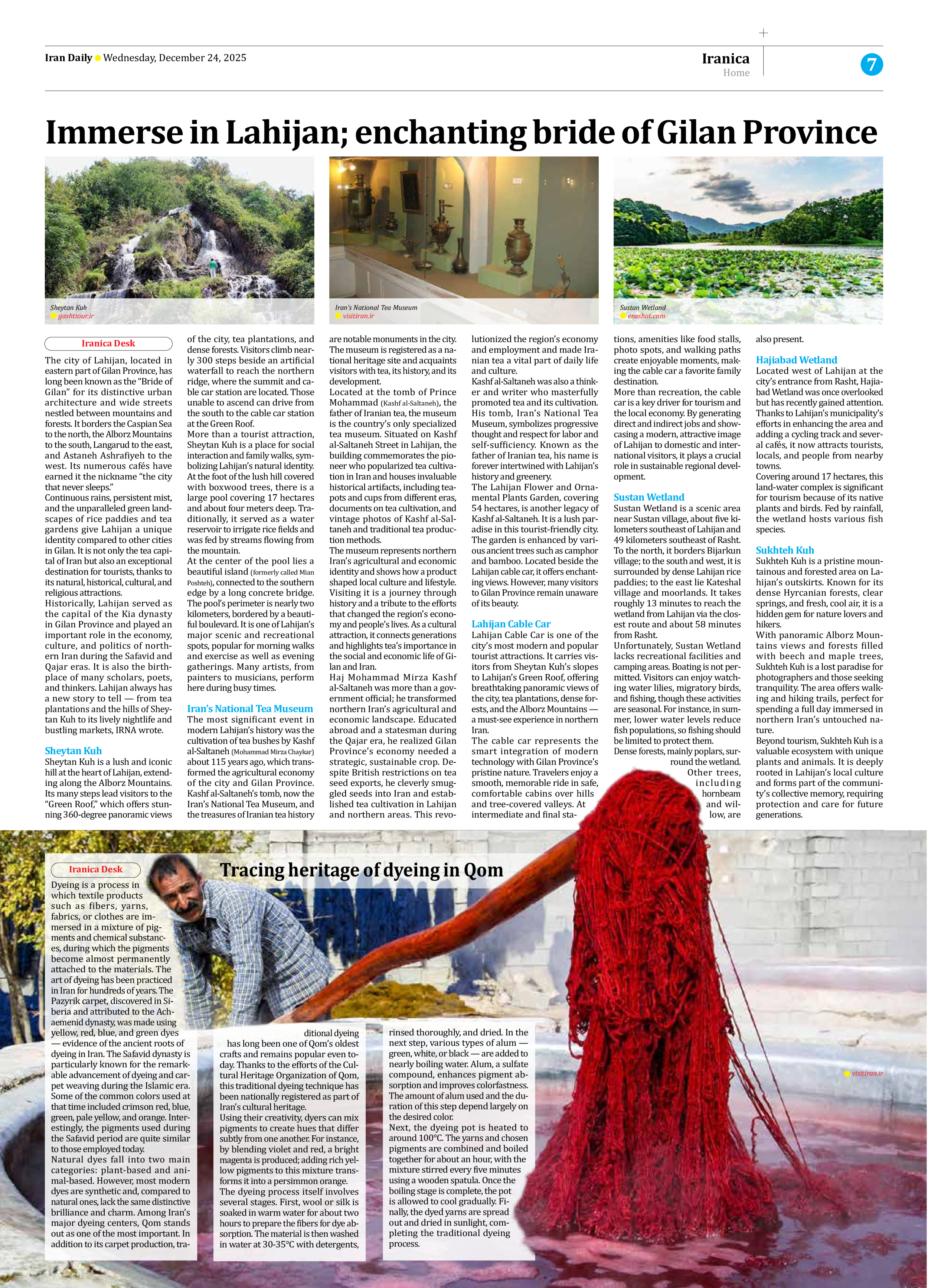


Tracing heritage of dyeing in Qom
Dyeing is a process in which textile products such as fibers, yarns, fabrics, or clothes are immersed in a mixture of pigments and chemical substances, during which the pigments become almost permanently attached to the materials. The art of dyeing has been practiced in Iran for hundreds of years. The Pazyrik carpet, discovered in Siberia and attributed to the Achaemenid dynasty, was made using yellow, red, blue, and green dyes — evidence of the ancient roots of dyeing in Iran. The Safavid dynasty is particularly known for the remarkable advancement of dyeing and carpet weaving during the Islamic era. Some of the common colors used at that time included crimson red, blue, green, pale yellow, and orange. Interestingly, the pigments used during the Safavid period are quite similar to those employed today.
Natural dyes fall into two main categories: plant-based and animal-based. However, most modern dyes are synthetic and, compared to natural ones, lack the same distinctive brilliance and charm. Among Iran’s major dyeing centers, Qom stands out as one of the most important. In addition to its carpet production, traditional dyeing has long been one of Qom’s oldest crafts and remains popular even today. Thanks to the efforts of the Cultural Heritage Organization of Qom, this traditional dyeing technique has been nationally registered as part of Iran’s cultural heritage.
Using their creativity, dyers can mix pigments to create hues that differ subtly from one another. For instance, by blending violet and red, a bright magenta is produced; adding rich yellow pigments to this mixture transforms it into a persimmon orange.
The dyeing process itself involves several stages. First, wool or silk is soaked in warm water for about two hours to prepare the fibers for dye absorption. The material is then washed in water at 30-35°C with detergents, rinsed thoroughly, and dried. In the next step, various types of alum —green, white, or black — are added to nearly boiling water. Alum, a sulfate compound, enhances pigment absorption and improves colorfastness. The amount of alum used and the duration of this step depend largely on the desired color.
Next, the dyeing pot is heated to around 100°C. The yarns and chosen pigments are combined and boiled together for about an hour, with the mixture stirred every five minutes using a wooden spatula. Once the boiling stage is complete, the pot is allowed to cool gradually. Finally, the dyed yarns are spread out and dried in sunlight, completing the traditional dyeing process.