







Immerse in Lahijan; enchanting bride of Gilan Province
The city of Lahijan, located in eastern part of Gilan Province, has long been known as the “Bride of Gilan” for its distinctive urban architecture and wide streets nestled between mountains and forests. It borders the Caspian Sea to the north, the Alborz Mountains to the south, Langarud to the east, and Astaneh Ashrafiyeh to the west. Its numerous cafés have earned it the nickname “the city that never sleeps.”
Continuous rains, persistent mist, and the unparalleled green landscapes of rice paddies and tea gardens give Lahijan a unique identity compared to other cities in Gilan. It is not only the tea capital of Iran but also an exceptional destination for tourists, thanks to its natural, historical, cultural, and religious attractions.
Historically, Lahijan served as the capital of the Kia dynasty in Gilan Province and played an important role in the economy, culture, and politics of northern Iran during the Safavid and Qajar eras. It is also the birthplace of many scholars, poets, and thinkers. Lahijan always has a new story to tell — from tea plantations and the hills of Sheytan Kuh to its lively nightlife and bustling markets, IRNA wrote.
Sheytan Kuh
Sheytan Kuh is a lush and iconic hill at the heart of Lahijan, extending along the Alborz Mountains. Its many steps lead visitors to the “Green Roof,” which offers stunning 360-degree panoramic views of the city, tea plantations, and dense forests. Visitors climb nearly 300 steps beside an artificial waterfall to reach the northern ridge, where the summit and cable car station are located. Those unable to ascend can drive from the south to the cable car station at the Green Roof.
More than a tourist attraction, Sheytan Kuh is a place for social interaction and family walks, symbolizing Lahijan’s natural identity.
At the foot of the lush hill covered with boxwood trees, there is a large pool covering 17 hectares and about four meters deep. Traditionally, it served as a water reservoir to irrigate rice fields and was fed by streams flowing from the mountain.
At the center of the pool lies a beautiful island (formerly called Mian Poshteh), connected to the southern edge by a long concrete bridge. The pool’s perimeter is nearly two kilometers, bordered by a beautiful boulevard. It is one of Lahijan’s major scenic and recreational spots, popular for morning walks and exercise as well as evening gatherings. Many artists, from painters to musicians, perform here during busy times.
Iran’s National Tea Museum
The most significant event in modern Lahijan’s history was the cultivation of tea bushes by Kashf al-Saltaneh (Mohammad Mirza Chaykar) about 115 years ago, which transformed the agricultural economy of the city and Gilan Province. Kashf al-Saltaneh’s tomb, now the Iran’s National Tea Museum, and the treasures of Iranian tea history are notable monuments in the city. The museum is registered as a national heritage site and acquaints visitors with tea, its history, and its development.
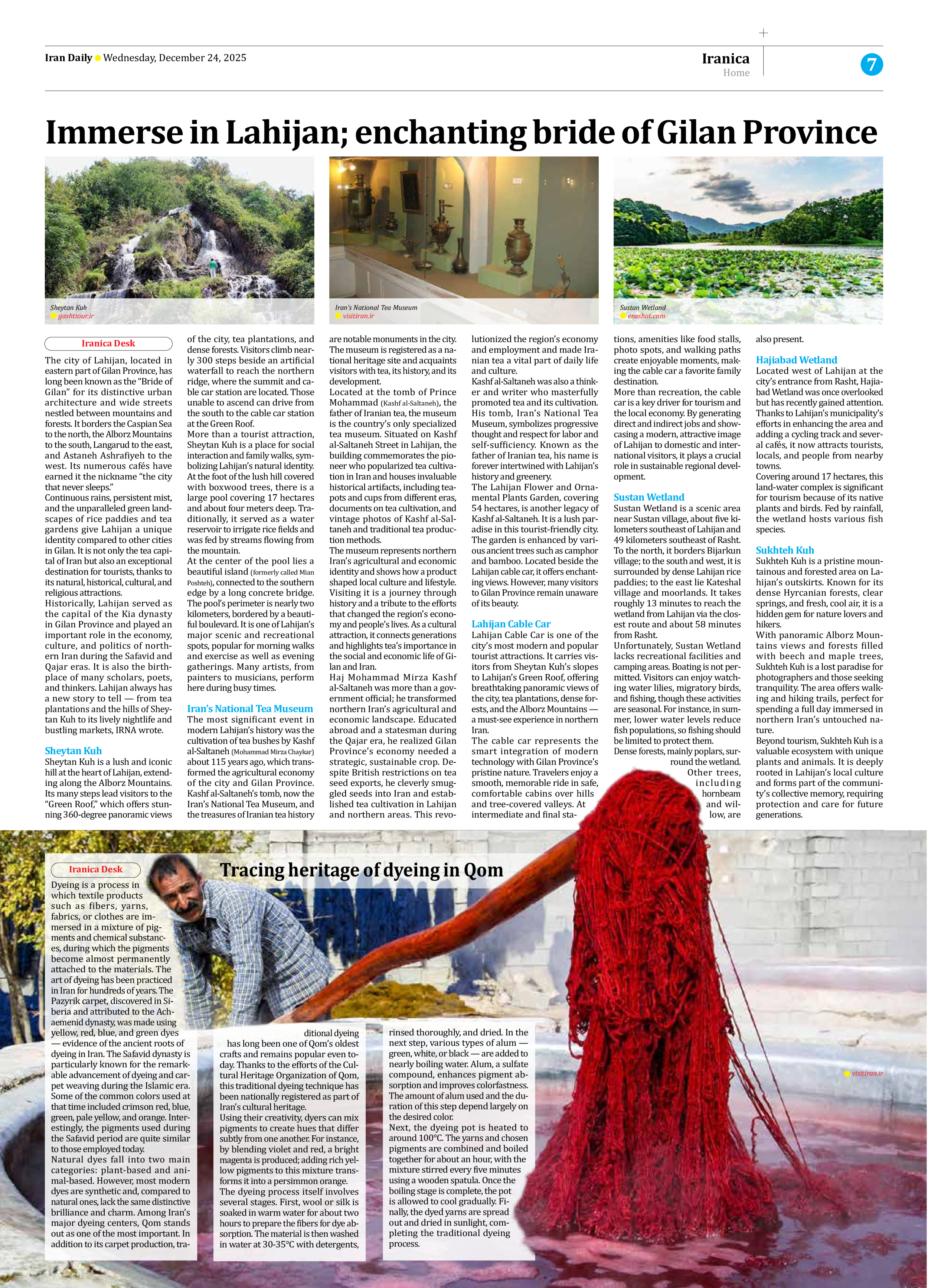
Located at the tomb of Prince Mohammad (Kashf al-Saltaneh), the father of Iranian tea, the museum is the country’s only specialized tea museum. Situated on Kashf al-Saltaneh Street in Lahijan, the building commemorates the pioneer who popularized tea cultivation in Iran and houses invaluable historical artifacts, including teapots and cups from different eras, documents on tea cultivation, and vintage photos of Kashf al-Saltaneh and traditional tea production methods.
The museum represents northern Iran’s agricultural and economic identity and shows how a product shaped local culture and lifestyle. Visiting it is a journey through history and a tribute to the efforts that changed the region’s economy and people’s lives. As a cultural attraction, it connects generations and highlights tea’s importance in the social and economic life of Gilan and Iran.
Haj Mohammad Mirza Kashf al-Saltaneh was more than a government official; he transformed northern Iran’s agricultural and economic landscape. Educated abroad and a statesman during the Qajar era, he realized Gilan Province’s economy needed a strategic, sustainable crop. Despite British restrictions on tea seed exports, he cleverly smuggled seeds into Iran and established tea cultivation in Lahijan and northern areas. This revolutionized the region’s economy and employment and made Iranian tea a vital part of daily life and culture.
Kashf al-Saltaneh was also a thinker and writer who masterfully promoted tea and its cultivation. His tomb, Iran’s National Tea Museum, symbolizes progressive thought and respect for labor and self-sufficiency. Known as the father of Iranian tea, his name is forever intertwined with Lahijan’s history and greenery.
The Lahijan Flower and Ornamental Plants Garden, covering 54 hectares, is another legacy of Kashf al-Saltaneh. It is a lush paradise in this tourist-friendly city. The garden is enhanced by various ancient trees such as camphor and bamboo. Located beside the Lahijan cable car, it offers enchanting views. However, many visitors to Gilan Province remain unaware of its beauty.
Lahijan Cable Car
Lahijan Cable Car is one of the city’s most modern and popular tourist attractions. It carries visitors from Sheytan Kuh’s slopes to Lahijan’s Green Roof, offering breathtaking panoramic views of the city, tea plantations, dense forests, and the Alborz Mountains — a must-see experience in northern Iran.
The cable car represents the smart integration of modern technology with Gilan Province’s pristine nature. Travelers enjoy a smooth, memorable ride in safe, comfortable cabins over hills and tree-covered valleys. At intermediate and final stations, amenities like food stalls, photo spots, and walking paths create enjoyable moments, making the cable car a favorite family destination.
More than recreation, the cable car is a key driver for tourism and the local economy. By generating direct and indirect jobs and showcasing a modern, attractive image of Lahijan to domestic and international visitors, it plays a crucial role in sustainable regional development.
Sustan Wetland
Sustan Wetland is a scenic area near Sustan village, about five kilometers southeast of Lahijan and 49 kilometers southeast of Rasht. To the north, it borders Bijarkun village; to the south and west, it is surrounded by dense Lahijan rice paddies; to the east lie Kateshal village and moorlands. It takes roughly 13 minutes to reach the wetland from Lahijan via the closest route and about 58 minutes from Rasht.
Unfortunately, Sustan Wetland lacks recreational facilities and camping areas. Boating is not permitted. Visitors can enjoy watching water lilies, migratory birds, and fishing, though these activities are seasonal. For instance, in summer, lower water levels reduce fish populations, so fishing should be limited to protect them.
Dense forests, mainly poplars, surround the wetland. Other trees, including hornbeam and willow, are also present.
Hajiabad Wetland
Located west of Lahijan at the city’s entrance from Rasht, Hajiabad Wetland was once overlooked but has recently gained attention. Thanks to Lahijan’s municipality’s efforts in enhancing the area and adding a cycling track and several cafés, it now attracts tourists, locals, and people from nearby towns.
Covering around 17 hectares, this land-water complex is significant for tourism because of its native plants and birds. Fed by rainfall, the wetland hosts various fish species.
Sukhteh Kuh
Sukhteh Kuh is a pristine mountainous and forested area on Lahijan’s outskirts. Known for its dense Hyrcanian forests, clear springs, and fresh, cool air, it is a hidden gem for nature lovers and hikers.
With panoramic Alborz Mountains views and forests filled with beech and maple trees, Sukhteh Kuh is a lost paradise for photographers and those seeking tranquility. The area offers walking and hiking trails, perfect for spending a full day immersed in northern Iran’s untouched nature.
Beyond tourism, Sukhteh Kuh is a valuable ecosystem with unique plants and animals. It is deeply rooted in Lahijan’s local culture and forms part of the community’s collective memory, requiring protection and care for future generations.