







Tehran’s ‘Palimento’ exhibition mapping memory through layered media
A multimedia exhibition titled ‘Palimento,’ by Iranian painter and new-media artist Behdad Najafi Asadollahi, is underway at Tehran’s Nian Gallery, showcasing more than 40 works curated by Rosa Matinfar of the Matin Art Platform.
The exhibition frames newspapers not as vehicles of breaking news but as historical media, transforming printed pages into visual archives on which new narratives are layered, Iran Daily reported.
The show opened on December 19 and runs for 10 days through December 29, excluding Saturdays.
Developed over four years, the project integrates painting, installation and participatory art to examine how meaning forms and mutates amid political messaging, temporal distance and emotional response.
‘Palimento’ draws on two related concepts. Palimpsest refers to a layered manuscript in which earlier texts persist beneath later writing. Pentimento, a term in painting, describes the resurfacing of an artist’s original decisions as pigments age. Together, the ideas advance a core premise: No image or narrative begins anew. Every gesture is built upon what already exists.
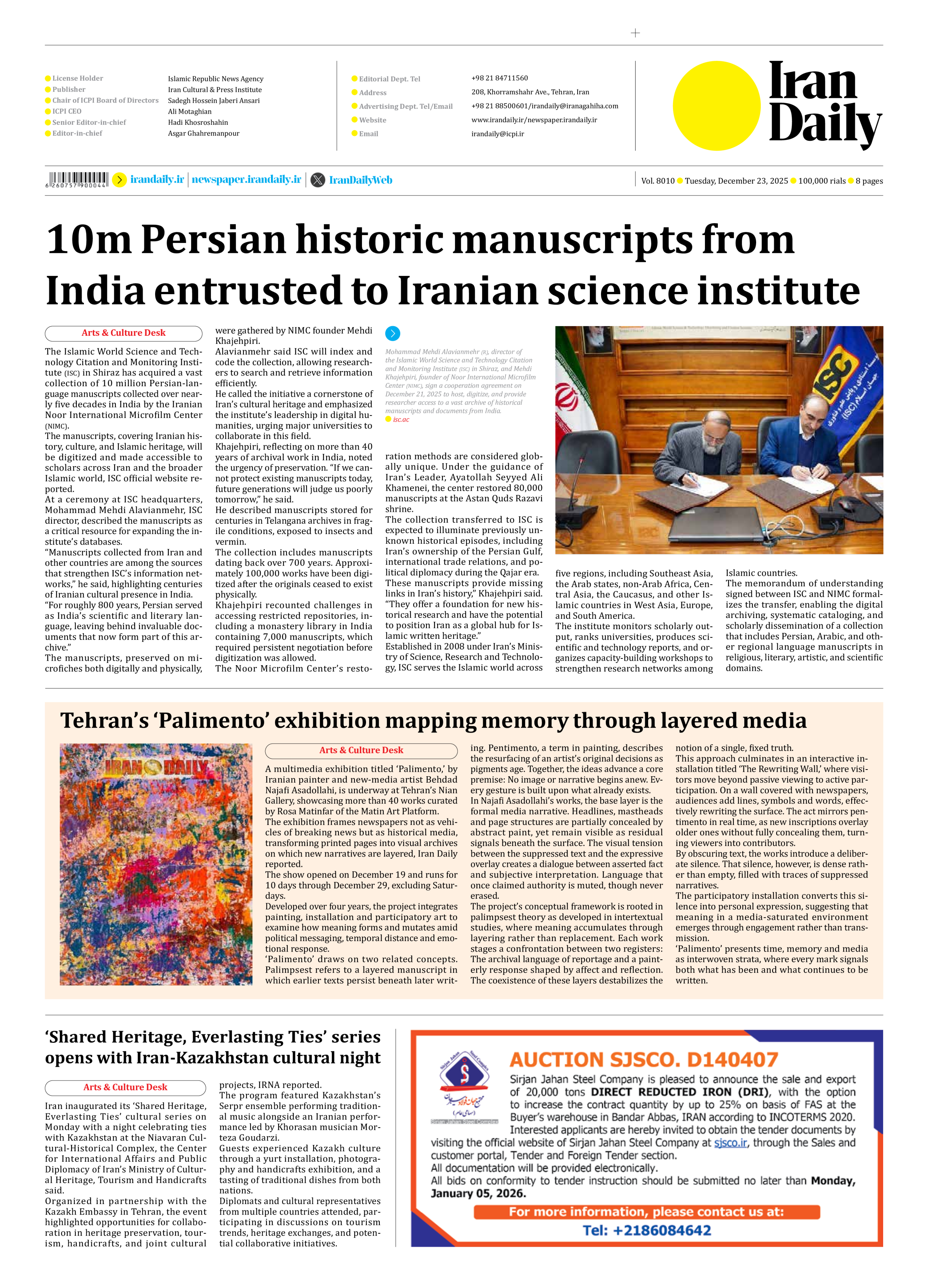
In Najafi Asadollahi’s works, the base layer is the formal media narrative. Headlines, mastheads and page structures are partially concealed by abstract paint, yet remain visible as residual signals beneath the surface. The visual tension between the suppressed text and the expressive overlay creates a dialogue between asserted fact and subjective interpretation. Language that once claimed authority is muted, though never erased.
The project’s conceptual framework is rooted in palimpsest theory as developed in intertextual studies, where meaning accumulates through layering rather than replacement. Each work stages a confrontation between two registers: The archival language of reportage and a painterly response shaped by affect and reflection. The coexistence of these layers destabilizes the notion of a single, fixed truth.
This approach culminates in an interactive installation titled ‘The Rewriting Wall,’ where visitors move beyond passive viewing to active participation. On a wall covered with newspapers, audiences add lines, symbols and words, effectively rewriting the surface. The act mirrors pentimento in real time, as new inscriptions overlay older ones without fully concealing them, turning viewers into contributors.
By obscuring text, the works introduce a deliberate silence. That silence, however, is dense rather than empty, filled with traces of suppressed narratives.
The participatory installation converts this silence into personal expression, suggesting that meaning in a media-saturated environment emerges through engagement rather than transmission.
‘Palimento’ presents time, memory and media as interwoven strata, where every mark signals both what has been and what continues to be written.