







Copy in clipboard...
10m Persian historic manuscripts from India entrusted to Iranian science institute
The manuscripts, covering Iranian history, culture, and Islamic heritage, will be digitized and made accessible to scholars across Iran and the broader Islamic world, ISC official website reported.
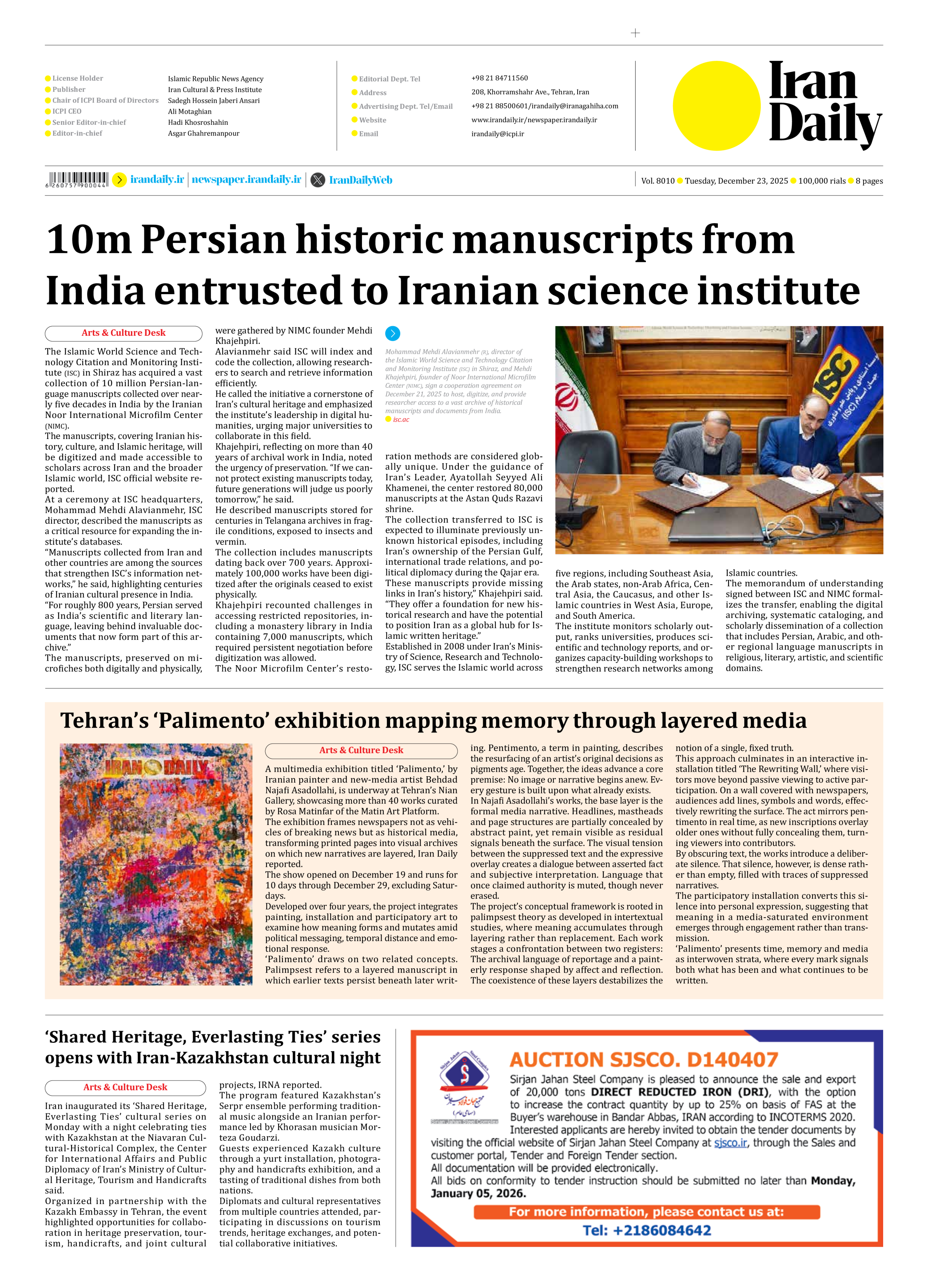
At a ceremony at ISC headquarters, Mohammad Mehdi Alavianmehr, ISC director, described the manuscripts as a critical resource for expanding the institute’s databases.
“Manuscripts collected from Iran and other countries are among the sources that strengthen ISC’s information networks,” he said, highlighting centuries of Iranian cultural presence in India.
“For roughly 800 years, Persian served as India’s scientific and literary language, leaving behind invaluable documents that now form part of this archive.”
The manuscripts, preserved on microfiches both digitally and physically, were gathered by NIMC founder Mehdi Khajehpiri.
Alavianmehr said ISC will index and code the collection, allowing researchers to search and retrieve information efficiently.
He called the initiative a cornerstone of Iran’s cultural heritage and emphasized the institute’s leadership in digital humanities, urging major universities to collaborate in this field.
Khajehpiri, reflecting on more than 40 years of archival work in India, noted the urgency of preservation. “If we cannot protect existing manuscripts today, future generations will judge us poorly tomorrow,” he said.
He described manuscripts stored for centuries in Telangana archives in fragile conditions, exposed to insects and vermin.
The collection includes manuscripts dating back over 700 years. Approximately 100,000 works have been digitized after the originals ceased to exist physically.
Khajehpiri recounted challenges in accessing restricted repositories, including a monastery library in India containing 7,000 manuscripts, which required persistent negotiation before digitization was allowed.
The Noor Microfilm Center’s restoration methods are considered globally unique. Under the guidance of Iran’s Leader, Ayatollah Seyyed Ali Khamenei, the center restored 80,000 manuscripts at the Astan Quds Razavi shrine.
The collection transferred to ISC is expected to illuminate previously unknown historical episodes, including Iran’s ownership of the Persian Gulf, international trade relations, and political diplomacy during the Qajar era.
These manuscripts provide missing links in Iran’s history,” Khajehpiri said. “They offer a foundation for new historical research and have the potential to position Iran as a global hub for Islamic written heritage.”
Established in 2008 under Iran’s Ministry of Science, Research and Technology, ISC serves the Islamic world across five regions, including Southeast Asia, the Arab states, non-Arab Africa, Central Asia, the Caucasus, and other Islamic countries in West Asia, Europe, and South America.
The institute monitors scholarly output, ranks universities, produces scientific and technology reports, and organizes capacity-building workshops to strengthen research networks among Islamic countries.
The memorandum of understanding signed between ISC and NIMC formalizes the transfer, enabling the digital archiving, systematic cataloging, and scholarly dissemination of a collection that includes Persian, Arabic, and other regional language manuscripts in religious, literary, artistic, and scientific domains.