





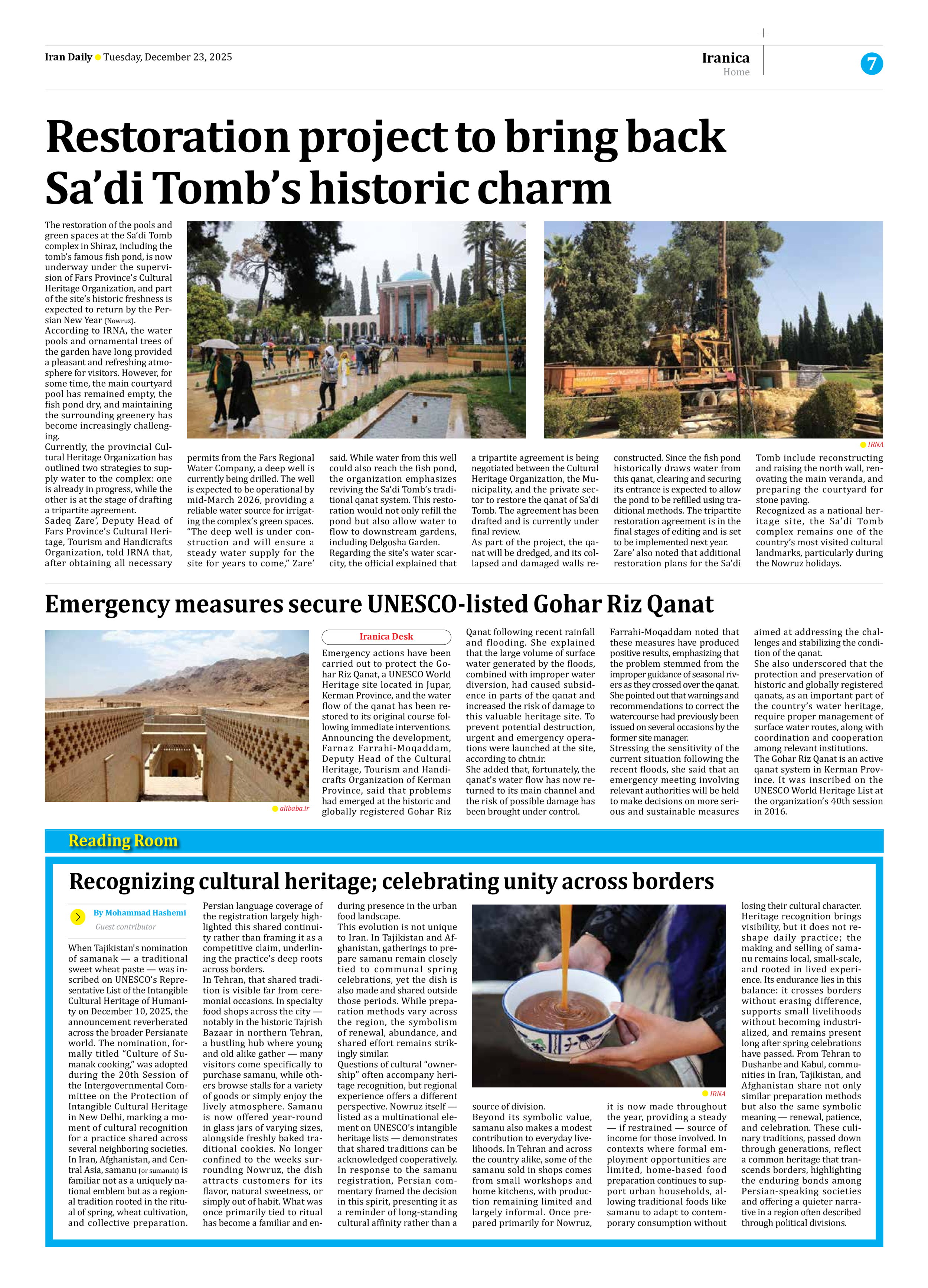


Emergency measures secure UNESCO-listed Gohar Riz Qanat
Emergency actions have been carried out to protect the Gohar Riz Qanat, a UNESCO World Heritage site located in Jupar, Kerman Province, and the water flow of the qanat has been restored to its original course following immediate interventions.
Announcing the development, Farnaz Farrahi-Moqaddam, Deputy Head of the Cultural Heritage, Tourism and Handicrafts Organization of Kerman Province, said that problems had emerged at the historic and globally registered Gohar Riz Qanat following recent rainfall and flooding. She explained that the large volume of surface water generated by the floods, combined with improper water diversion, had caused subsidence in parts of the qanat and increased the risk of damage to this valuable heritage site. To prevent potential destruction, urgent and emergency operations were launched at the site, according to chtn.ir.
She added that, fortunately, the qanat’s water flow has now returned to its main channel and the risk of possible damage has been brought under control.
Farrahi-Moqaddam noted that these measures have produced positive results, emphasizing that the problem stemmed from the improper guidance of seasonal rivers as they crossed over the qanat. She pointed out that warnings and recommendations to correct the watercourse had previously been issued on several occasions by the former site manager.
Stressing the sensitivity of the current situation following the recent floods, she said that an emergency meeting involving relevant authorities will be held to make decisions on more serious and sustainable measures aimed at addressing the challenges and stabilizing the condition of the qanat.
She also underscored that the protection and preservation of historic and globally registered qanats, as an important part of the country’s water heritage, require proper management of surface water routes, along with coordination and cooperation among relevant institutions.
The Gohar Riz Qanat is an active qanat system in Kerman Province. It was inscribed on the UNESCO World Heritage List at the organization’s 40th session in 2016.