





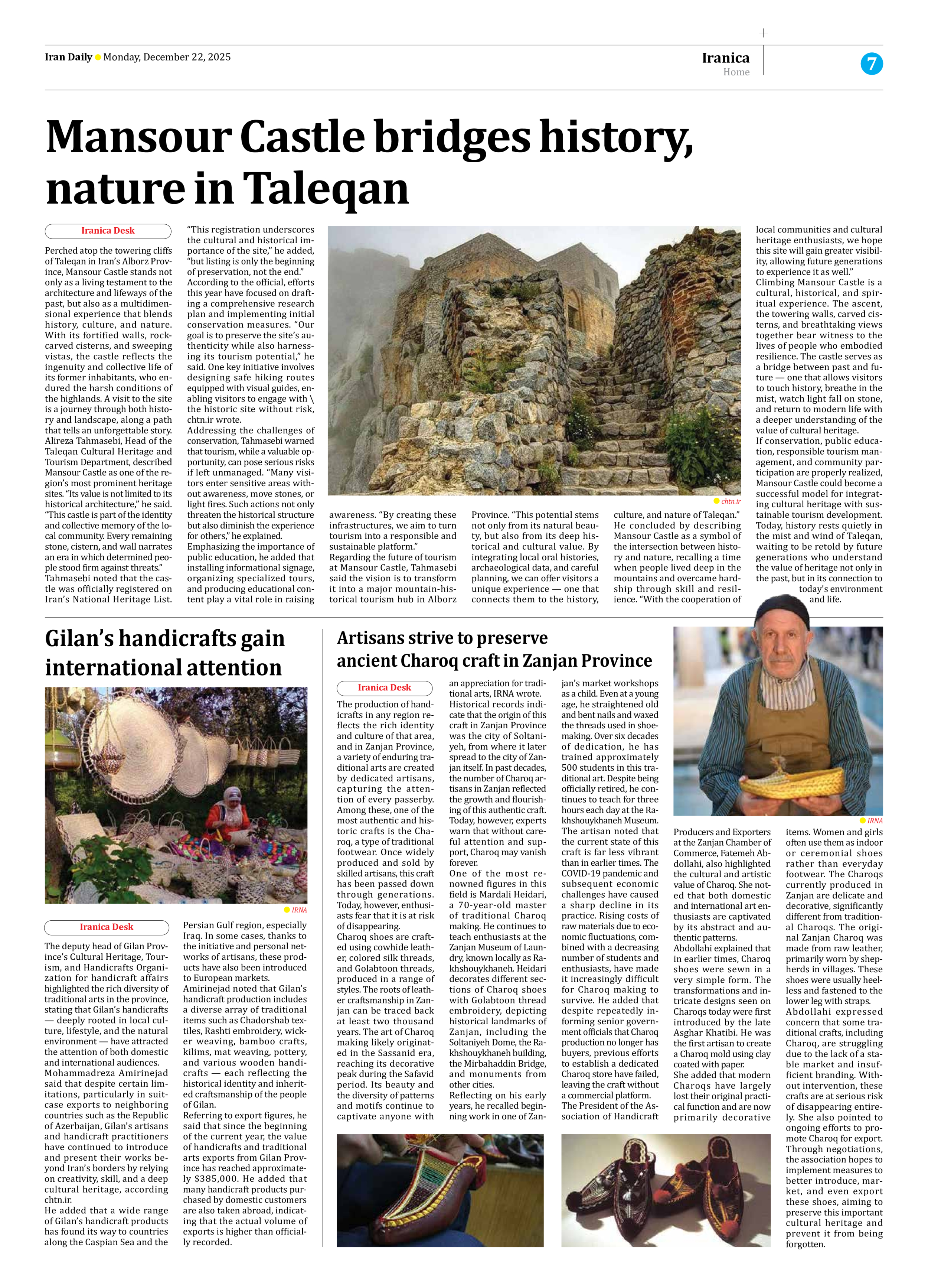


Artisans strive to preserve ancient Charoq craft in Zanjan Province
The production of handicrafts in any region reflects the rich identity and culture of that area, and in Zanjan Province, a variety of enduring traditional arts are created by dedicated artisans, capturing the attention of every passerby. Among these, one of the most authentic and historic crafts is the Charoq, a type of traditional footwear. Once widely produced and sold by skilled artisans, this craft has been passed down through generations. Today, however, enthusiasts fear that it is at risk of disappearing.
Charoq shoes are crafted using cowhide leather, colored silk threads, and Golabtoon threads, produced in a range of styles. The roots of leather craftsmanship in Zanjan can be traced back at least two thousand years. The art of Charoq making likely originated in the Sassanid era, reaching its decorative peak during the Safavid period. Its beauty and the diversity of patterns and motifs continue to captivate anyone with an appreciation for traditional arts, IRNA wrote.
Historical records indicate that the origin of this craft in Zanjan Province was the city of Soltaniyeh, from where it later spread to the city of Zanjan itself. In past decades, the number of Charoq artisans in Zanjan reflected the growth and flourishing of this authentic craft. Today, however, experts warn that without careful attention and support, Charoq may vanish forever.
One of the most renowned figures in this field is Mardali Heidari, a 70-year-old master of traditional Charoq making. He continues to teach enthusiasts at the Zanjan Museum of Laundry, known locally as Rakhshouykhaneh. Heidari decorates different sections of Charoq shoes with Golabtoon thread embroidery, depicting historical landmarks of Zanjan, including the Soltaniyeh Dome, the Rakhshouykhaneh building, the Mirbahaddin Bridge, and monuments from other cities.
Reflecting on his early years, he recalled beginning work in one of Zanjan’s market workshops as a child. Even at a young age, he straightened old and bent nails and waxed the threads used in shoemaking. Over six decades of dedication, he has trained approximately 500 students in this traditional art. Despite being officially retired, he continues to teach for three hours each day at the Rakhshouykhaneh Museum.
The artisan noted that the current state of this craft is far less vibrant than in earlier times. The COVID-19 pandemic and subsequent economic challenges have caused a sharp decline in its practice. Rising costs of raw materials due to economic fluctuations, combined with a decreasing number of students and enthusiasts, have made it increasingly difficult for Charoq making to survive. He added that despite repeatedly informing senior government officials that Charoq production no longer has buyers, previous efforts to establish a dedicated Charoq store have failed, leaving the craft without a commercial platform.
The President of the Association of Handicraft Producers and Exporters at the Zanjan Chamber of Commerce, Fatemeh Abdollahi, also highlighted the cultural and artistic value of Charoq. She noted that both domestic and international art enthusiasts are captivated by its abstract and authentic patterns.
Abdollahi explained that in earlier times, Charoq shoes were sewn in a very simple form. The transformations and intricate designs seen on Charoqs today were first introduced by the late Asghar Khatibi. He was the first artisan to create a Charoq mold using clay coated with paper.
She added that modern Charoqs have largely lost their original practical function and are now primarily decorative items. Women and girls often use them as indoor or ceremonial shoes rather than everyday footwear. The Charoqs currently produced in Zanjan are delicate and decorative, significantly different from traditional Charoqs. The original Zanjan Charoq was made from raw leather, primarily worn by shepherds in villages. These shoes were usually heel-less and fastened to the lower leg with straps.
Abdollahi expressed concern that some traditional crafts, including Charoq, are struggling due to the lack of a stable market and insufficient branding. Without intervention, these crafts are at serious risk of disappearing entirely. She also pointed to ongoing efforts to promote Charoq for export. Through negotiations, the association hopes to implement measures to better introduce, market, and even export these shoes, aiming to preserve this important cultural heritage and prevent it from being forgotten.