





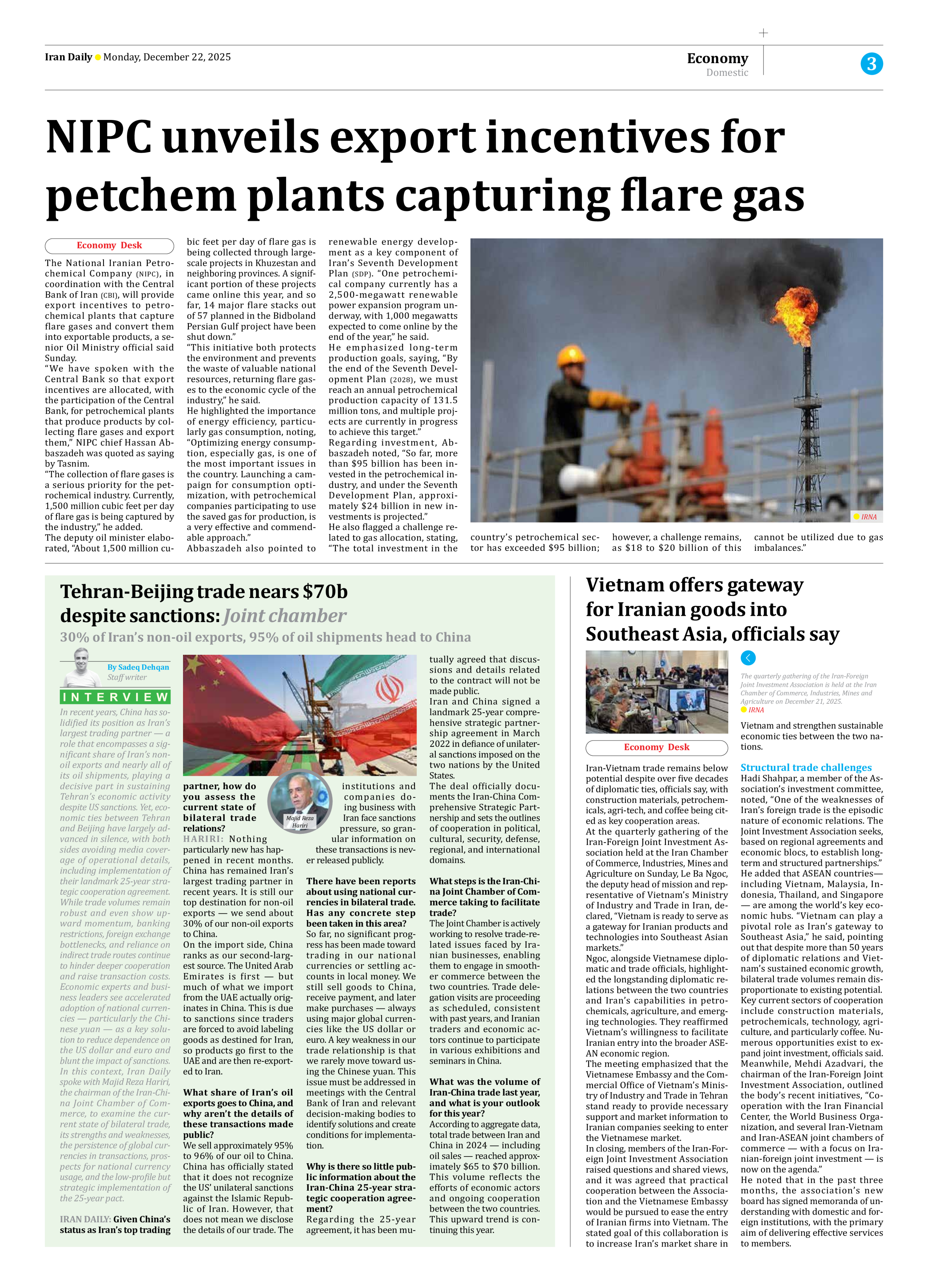


Tehran-Beijing trade nears $70b despite sanctions: Joint chamber
30% of Iran’s non-oil exports, 95% of oil shipments head to China
By Sadeq Dehqan
Staff writer
In recent years, China has solidified its position as Iran’s largest trading partner — a role that encompasses a significant share of Iran’s non-oil exports and nearly all of its oil shipments, playing a decisive part in sustaining Tehran’s economic activity despite US sanctions. Yet, economic ties between Tehran and Beijing have largely advanced in silence, with both sides avoiding media coverage of operational details, including implementation of their landmark 25-year strategic cooperation agreement.
While trade volumes remain robust and even show upward momentum, banking restrictions, foreign exchange bottlenecks, and reliance on indirect trade routes continue to hinder deeper cooperation and raise transaction costs. Economic experts and business leaders see accelerated adoption of national currencies — particularly the Chinese yuan — as a key solution to reduce dependence on the US dollar and euro and blunt the impact of sanctions.
In this context, Iran Daily spoke with Majid Reza Hariri, the chairman of the Iran-China Joint Chamber of Commerce, to examine the current state of bilateral trade, its strengths and weaknesses, the persistence of global currencies in transactions, prospects for national currency usage, and the low-profile but strategic implementation of the 25-year pact.
IRAN DAILY: Given China’s status as Iran’s top trading partner, how do you assess the current state of bilateral trade relations?
HARIRI: Nothing particularly new has happened in recent months. China has remained Iran’s largest trading partner in recent years. It is still our top destination for non-oil exports — we send about 30% of our non-oil exports to China.
On the import side, China ranks as our second-largest source. The United Arab Emirates is first — but much of what we import from the UAE actually originates in China. This is due to sanctions since traders are forced to avoid labeling goods as destined for Iran, so products go first to the UAE and are then re-exported to Iran.
What share of Iran’s oil exports goes to China, and why aren’t the details of these transactions made public?
We sell approximately 95% to 96% of our oil to China. China has officially stated that it does not recognize the US’ unilateral sanctions against the Islamic Republic of Iran. However, that does not mean we disclose the details of our trade. The institutions and companies doing business with Iran face sanctions pressure, so granular information on these transactions is never released publicly.
There have been reports about using national currencies in bilateral trade. Has any concrete step been taken in this area?
So far, no significant progress has been made toward trading in our national currencies or settling accounts in local money. We still sell goods to China, receive payment, and later make purchases — always using major global currencies like the US dollar or euro. A key weakness in our trade relationship is that we rarely move toward using the Chinese yuan. This issue must be addressed in meetings with the Central Bank of Iran and relevant decision-making bodies to identify solutions and create conditions for implementation.
Why is there so little public information about the Iran-China 25-year strategic cooperation agreement?
Regarding the 25-year agreement, it has been mutually agreed that discussions and details related to the contract will not be made public.
Iran and China signed a landmark 25-year comprehensive strategic partnership agreement in March 2022 in defiance of unilateral sanctions imposed on the two nations by the United States.
The deal officially documents the Iran-China Comprehensive Strategic Partnership and sets the outlines of cooperation in political, cultural, security, defense, regional, and international domains.
What steps is the Iran-China Joint Chamber of Commerce taking to facilitate trade?
The Joint Chamber is actively working to resolve trade-related issues faced by Iranian businesses, enabling them to engage in smoother commerce between the two countries. Trade delegation visits are proceeding as scheduled, consistent with past years, and Iranian traders and economic actors continue to participate in various exhibitions and seminars in China.
What was the volume of Iran-China trade last year, and what is your outlook for this year?
According to aggregate data, total trade between Iran and China in 2024 — including oil sales — reached approximately $65 to $70 billion. This volume reflects the efforts of economic actors and ongoing cooperation between the two countries. This upward trend is continuing this year.