







NIPC unveils export incentives for petchem plants capturing flare gas
The National Iranian Petrochemical Company (NIPC), in coordination with the Central Bank of Iran (CBI), will provide export incentives to petrochemical plants that capture flare gases and convert them into exportable products, a senior Oil Ministry official said Sunday.
“We have spoken with the Central Bank so that export incentives are allocated, with the participation of the Central Bank, for petrochemical plants that produce products by collecting flare gases and export them,” NIPC chief Hassan Abbaszadeh was quoted as saying by Tasnim.
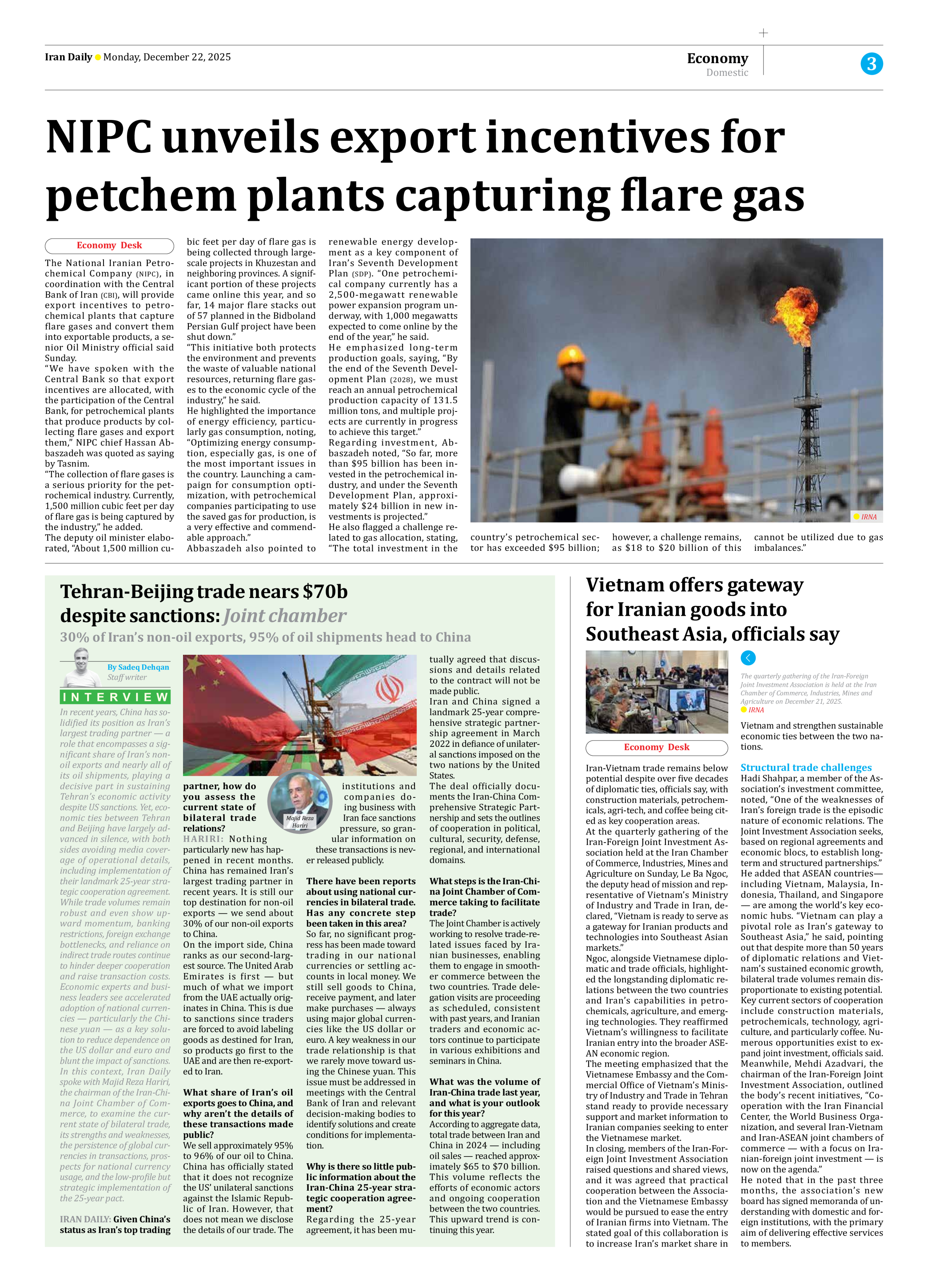
“The collection of flare gases is a serious priority for the petrochemical industry. Currently, 1,500 million cubic feet per day of flare gas is being captured by the industry,” he added.
The deputy oil minister elaborated, “About 1,500 million cubic feet per day of flare gas is being collected through large-scale projects in Khuzestan and neighboring provinces. A significant portion of these projects came online this year, and so far, 14 major flare stacks out of 57 planned in the Bidboland Persian Gulf project have been shut down.”
“This initiative both protects the environment and prevents the waste of valuable national resources, returning flare gases to the economic cycle of the industry,” he said.
He highlighted the importance of energy efficiency, particularly gas consumption, noting, “Optimizing energy consumption, especially gas, is one of the most important issues in the country. Launching a campaign for consumption optimization, with petrochemical companies participating to use the saved gas for production, is a very effective and commendable approach.”
Abbaszadeh also pointed to renewable energy development as a key component of Iran’s Seventh Development Plan (SDP). “One petrochemical company currently has a 2,500-megawatt renewable power expansion program underway, with 1,000 megawatts expected to come online by the end of the year,” he said.
He emphasized long-term production goals, saying, “By the end of the Seventh Development Plan (2028), we must reach an annual petrochemical production capacity of 131.5 million tons, and multiple projects are currently in progress to achieve this target.”
Regarding investment, Abbaszadeh noted, “So far, more than $95 billion has been invested in the petrochemical industry, and under the Seventh Development Plan, approximately $24 billion in new investments is projected.”
He also flagged a challenge related to gas allocation, stating, “The total investment in the country’s petrochemical sector has exceeded $95 billion; however, a challenge remains, as $18 to $20 billion of this cannot be utilized due to gas imbalances.”