







Gov’t drafts near-zero deficit budget for coming year, vows no CBI financing
Finance Minister Ali Madanizadeh said on Saturday that Iran’s draft budget for the next fiscal year — which begins on March 21, 2026 — has been structured to achieve a near-zero deficit, imposing no pressure on the Central Bank (CBI), and helping control inflation.
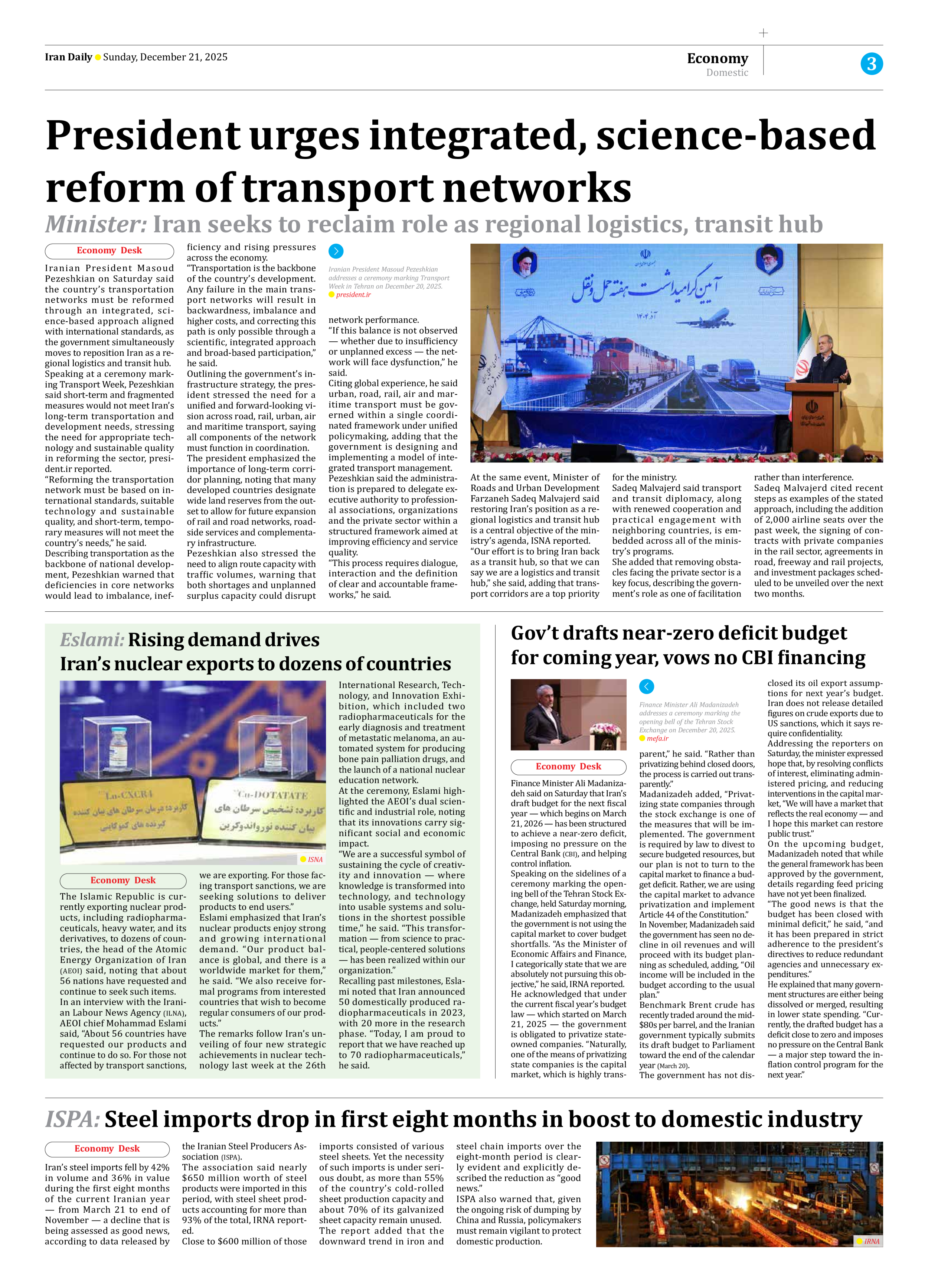
Speaking on the sidelines of a ceremony marking the opening bell of the Tehran Stock Exchange, held Saturday morning, Madanizadeh emphasized that the government is not using the capital market to cover budget shortfalls. “As the Minister of Economic Affairs and Finance, I categorically state that we are absolutely not pursuing this objective,” he said, IRNA reported.
He acknowledged that under the current fiscal year’s budget law — which started on March 21, 2025 — the government is obligated to privatize state-owned companies. “Naturally, one of the means of privatizing state companies is the capital market, which is highly transparent,” he said. “Rather than privatizing behind closed doors, the process is carried out transparently.”
Madanizadeh added, “Privatizing state companies through the stock exchange is one of the measures that will be implemented. The government is required by law to divest to secure budgeted resources, but our plan is not to turn to the capital market to finance a budget deficit. Rather, we are using the capital market to advance privatization and implement Article 44 of the Constitution.”
In November, Madanizadeh said the government has seen no decline in oil revenues and will proceed with its budget planning as scheduled, adding, “Oil income will be included in the budget according to the usual plan.”
Benchmark Brent crude has recently traded around the mid-$80s per barrel, and the Iranian government typically submits its draft budget to Parliament toward the end of the calendar year (March 20).
The government has not disclosed its oil export assumptions for next year’s budget. Iran does not release detailed figures on crude exports due to US sanctions, which it says require confidentiality.
Addressing the reporters on Saturday, the minister expressed hope that, by resolving conflicts of interest, eliminating administered pricing, and reducing interventions in the capital market, “We will have a market that reflects the real economy — and I hope this market can restore public trust.”
On the upcoming budget, Madanizadeh noted that while the general framework has been approved by the government, details regarding feed pricing have not yet been finalized.
“The good news is that the budget has been closed with minimal deficit,” he said, “and it has been prepared in strict adherence to the president’s directives to reduce redundant agencies and unnecessary expenditures.”
He explained that many government structures are either being dissolved or merged, resulting in lower state spending. “Currently, the drafted budget has a deficit close to zero and imposes no pressure on the Central Bank — a major step toward the inflation control program for the next year.”