







President urges integrated, science-based reform of transport networks
Minister: Iran seeks to reclaim role as regional logistics, transit hub
Iranian President Masoud Pezeshkian on Saturday said the country’s transportation networks must be reformed through an integrated, science-based approach aligned with international standards, as the government simultaneously moves to reposition Iran as a regional logistics and transit hub.
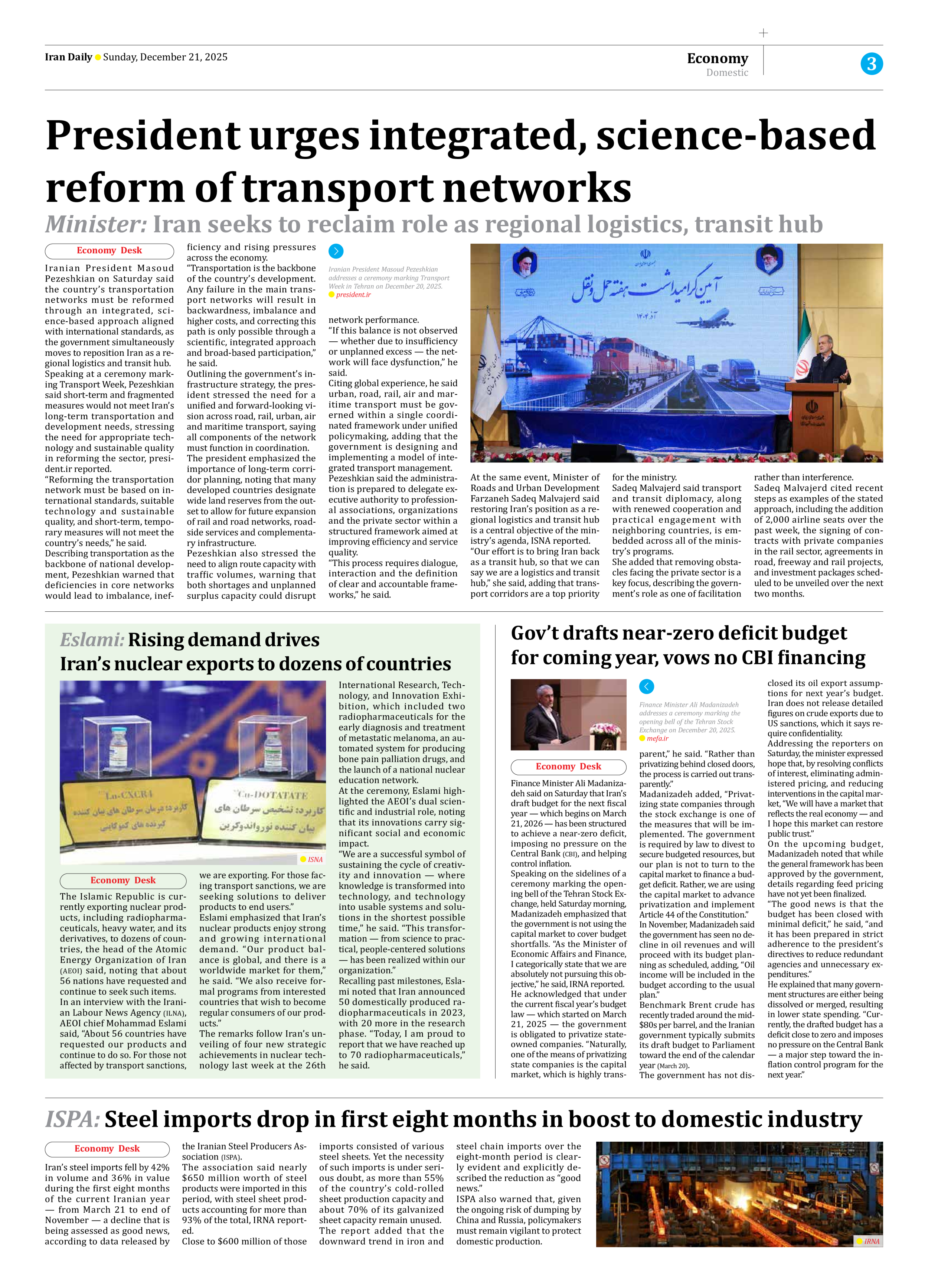
Speaking at a ceremony marking Transport Week, Pezeshkian said short-term and fragmented measures would not meet Iran’s long-term transportation and development needs, stressing the need for appropriate technology and sustainable quality in reforming the sector, president.ir reported.
“Reforming the transportation network must be based on international standards, suitable technology and sustainable quality, and short-term, temporary measures will not meet the country’s needs,” he said.
Describing transportation as the backbone of national development, Pezeshkian warned that deficiencies in core networks would lead to imbalance, inefficiency and rising pressures across the economy.
“Transportation is the backbone of the country’s development. Any failure in the main transport networks will result in backwardness, imbalance and higher costs, and correcting this path is only possible through a scientific, integrated approach and broad-based participation,” he said.
Outlining the government’s infrastructure strategy, the president stressed the need for a unified and forward-looking vision across road, rail, urban, air and maritime transport, saying all components of the network must function in coordination.
The president emphasized the importance of long-term corridor planning, noting that many developed countries designate wide land reserves from the outset to allow for future expansion of rail and road networks, roadside services and complementary infrastructure.
Pezeshkian also stressed the need to align route capacity with traffic volumes, warning that both shortages and unplanned surplus capacity could disrupt network performance.
“If this balance is not observed — whether due to insufficiency or unplanned excess — the network will face dysfunction,” he said.
Citing global experience, he said urban, road, rail, air and maritime transport must be governed within a single coordinated framework under unified policymaking, adding that the government is designing and implementing a model of integrated transport management.
Pezeshkian said the administration is prepared to delegate executive authority to professional associations, organizations and the private sector within a structured framework aimed at improving efficiency and service quality.
“This process requires dialogue, interaction and the definition of clear and accountable frameworks,” he said.
At the same event, Minister of Roads and Urban Development Farzaneh Sadeq Malvajerd said restoring Iran’s position as a regional logistics and transit hub is a central objective of the ministry’s agenda, ISNA reported.
“Our effort is to bring Iran back as a transit hub, so that we can say we are a logistics and transit hub,” she said, adding that transport corridors are a top priority for the ministry.
Sadeq Malvajerd said transport and transit diplomacy, along with renewed cooperation and practical engagement with neighboring countries, is embedded across all of the ministry’s programs.
She added that removing obstacles facing the private sector is a key focus, describing the government’s role as one of facilitation rather than interference.
Sadeq Malvajerd cited recent steps as examples of the stated approach, including the addition of 2,000 airline seats over the past week, the signing of contracts with private companies in the rail sector, agreements in road, freeway and rail projects, and investment packages scheduled to be unveiled over the next two months.