





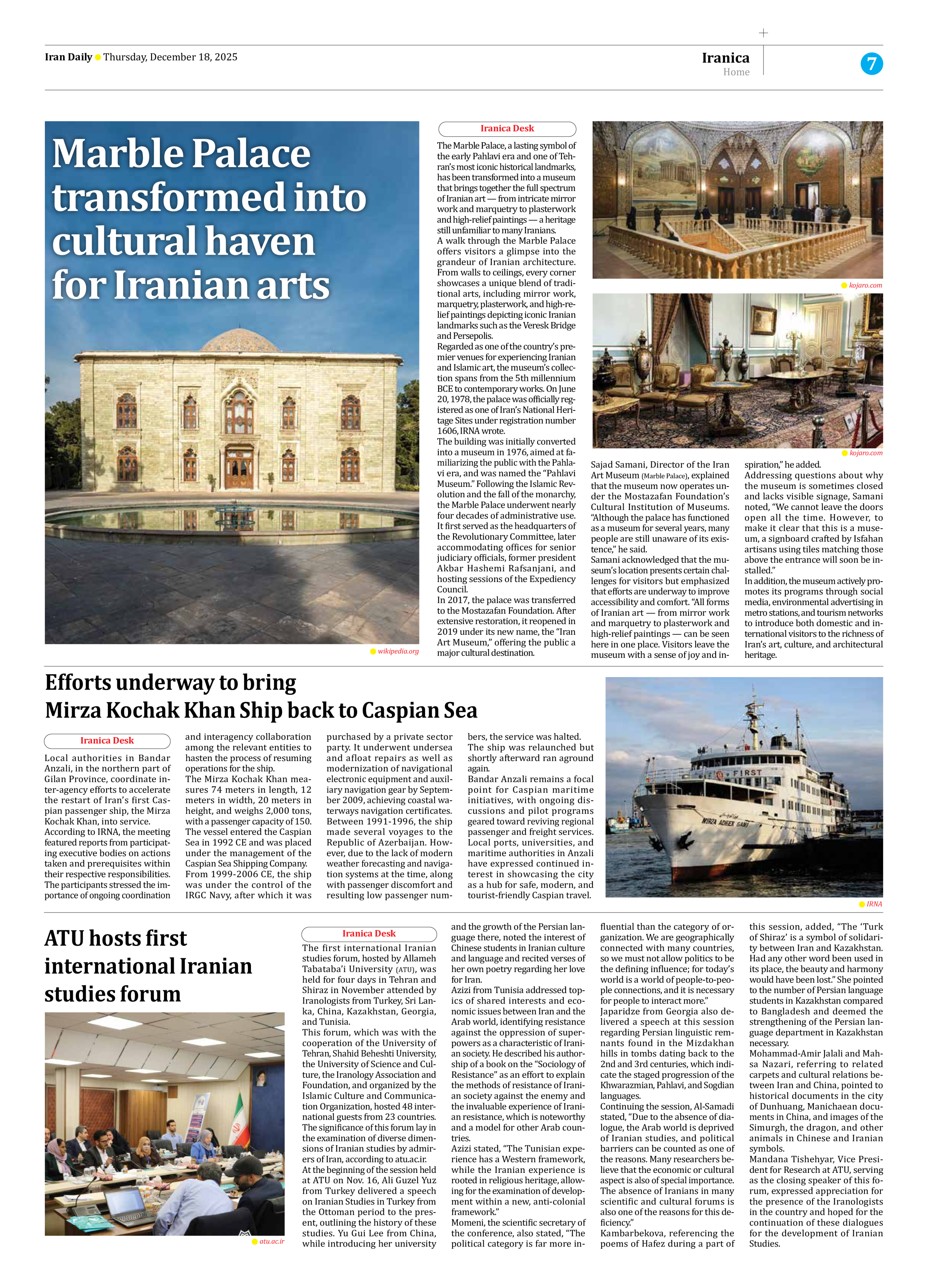


ATU hosts first international Iranian studies forum
The first international Iranian studies forum, hosted by Allameh Tabataba’i University (ATU), was held for four days in Tehran and Shiraz in November attended by Iranologists from Turkey, Sri Lanka, China, Kazakhstan, Georgia, and Tunisia.
This forum, which was with the cooperation of the University of Tehran, Shahid Beheshti University, the University of Science and Culture, the Iranology Association and Foundation, and organized by the Islamic Culture and Communication Organization, hosted 48 international guests from 23 countries. The significance of this forum lay in the examination of diverse dimensions of Iranian studies by admirers of Iran, according to atu.ac.ir.
At the beginning of the session held at ATU on Nov. 16, Ali Guzel Yuz from Turkey delivered a speech on Iranian Studies in Turkey from the Ottoman period to the present, outlining the history of these studies. Yu Gui Lee from China, while introducing her university and the growth of the Persian language there, noted the interest of Chinese students in Iranian culture and language and recited verses of her own poetry regarding her love for Iran.
Azizi from Tunisia addressed topics of shared interests and economic issues between Iran and the Arab world, identifying resistance against the oppression of superpowers as a characteristic of Iranian society. He described his authorship of a book on the “Sociology of Resistance” as an effort to explain the methods of resistance of Iranian society against the enemy and the invaluable experience of Iranian resistance, which is noteworthy and a model for other Arab countries.
Azizi stated, “The Tunisian experience has a Western framework, while the Iranian experience is rooted in religious heritage, allowing for the examination of development within a new, anti-colonial framework.”
Momeni, the scientific secretary of the conference, also stated, “The political category is far more influential than the category of organization. We are geographically connected with many countries, so we must not allow politics to be the defining influence; for today’s world is a world of people-to-people connections, and it is necessary for people to interact more.”
Japaridze from Georgia also delivered a speech at this session regarding Persian linguistic remnants found in the Mizdakhan hills in tombs dating back to the 2nd and 3rd centuries, which indicate the staged progression of the Khwarazmian, Pahlavi, and Sogdian languages.
Continuing the session, Al-Samadi stated, “Due to the absence of dialogue, the Arab world is deprived of Iranian studies, and political barriers can be counted as one of the reasons. Many researchers believe that the economic or cultural aspect is also of special importance. The absence of Iranians in many scientific and cultural forums is also one of the reasons for this deficiency.”
Kambarbekova, referencing the poems of Hafez during a part of this session, added, “The ‘Turk of Shiraz’ is a symbol of solidarity between Iran and Kazakhstan. Had any other word been used in its place, the beauty and harmony would have been lost.” She pointed to the number of Persian language students in Kazakhstan compared to Bangladesh and deemed the strengthening of the Persian language department in Kazakhstan necessary.
Mohammad-Amir Jalali and Mahsa Nazari, referring to related carpets and cultural relations between Iran and China, pointed to historical documents in the city of Dunhuang, Manichaean documents in China, and images of the Simurgh, the dragon, and other animals in Chinese and Iranian symbols.
Mandana Tishehyar, Vice President for Research at ATU, serving as the closing speaker of this forum, expressed appreciation for the presence of the Iranologists in the country and hoped for the continuation of these dialogues for the development of Iranian Studies.