





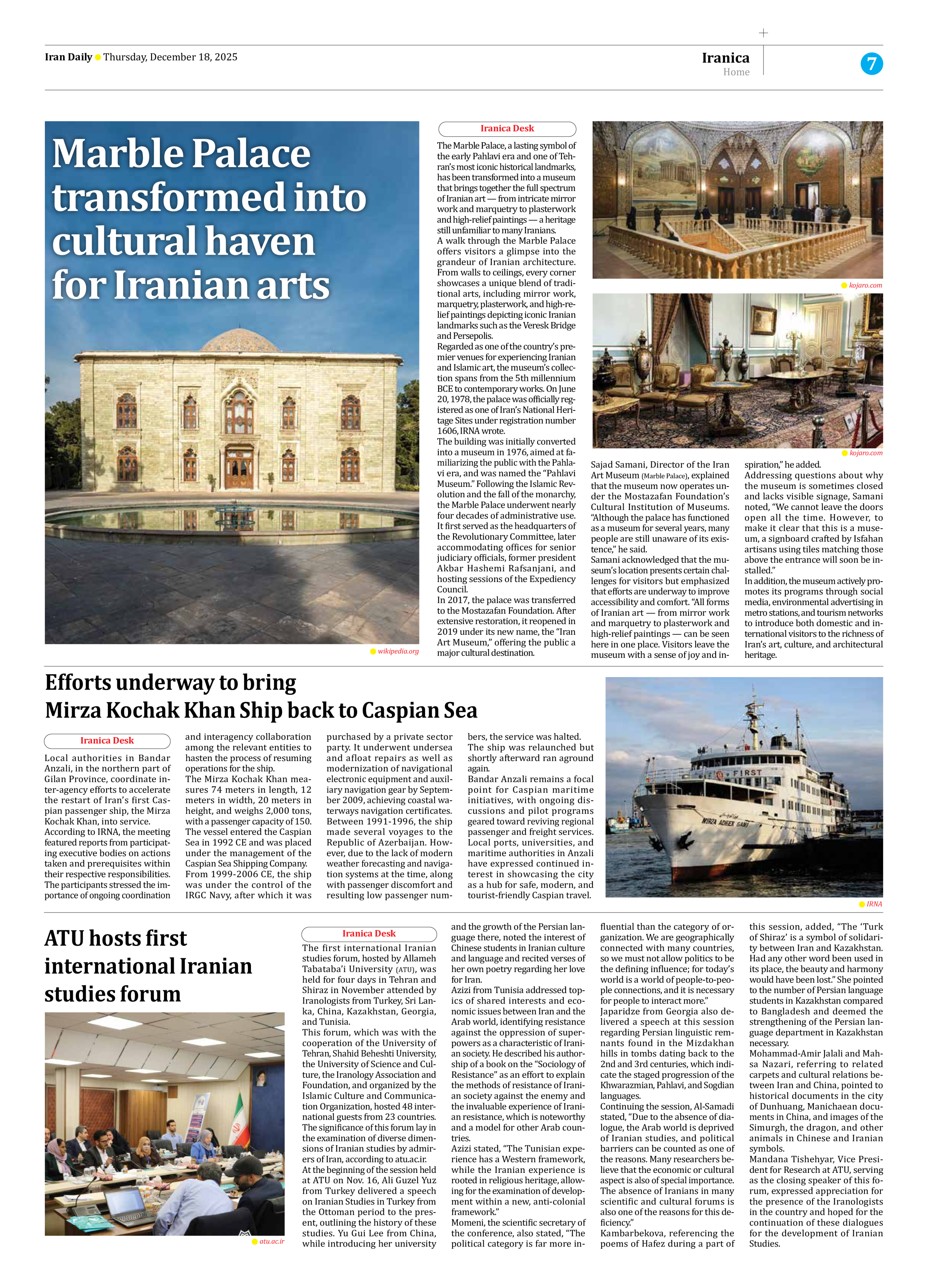


Marble Palace transformed into cultural haven for Iranian arts
The Marble Palace, a lasting symbol of the early Pahlavi era and one of Tehran’s most iconic historical landmarks, has been transformed into a museum that brings together the full spectrum of Iranian art — from intricate mirror work and marquetry to plasterwork and high-relief paintings — a heritage still unfamiliar to many Iranians.
A walk through the Marble Palace offers visitors a glimpse into the grandeur of Iranian architecture. From walls to ceilings, every corner showcases a unique blend of traditional arts, including mirror work, marquetry, plasterwork, and high-relief paintings depicting iconic Iranian landmarks such as the Veresk Bridge and Persepolis.
Regarded as one of the country’s premier venues for experiencing Iranian and Islamic art, the museum’s collection spans from the 5th millennium BCE to contemporary works. On June 20, 1978, the palace was officially registered as one of Iran’s National Heritage Sites under registration number 1606, IRNA wrote.
The building was initially converted into a museum in 1976, aimed at familiarizing the public with the Pahlavi era, and was named the “Pahlavi Museum.” Following the Islamic Revolution and the fall of the monarchy, the Marble Palace underwent nearly four decades of administrative use. It first served as the headquarters of the Revolutionary Committee, later accommodating offices for senior judiciary officials, former president Akbar Hashemi Rafsanjani, and hosting sessions of the Expediency Council.
In 2017, the palace was transferred to the Mostazafan Foundation. After extensive restoration, it reopened in 2019 under its new name, the “Iran Art Museum,” offering the public a major cultural destination.
Sajad Samani, Director of the Iran Art Museum (Marble Palace), explained that the museum now operates under the Mostazafan Foundation’s Cultural Institution of Museums. “Although the palace has functioned as a museum for several years, many people are still unaware of its existence,” he said.
Samani acknowledged that the museum’s location presents certain challenges for visitors but emphasized that efforts are underway to improve accessibility and comfort. “All forms of Iranian art — from mirror work and marquetry to plasterwork and high-relief paintings — can be seen here in one place. Visitors leave the museum with a sense of joy and inspiration,” he added.
Addressing questions about why the museum is sometimes closed and lacks visible signage, Samani noted, “We cannot leave the doors open all the time. However, to make it clear that this is a museum, a signboard crafted by Isfahan artisans using tiles matching those above the entrance will soon be installed.”
In addition, the museum actively promotes its programs through social media, environmental advertising in metro stations, and tourism networks to introduce both domestic and international visitors to the richness of Iran’s art, culture, and architectural heritage.