





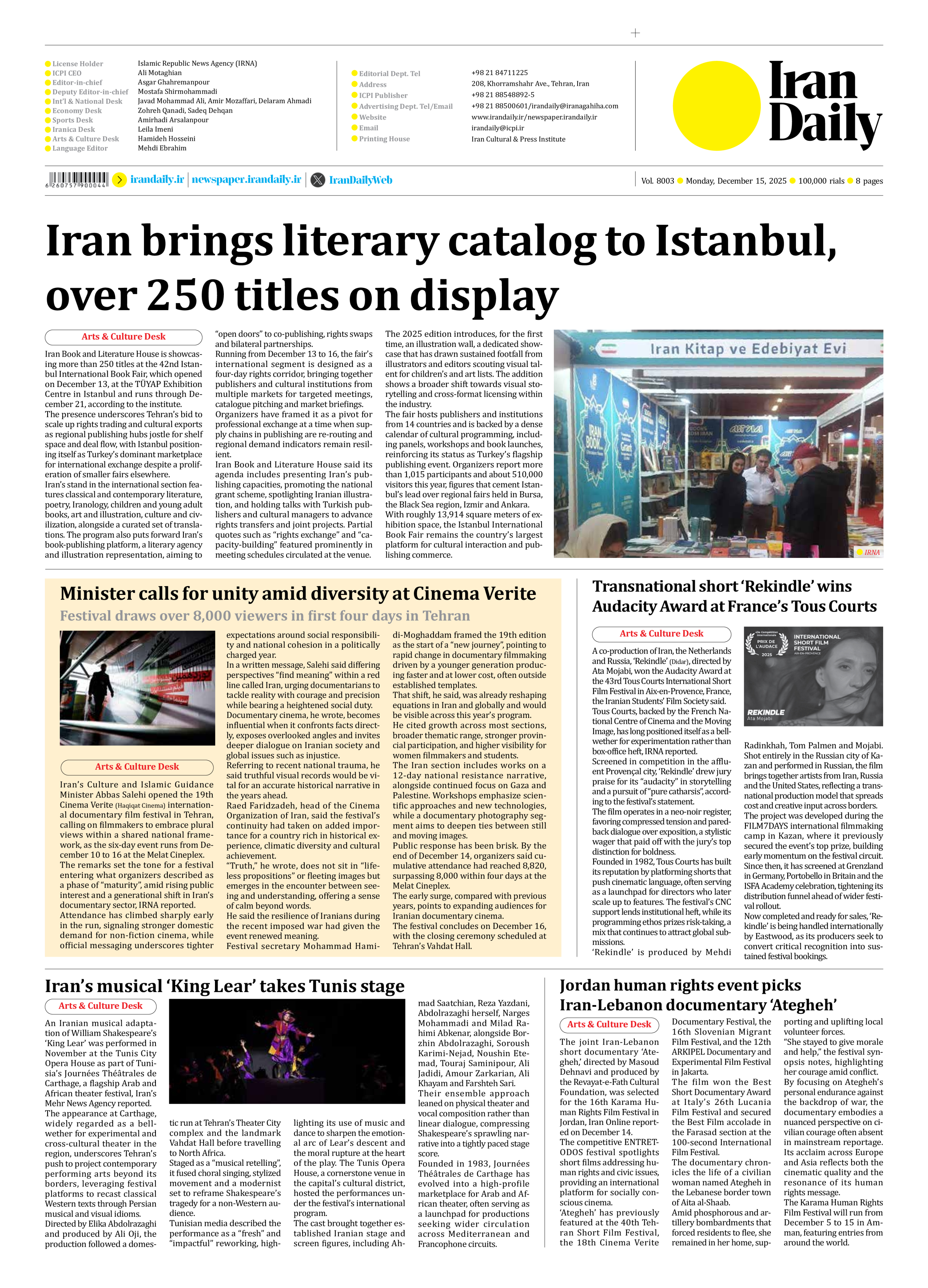


Iran’s musical ‘King Lear’ takes Tunis stage
An Iranian musical adaptation of William Shakespeare’s ‘King Lear’ was performed in November at the Tunis City Opera House as part of Tunisia’s Journées Théâtrales de Carthage, a flagship Arab and African theater festival, Iran’s Mehr News Agency reported.
The appearance at Carthage, widely regarded as a bellwether for experimental and cross-cultural theater in the region, underscores Tehran’s push to project contemporary performing arts beyond its borders, leveraging festival platforms to recast classical Western texts through Persian musical and visual idioms.
Directed by Elika Abdolrazaghi and produced by Ali Oji, the production followed a domestic run at Tehran’s Theater City complex and the landmark Vahdat Hall before travelling to North Africa.
Staged as a “musical retelling”, it fused choral singing, stylized movement and a modernist set to reframe Shakespeare’s tragedy for a non-Western audience.
Tunisian media described the performance as a “fresh” and “impactful” reworking, highlighting its use of music and dance to sharpen the emotional arc of Lear’s descent and the moral rupture at the heart of the play. The Tunis Opera House, a cornerstone venue in the capital’s cultural district, hosted the performances under the festival’s international program.
The cast brought together established Iranian stage and screen figures, including Ahmad Saatchian, Reza Yazdani, Abdolrazaghi herself, Narges Mohammadi and Milad Rahimi Abkenar, alongside Borzhin Abdolrazaghi, Soroush Karimi-Nejad, Noushin Etemad, Touraj Saminipour, Ali Jadidi, Amour Zarkarian, Ali Khayam and Farshteh Sari.
Their ensemble approach leaned on physical theater and vocal composition rather than linear dialogue, compressing Shakespeare’s sprawling narrative into a tightly paced stage score.
Founded in 1983, Journées Théâtrales de Carthage has evolved into a high-profile marketplace for Arab and African theater, often serving as a launchpad for productions seeking wider circulation across Mediterranean and Francophone circuits.