







Copy in clipboard...
Minister calls for unity amid diversity at Cinema Verite
Festival draws over 8,000 viewers in first four days in Tehran
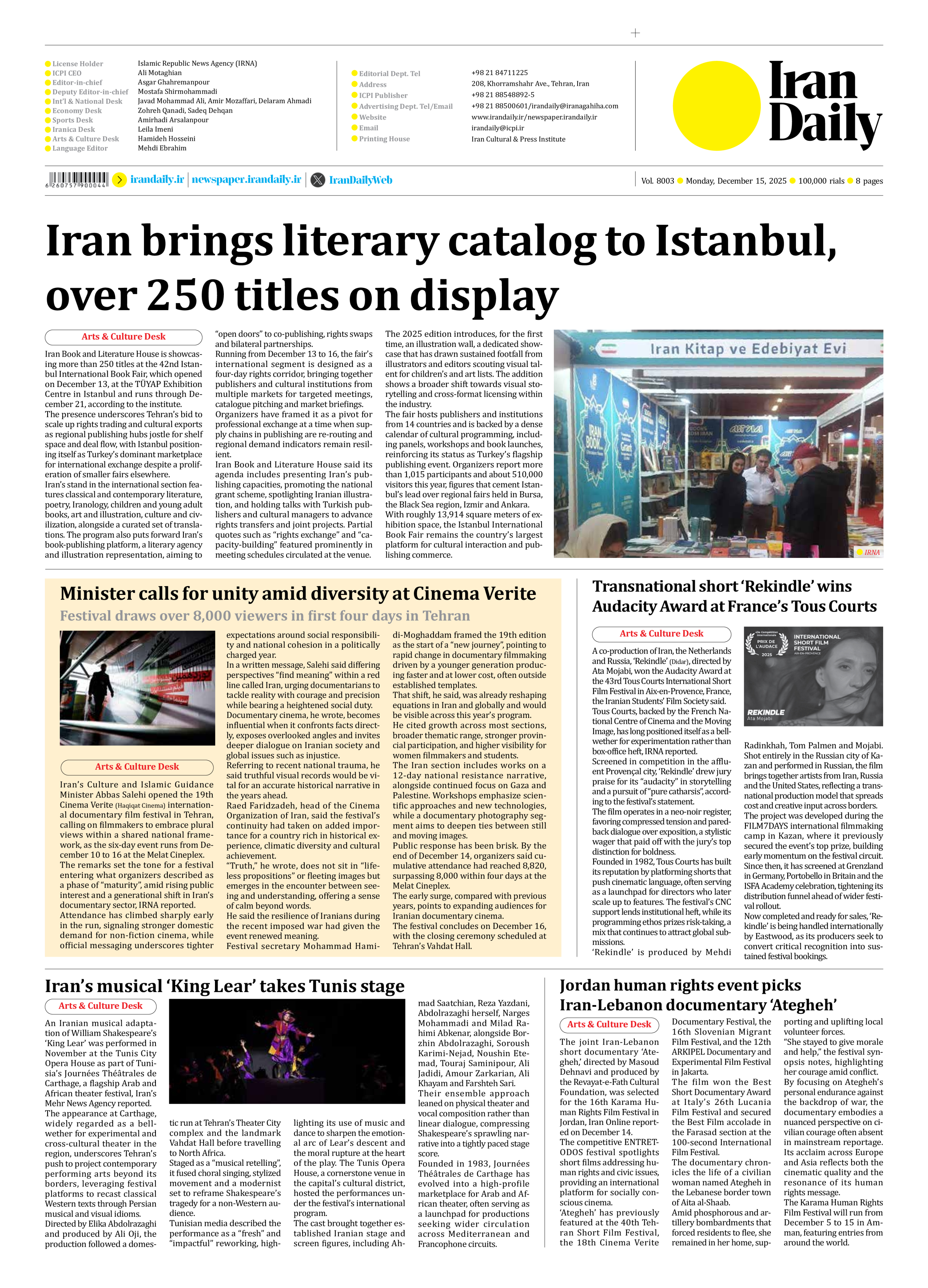
Iran’s Culture and Islamic Guidance Minister Abbas Salehi opened the 19th Cinema Verite (Haqiqat Cinema) international documentary film festival in Tehran, calling on filmmakers to embrace plural views within a shared national framework, as the six-day event runs from December 10 to 16 at the Melat Cineplex.
The remarks set the tone for a festival entering what organizers described as a phase of “maturity”, amid rising public interest and a generational shift in Iran’s documentary sector, IRNA reported.
Attendance has climbed sharply early in the run, signaling stronger domestic demand for non-fiction cinema, while official messaging underscores tighter expectations around social responsibility and national cohesion in a politically charged year.
In a written message, Salehi said differing perspectives “find meaning” within a red line called Iran, urging documentarians to tackle reality with courage and precision while bearing a heightened social duty.
Documentary cinema, he wrote, becomes influential when it confronts facts directly, exposes overlooked angles and invites deeper dialogue on Iranian society and global issues such as injustice.
Referring to recent national trauma, he said truthful visual records would be vital for an accurate historical narrative in the years ahead.
Raed Faridzadeh, head of the Cinema Organization of Iran, said the festival’s continuity had taken on added importance for a country rich in historical experience, climatic diversity and cultural achievement.
“Truth,” he wrote, does not sit in “lifeless propositions” or fleeting images but emerges in the encounter between seeing and understanding, offering a sense of calm beyond words.
He said the resilience of Iranians during the recent imposed war had given the event renewed meaning.
Festival secretary Mohammad Hamidi-Moghaddam framed the 19th edition as the start of a “new journey”, pointing to rapid change in documentary filmmaking driven by a younger generation producing faster and at lower cost, often outside established templates.
That shift, he said, was already reshaping equations in Iran and globally and would be visible across this year’s program.
He cited growth across most sections, broader thematic range, stronger provincial participation, and higher visibility for women filmmakers and students.
The Iran section includes works on a 12-day national resistance narrative, alongside continued focus on Gaza and Palestine. Workshops emphasize scientific approaches and new technologies, while a documentary photography segment aims to deepen ties between still and moving images.
Public response has been brisk. By the end of December 14, organizers said cumulative attendance had reached 8,820, surpassing 8,000 within four days at the Melat Cineplex.
The early surge, compared with previous years, points to expanding audiences for Iranian documentary cinema.
The festival concludes on December 16, with the closing ceremony scheduled at Tehran’s Vahdat Hall.