







Reviving Gilan’s heritage through eco-lodges
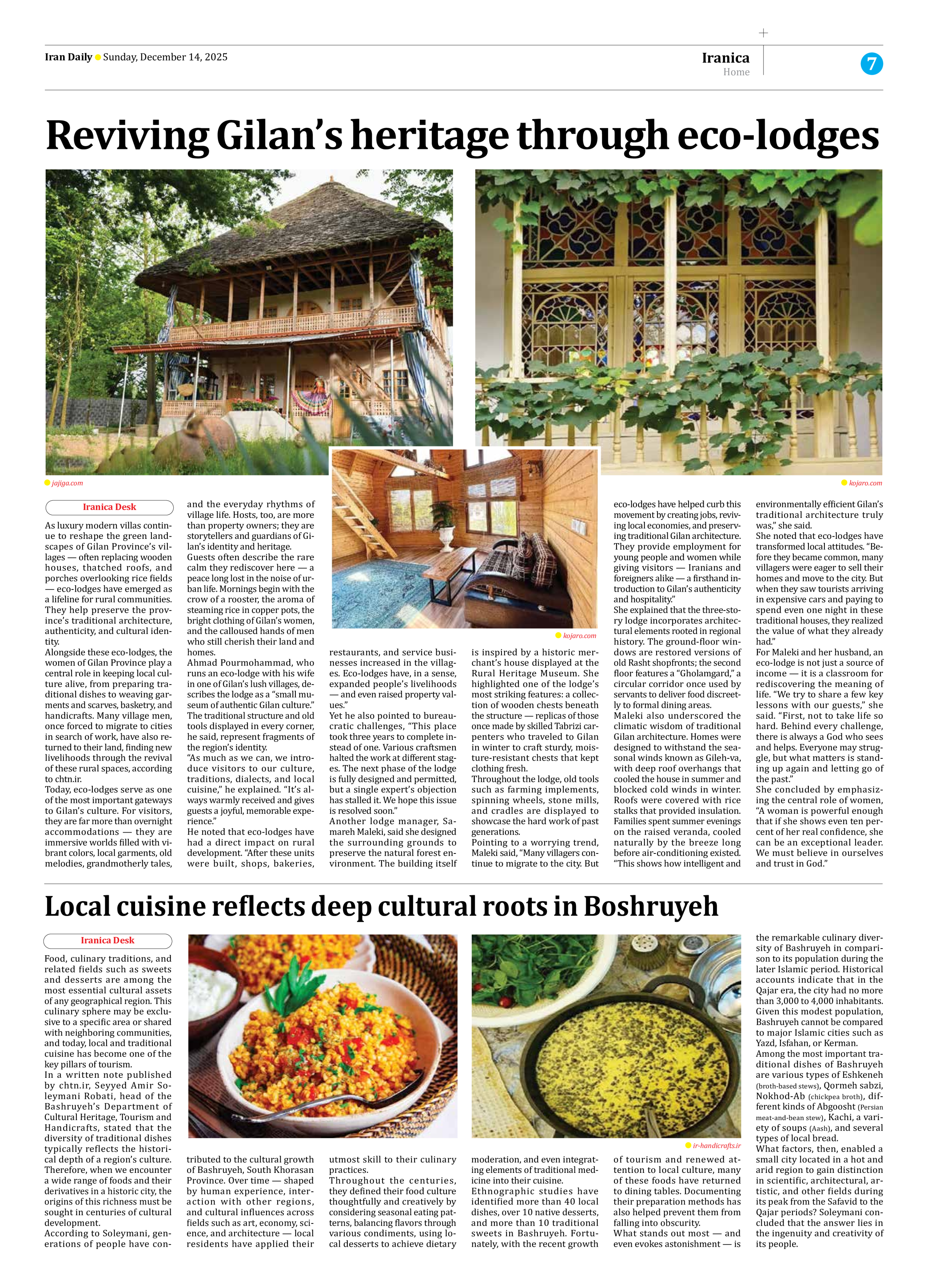
As luxury modern villas continue to reshape the green landscapes of Gilan Province’s villages — often replacing wooden houses, thatched roofs, and porches overlooking rice fields — eco-lodges have emerged as a lifeline for rural communities. They help preserve the province’s traditional architecture, authenticity, and cultural identity.
Alongside these eco-lodges, the women of Gilan Province play a central role in keeping local culture alive, from preparing traditional dishes to weaving garments and scarves, basketry, and handicrafts. Many village men, once forced to migrate to cities in search of work, have also returned to their land, finding new livelihoods through the revival of these rural spaces, according to chtn.ir.
Today, eco-lodges serve as one of the most important gateways to Gilan’s culture. For visitors, they are far more than overnight accommodations — they are immersive worlds filled with vibrant colors, local garments, old melodies, grandmotherly tales, and the everyday rhythms of village life. Hosts, too, are more than property owners; they are storytellers and guardians of Gilan’s identity and heritage.
Guests often describe the rare calm they rediscover here — a peace long lost in the noise of urban life. Mornings begin with the crow of a rooster, the aroma of steaming rice in copper pots, the bright clothing of Gilan’s women, and the calloused hands of men who still cherish their land and homes.
Ahmad Pourmohammad, who runs an eco-lodge with his wife in one of Gilan’s lush villages, describes the lodge as a “small museum of authentic Gilan culture.” The traditional structure and old tools displayed in every corner, he said, represent fragments of the region’s identity.
“As much as we can, we introduce visitors to our culture, traditions, dialects, and local cuisine,” he explained. “It’s always warmly received and gives guests a joyful, memorable experience.”
He noted that eco-lodges have had a direct impact on rural development. “After these units were built, shops, bakeries, restaurants, and service businesses increased in the villages. Eco-lodges have, in a sense, expanded people’s livelihoods — and even raised property values.”
Yet he also pointed to bureaucratic challenges, “This place took three years to complete instead of one. Various craftsmen halted the work at different stages. The next phase of the lodge is fully designed and permitted, but a single expert’s objection has stalled it. We hope this issue is resolved soon.”
Another lodge manager, Samareh Maleki, said she designed the surrounding grounds to preserve the natural forest environment. The building itself is inspired by a historic merchant’s house displayed at the Rural Heritage Museum. She highlighted one of the lodge’s most striking features: a collection of wooden chests beneath the structure — replicas of those once made by skilled Tabrizi carpenters who traveled to Gilan in winter to craft sturdy, moisture-resistant chests that kept clothing fresh.
Throughout the lodge, old tools such as farming implements, spinning wheels, stone mills, and cradles are displayed to showcase the hard work of past generations.
Pointing to a worrying trend, Maleki said, “Many villagers continue to migrate to the city. But eco-lodges have helped curb this movement by creating jobs, reviving local economies, and preserving traditional Gilan architecture. They provide employment for young people and women while giving visitors — Iranians and foreigners alike — a firsthand introduction to Gilan’s authenticity and hospitality.”
She explained that the three-story lodge incorporates architectural elements rooted in regional history. The ground-floor windows are restored versions of old Rasht shopfronts; the second floor features a “Gholamgard,” a circular corridor once used by servants to deliver food discreetly to formal dining areas.
Maleki also underscored the climatic wisdom of traditional Gilan architecture. Homes were designed to withstand the seasonal winds known as Gileh-va, with deep roof overhangs that cooled the house in summer and blocked cold winds in winter. Roofs were covered with rice stalks that provided insulation. Families spent summer evenings on the raised veranda, cooled naturally by the breeze long before air-conditioning existed. “This shows how intelligent and environmentally efficient Gilan’s traditional architecture truly was,” she said.
She noted that eco-lodges have transformed local attitudes. “Before they became common, many villagers were eager to sell their homes and move to the city. But when they saw tourists arriving in expensive cars and paying to spend even one night in these traditional houses, they realized the value of what they already had.”
For Maleki and her husband, an eco-lodge is not just a source of income — it is a classroom for rediscovering the meaning of life. “We try to share a few key lessons with our guests,” she said. “First, not to take life so hard. Behind every challenge, there is always a God who sees and helps. Everyone may struggle, but what matters is standing up again and letting go of the past.”
She concluded by emphasizing the central role of women, “A woman is powerful enough that if she shows even ten percent of her real confidence, she can be an exceptional leader. We must believe in ourselves and trust in God.”