





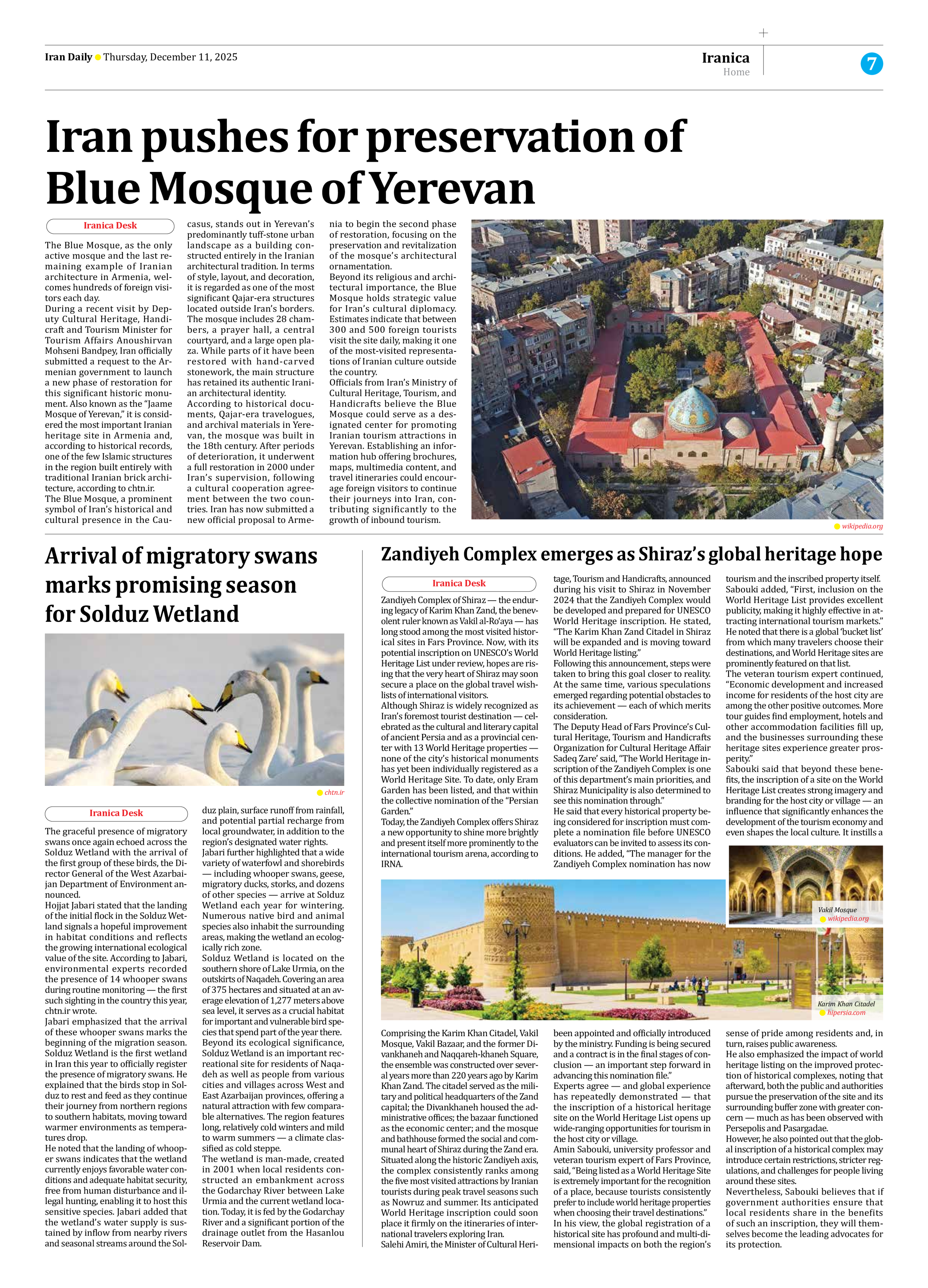


Zandiyeh Complex emerges as Shiraz’s global heritage hope
Zandiyeh Complex of Shiraz — the enduring legacy of Karim Khan Zand, the benevolent ruler known as Vakil al-Ro‘aya — has long stood among the most visited historical sites in Fars Province. Now, with its potential inscription on UNESCO’s World Heritage List under review, hopes are rising that the very heart of Shiraz may soon secure a place on the global travel wish-lists of international visitors.
Although Shiraz is widely recognized as Iran’s foremost tourist destination — celebrated as the cultural and literary capital of ancient Persia and as a provincial center with 13 World Heritage properties — none of the city’s historical monuments has yet been individually registered as a World Heritage Site. To date, only Eram Garden has been listed, and that within the collective nomination of the “Persian Garden.”
Today, the Zandiyeh Complex offers Shiraz a new opportunity to shine more brightly and present itself more prominently to the international tourism arena, according to IRNA.
Comprising the Karim Khan Citadel, Vakil Mosque, Vakil Bazaar, and the former Divankhaneh and Naqqareh-khaneh Square, the ensemble was constructed over several years more than 220 years ago by Karim Khan Zand. The citadel served as the military and political headquarters of the Zand capital; the Divankhaneh housed the administrative offices; the bazaar functioned as the economic center; and the mosque and bathhouse formed the social and communal heart of Shiraz during the Zand era.
Situated along the historic Zandiyeh axis, the complex consistently ranks among the five most visited attractions by Iranian tourists during peak travel seasons such as Nowruz and summer. Its anticipated World Heritage inscription could soon place it firmly on the itineraries of international travelers exploring Iran.
Salehi Amiri, the Minister of Cultural Heritage, Tourism and Handicrafts, announced during his visit to Shiraz in November 2024 that the Zandiyeh Complex would be developed and prepared for UNESCO World Heritage inscription. He stated, “The Karim Khan Zand Citadel in Shiraz will be expanded and is moving toward World Heritage listing.”
Following this announcement, steps were taken to bring this goal closer to reality. At the same time, various speculations emerged regarding potential obstacles to its achievement — each of which merits consideration.
The Deputy Head of Fars Province’s Cultural Heritage, Tourism and Handicrafts Organization for Cultural Heritage Affair Sadeq Zare’ said, “The World Heritage inscription of the Zandiyeh Complex is one of this department’s main priorities, and Shiraz Municipality is also determined to see this nomination through.”
He said that every historical property being considered for inscription must complete a nomination file before UNESCO evaluators can be invited to assess its conditions. He added, “The manager for the Zandiyeh Complex nomination has now been appointed and officially introduced by the ministry. Funding is being secured and a contract is in the final stages of conclusion — an important step forward in advancing this nomination file.”
Experts agree — and global experience has repeatedly demonstrated — that the inscription of a historical heritage site on the World Heritage List opens up wide-ranging opportunities for tourism in the host city or village.
Amin Sabouki, university professor and veteran tourism expert of Fars Province, said, “Being listed as a World Heritage Site is extremely important for the recognition of a place, because tourists consistently prefer to include world heritage properties when choosing their travel destinations.”
In his view, the global registration of a historical site has profound and multi-dimensional impacts on both the region’s tourism and the inscribed property itself.
Sabouki added, “First, inclusion on the World Heritage List provides excellent publicity, making it highly effective in attracting international tourism markets.” He noted that there is a global ‘bucket list’ from which many travelers choose their destinations, and World Heritage sites are prominently featured on that list.
The veteran tourism expert continued, “Economic development and increased income for residents of the host city are among the other positive outcomes. More tour guides find employment, hotels and other accommodation facilities fill up, and the businesses surrounding these heritage sites experience greater prosperity.”
Sabouki said that beyond these benefits, the inscription of a site on the World Heritage List creates strong imagery and branding for the host city or village — an influence that significantly enhances the development of the tourism economy and even shapes the local culture. It instills a sense of pride among residents and, in turn, raises public awareness.
He also emphasized the impact of world heritage listing on the improved protection of historical complexes, noting that afterward, both the public and authorities pursue the preservation of the site and its surrounding buffer zone with greater concern — much as has been observed with Persepolis and Pasargadae.
However, he also pointed out that the global inscription of a historical complex may introduce certain restrictions, stricter regulations, and challenges for people living around these sites.
Nevertheless, Sabouki believes that if government authorities ensure that local residents share in the benefits of such an inscription, they will themselves become the leading advocates for its protection.