







Exemplifying patriotism in Qajar-era history books for kids
Qajar-era textbooks not only carry historical value and educational significance but are still engaging and enjoyable to read. One of the earliest history textbooks for elementary schools was authored by Mahmoud Meftah-ol-Molk, who, more than three decades earlier, had also produced one of the first examples of modern Persian children’s literature. He sought to create a child-friendly, fluent, and captivating account of Iranian history using the Shahnameh.
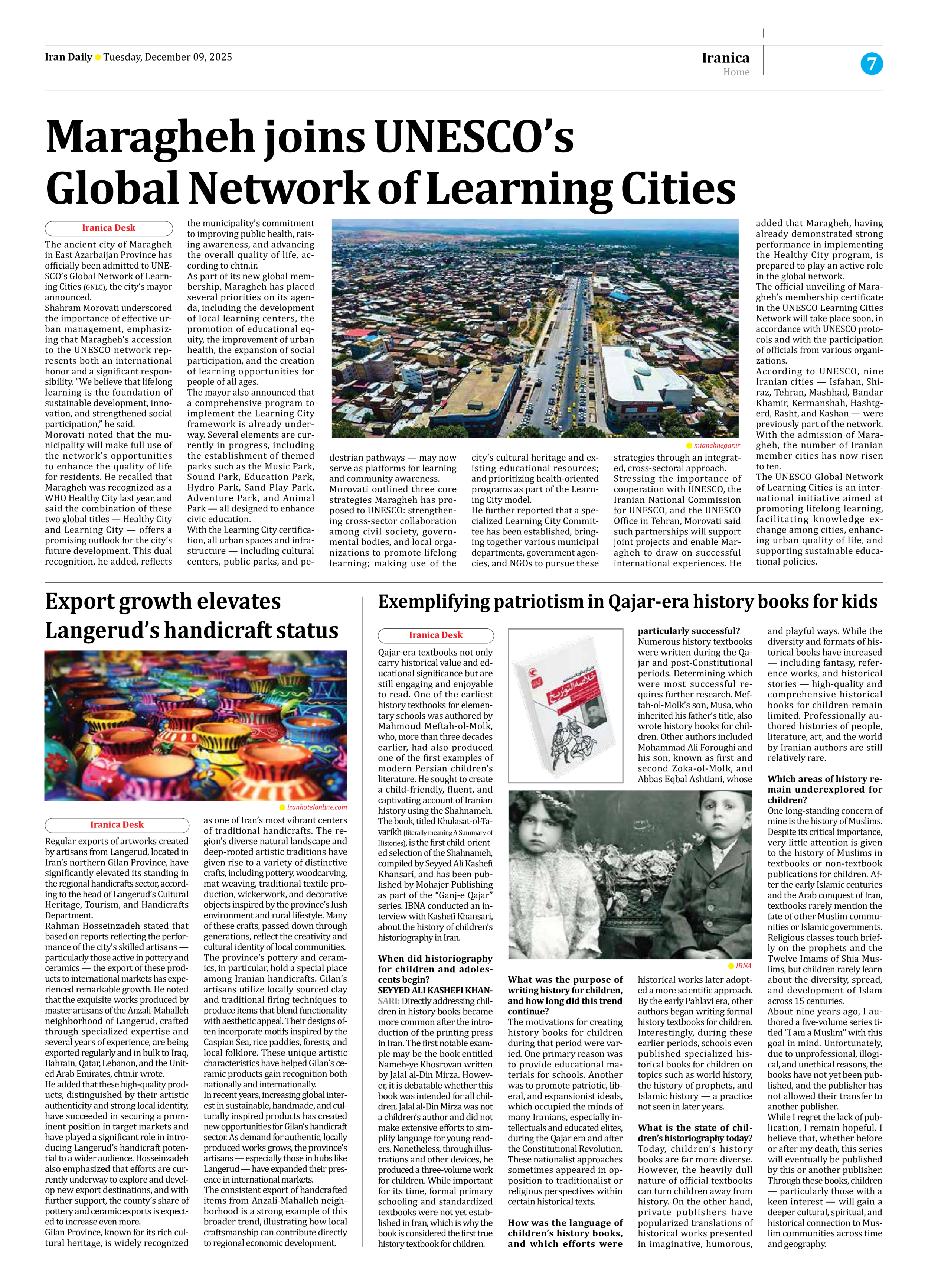
The book, titled Khulasat-ol-Tavarikh (literally meaning A Summary of Histories), is the first child-oriented selection of the Shahnameh, compiled by Seyyed Ali Kashefi Khansari, and has been published by Mohajer Publishing as part of the “Ganj-e Qajar” series. IBNA conducted an interview with Kashefi Khansari, about the history of children’s historiography in Iran.
When did historiography for children and adolescents begin?
SEYYED ALI KASHEFI KHANSARI: Directly addressing children in history books became more common after the introduction of the printing press in Iran. The first notable example may be the book entitled Nameh-ye Khosrovan written by Jalal al-Din Mirza. However, it is debatable whether this book was intended for all children. Jalal al-Din Mirza was not a children’s author and did not make extensive efforts to simplify language for young readers. Nonetheless, through illustrations and other devices, he produced a three-volume work for children. While important for its time, formal primary schooling and standardized textbooks were not yet established in Iran, which is why the book is considered the first true history textbook for children.
What was the purpose of writing history for children, and how long did this trend continue?
The motivations for creating history books for children during that period were varied. One primary reason was to provide educational materials for schools. Another was to promote patriotic, liberal, and expansionist ideals, which occupied the minds of many Iranians, especially intellectuals and educated elites, during the Qajar era and after the Constitutional Revolution. These nationalist approaches sometimes appeared in opposition to traditionalist or religious perspectives within certain historical texts.
How was the language of children’s history books, and which efforts were particularly successful?
Numerous history textbooks were written during the Qajar and post-Constitutional periods. Determining which were most successful requires further research. Meftah-ol-Molk’s son, Musa, who inherited his father’s title, also wrote history books for children. Other authors included Mohammad Ali Foroughi and his son, known as first and second Zoka-ol-Molk, and Abbas Eqbal Ashtiani, whose historical works later adopted a more scientific approach. By the early Pahlavi era, other authors began writing formal history textbooks for children. Interestingly, during these earlier periods, schools even published specialized historical books for children on topics such as world history, the history of prophets, and Islamic history — a practice not seen in later years.
What is the state of children’s historiography today?
Today, children’s history books are far more diverse. However, the heavily dull nature of official textbooks can turn children away from history. On the other hand, private publishers have popularized translations of historical works presented in imaginative, humorous, and playful ways. While the diversity and formats of historical books have increased — including fantasy, reference works, and historical stories — high-quality and comprehensive historical books for children remain limited. Professionally authored histories of people, literature, art, and the world by Iranian authors are still relatively rare.
Which areas of history remain underexplored for children?
One long-standing concern of mine is the history of Muslims. Despite its critical importance, very little attention is given to the history of Muslims in textbooks or non-textbook publications for children. After the early Islamic centuries and the Arab conquest of Iran, textbooks rarely mention the fate of other Muslim communities or Islamic governments.
Religious classes touch briefly on the prophets and the Twelve Imams of Shia Muslims, but children rarely learn about the diversity, spread, and development of Islam across 15 centuries.
About nine years ago, I authored a five-volume series titled “I am a Muslim” with this goal in mind. Unfortunately, due to unprofessional, illogical, and unethical reasons, the books have not yet been published, and the publisher has not allowed their transfer to another publisher.
While I regret the lack of publication, I remain hopeful. I believe that, whether before or after my death, this series will eventually be published by this or another publisher. Through these books, children — particularly those with a keen interest — will gain a deeper cultural, spiritual, and historical connection to Muslim communities across time and geography.