







Ancient neolithic settlement discovered in Dehdasht
A 7,000-year-old prehistoric village has been discovered at the heart of the ancient city of Belad-e Shapur in Dehdasht, Kohgiluyeh and Boyer-Ahmad Province, according to Zabihollah Masoudinia, the head of the archaeological excavation team.
He noted that no archaeological research had previously been carried out in this ancient city, adding that this project marks the first scientific investigation in the area. Following the issuance of excavation permits, several exploratory trenches were opened across different parts of the city, Mehr News Agency reported.
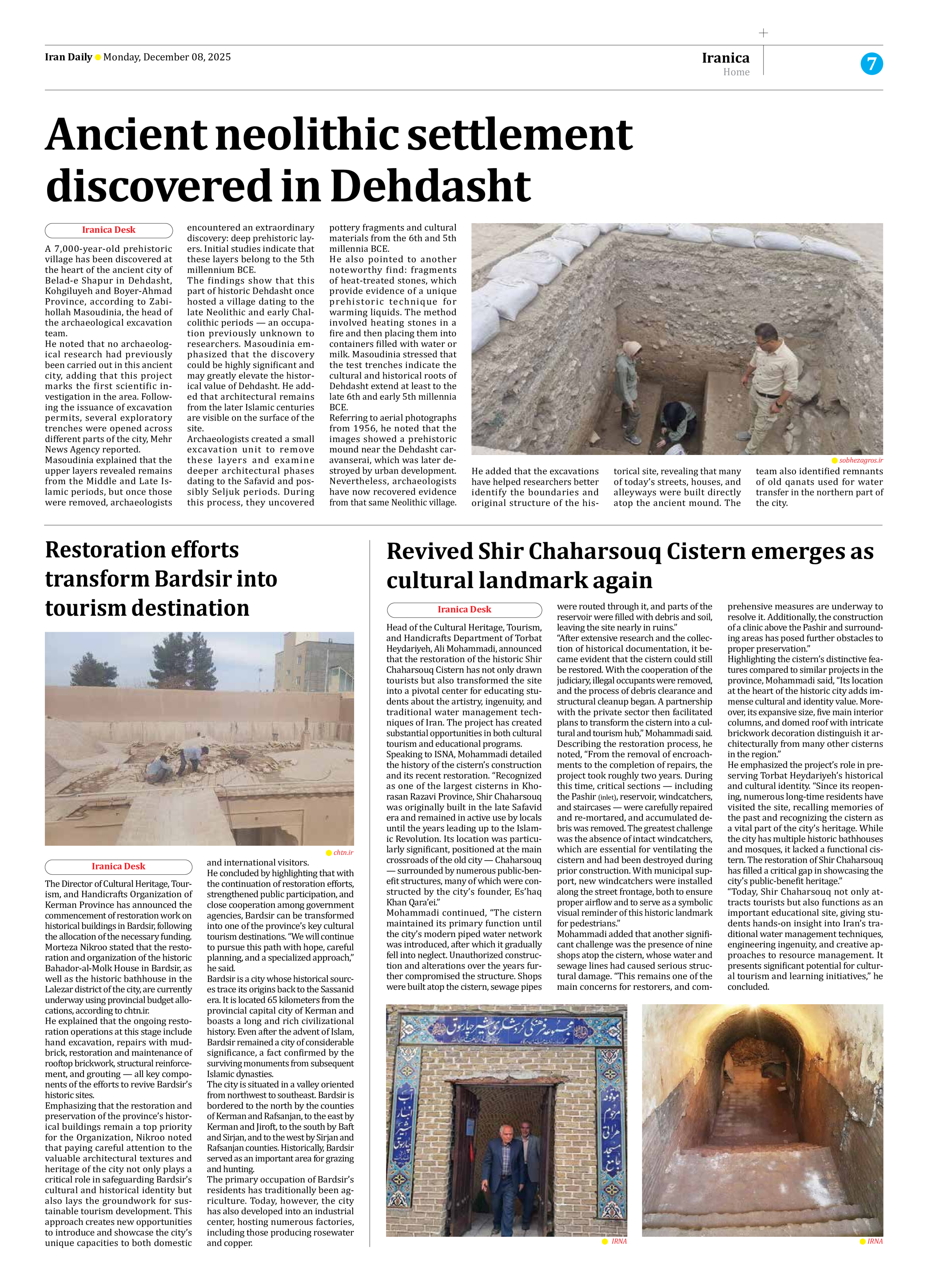
Masoudinia explained that the upper layers revealed remains from the Middle and Late Islamic periods, but once those were removed, archaeologists encountered an extraordinary discovery: deep prehistoric layers. Initial studies indicate that these layers belong to the 5th millennium BCE.
The findings show that this part of historic Dehdasht once hosted a village dating to the late Neolithic and early Chalcolithic periods — an occupation previously unknown to researchers. Masoudinia emphasized that the discovery could be highly significant and may greatly elevate the historical value of Dehdasht. He added that architectural remains from the later Islamic centuries are visible on the surface of the site.
Archaeologists created a small excavation unit to remove these layers and examine deeper architectural phases dating to the Safavid and possibly Seljuk periods. During this process, they uncovered pottery fragments and cultural materials from the 6th and 5th millennia BCE.
He also pointed to another noteworthy find: fragments of heat-treated stones, which provide evidence of a unique prehistoric technique for warming liquids. The method involved heating stones in a fire and then placing them into containers filled with water or milk. Masoudinia stressed that the test trenches indicate the cultural and historical roots of Dehdasht extend at least to the late 6th and early 5th millennia BCE.
Referring to aerial photographs from 1956, he noted that the images showed a prehistoric mound near the Dehdasht caravanserai, which was later destroyed by urban development. Nevertheless, archaeologists have now recovered evidence from that same Neolithic village.
He added that the excavations have helped researchers better identify the boundaries and original structure of the historical site, revealing that many of today’s streets, houses, and alleyways were built directly atop the ancient mound. The team also identified remnants of old qanats used for water transfer in the northern part of the city.