







Prospect of tech contest between US, China
By Arian Nourani
Expert on international affairs
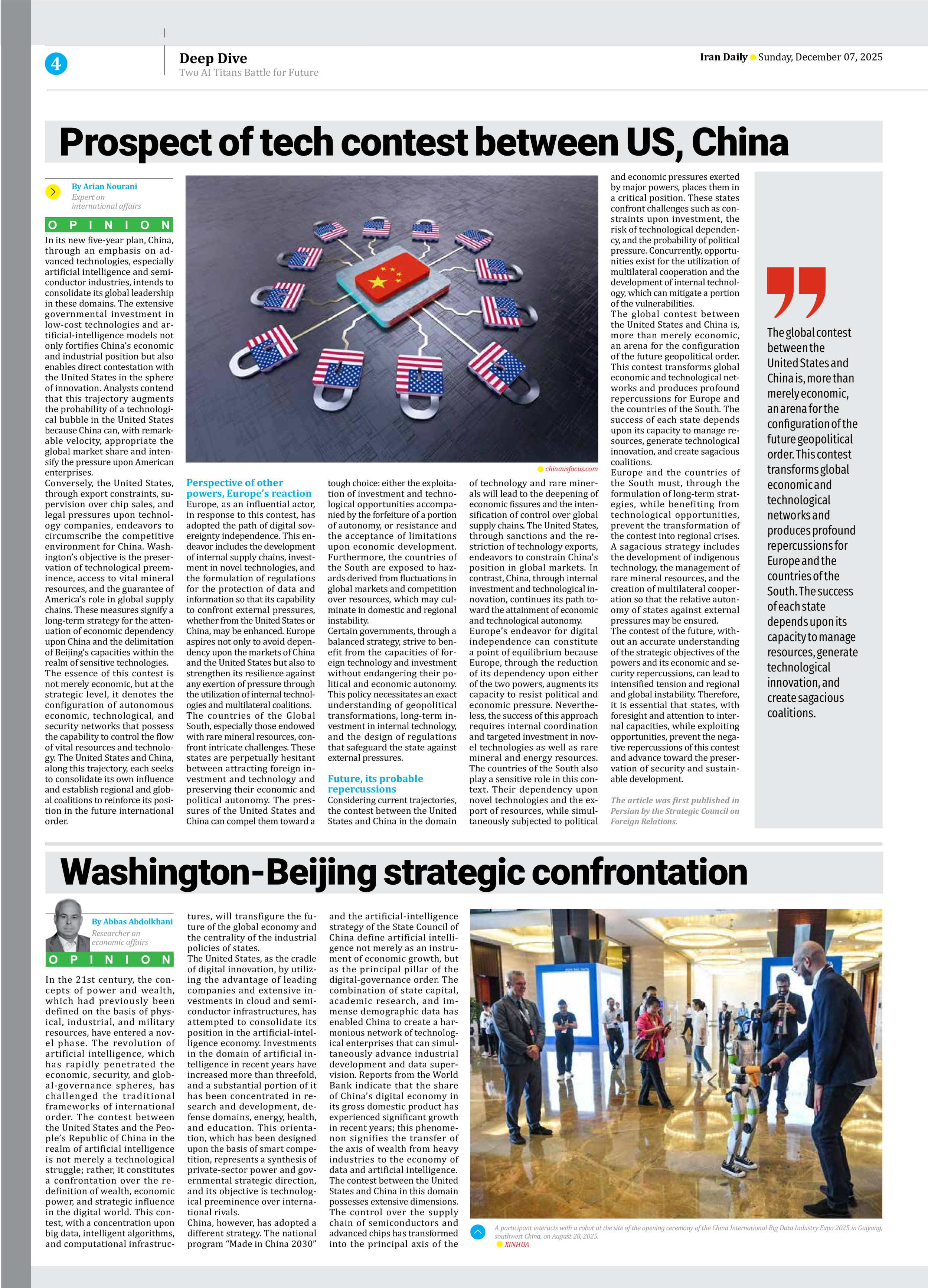
In its new five-year plan, China, through an emphasis on advanced technologies, especially artificial intelligence and semiconductor industries, intends to consolidate its global leadership in these domains. The extensive governmental investment in low-cost technologies and artificial-intelligence models not only fortifies China’s economic and industrial position but also enables direct contestation with the United States in the sphere of innovation. Analysts contend that this trajectory augments the probability of a technological bubble in the United States because China can, with remarkable velocity, appropriate the global market share and intensify the pressure upon American enterprises.
Conversely, the United States, through export constraints, supervision over chip sales, and legal pressures upon technology companies, endeavors to circumscribe the competitive environment for China. Washington’s objective is the preservation of technological preeminence, access to vital mineral resources, and the guarantee of America’s role in global supply chains. These measures signify a long-term strategy for the attenuation of economic dependency upon China and the delimitation of Beijing’s capacities within the realm of sensitive technologies.
The essence of this contest is not merely economic, but at the strategic level, it denotes the configuration of autonomous economic, technological, and security networks that possess the capability to control the flow of vital resources and technology. The United States and China, along this trajectory, each seeks to consolidate its own influence and establish regional and global coalitions to reinforce its position in the future international order.
Perspective of other powers, Europe’s reaction
Europe, as an influential actor, in response to this contest, has adopted the path of digital sovereignty independence. This endeavor includes the development of internal supply chains, investment in novel technologies, and the formulation of regulations for the protection of data and information so that its capability to confront external pressures, whether from the United States or China, may be enhanced. Europe aspires not only to avoid dependency upon the markets of China and the United States but also to strengthen its resilience against any exertion of pressure through the utilization of internal technologies and multilateral coalitions.
The countries of the Global South, especially those endowed with rare mineral resources, confront intricate challenges. These states are perpetually hesitant between attracting foreign investment and technology and preserving their economic and political autonomy. The pressures of the United States and China can compel them toward a tough choice: either the exploitation of investment and technological opportunities accompanied by the forfeiture of a portion of autonomy, or resistance and the acceptance of limitations upon economic development. Furthermore, the countries of the South are exposed to hazards derived from fluctuations in global markets and competition over resources, which may culminate in domestic and regional instability.
Certain governments, through a balanced strategy, strive to benefit from the capacities of foreign technology and investment without endangering their political and economic autonomy. This policy necessitates an exact understanding of geopolitical transformations, long-term investment in internal technology, and the design of regulations that safeguard the state against external pressures.
Future, its probable repercussions
Considering current trajectories, the contest between the United States and China in the domain of technology and rare minerals will lead to the deepening of economic fissures and the intensification of control over global supply chains. The United States, through sanctions and the restriction of technology exports, endeavors to constrain China’s position in global markets. In contrast, China, through internal investment and technological innovation, continues its path toward the attainment of economic and technological autonomy.
Europe’s endeavor for digital independence can constitute a point of equilibrium because Europe, through the reduction of its dependency upon either of the two powers, augments its capacity to resist political and economic pressure. Nevertheless, the success of this approach requires internal coordination and targeted investment in novel technologies as well as rare mineral and energy resources. The countries of the South also play a sensitive role in this context. Their dependency upon novel technologies and the export of resources, while simultaneously subjected to political and economic pressures exerted by major powers, places them in a critical position. These states confront challenges such as constraints upon investment, the risk of technological dependency, and the probability of political pressure. Concurrently, opportunities exist for the utilization of multilateral cooperation and the development of internal technology, which can mitigate a portion of the vulnerabilities.
The global contest between the United States and China is, more than merely economic, an arena for the configuration of the future geopolitical order. This contest transforms global economic and technological networks and produces profound repercussions for Europe and the countries of the South. The success of each state depends upon its capacity to manage resources, generate technological innovation, and create sagacious coalitions.
Europe and the countries of the South must, through the formulation of long-term strategies, while benefiting from technological opportunities, prevent the transformation of the contest into regional crises. A sagacious strategy includes the development of indigenous technology, the management of rare mineral resources, and the creation of multilateral cooperation so that the relative autonomy of states against external pressures may be ensured.
The contest of the future, without an accurate understanding of the strategic objectives of the powers and its economic and security repercussions, can lead to intensified tension and regional and global instability. Therefore, it is essential that states, with foresight and attention to internal capacities, while exploiting opportunities, prevent the negative repercussions of this contest and advance toward the preservation of security and sustainable development.
The article was first published in Persian by the Strategic Council on Foreign Relations.