





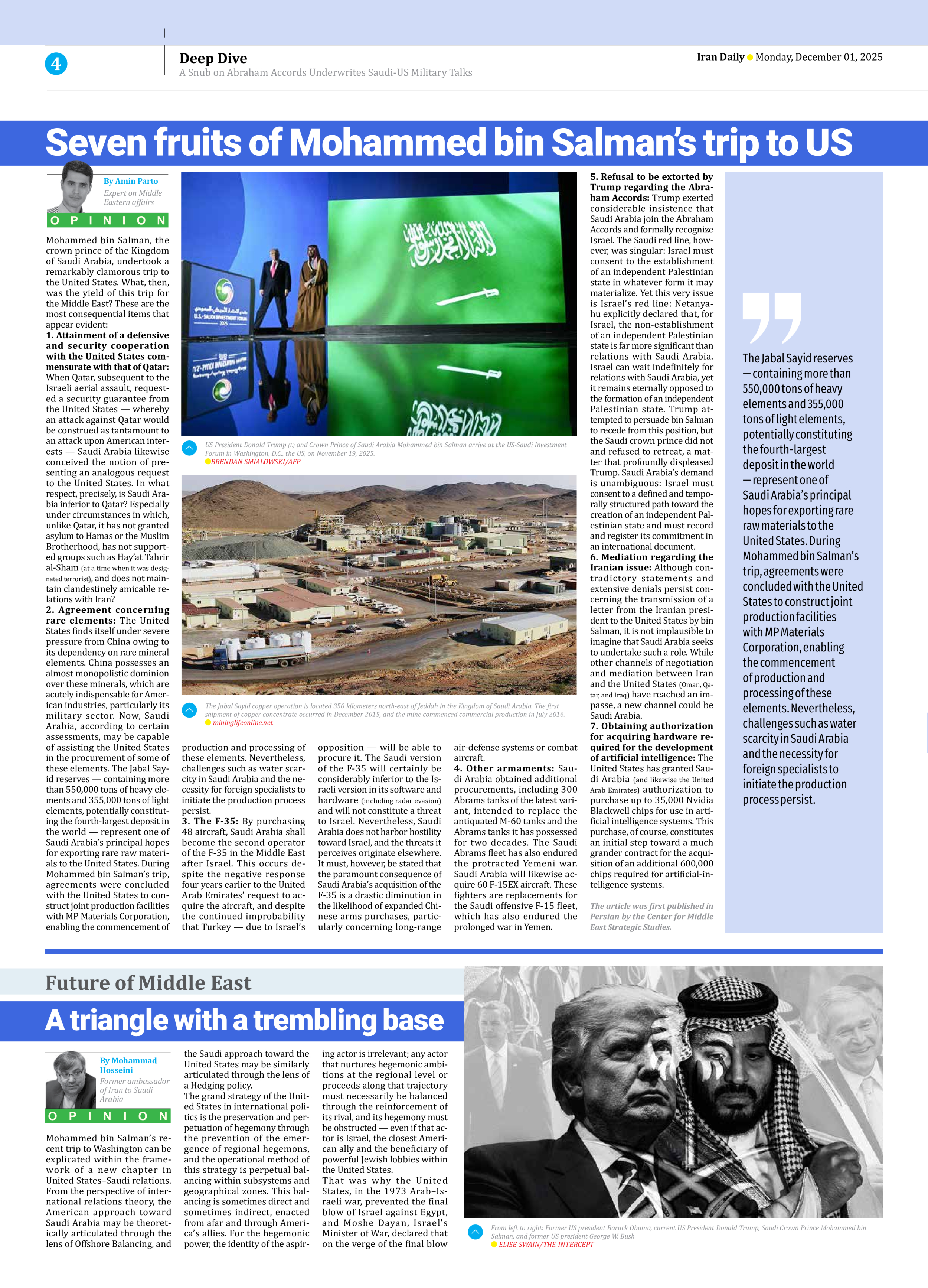


Future of Middle East
A triangle with a trembling base
By Mohammad Hosseini
Former ambassador of Iran to Saudi Arabia
Mohammed bin Salman’s recent trip to Washington can be explicated within the framework of a new chapter in United States–Saudi relations. From the perspective of international relations theory, the American approach toward Saudi Arabia may be theoretically articulated through the lens of Offshore Balancing, and the Saudi approach toward the United States may be similarly articulated through the lens of a Hedging policy.
The grand strategy of the United States in international politics is the preservation and perpetuation of hegemony through the prevention of the emergence of regional hegemons, and the operational method of this strategy is perpetual balancing within subsystems and geographical zones. This balancing is sometimes direct and sometimes indirect, enacted from afar and through America’s allies. For the hegemonic power, the identity of the aspiring actor is irrelevant; any actor that nurtures hegemonic ambitions at the regional level or proceeds along that trajectory must necessarily be balanced through the reinforcement of its rival, and its hegemony must be obstructed — even if that actor is Israel, the closest American ally and the beneficiary of powerful Jewish lobbies within the United States.
That was why the United States, in the 1973 Arab–Israeli war, prevented the final blow of Israel against Egypt, and Moshe Dayan, Israel’s Minister of War, declared that on the verge of the final blow to Egypt and the occupation of Cairo, Kissinger imposed a peace on Israel that was to the benefit of the Arabs. The logic of American conduct in 1973 was unambiguous: Israel must be secure; Israel must triumph in regional conflicts; yet Israel is not permitted to become the hegemon of the Middle East — just as Britain, Germany, and France were not permitted such a status in Europe from the American vantage point, and still are not, and must, within an asymmetrical distribution of power, balance one another, as must other regions as well.
From the perspective of American strategists, after October 7, 2023, and especially following the imposed 12-day war, the balance of power in the Middle East has shifted to the advantage of Israel; however, the desirable American model for the Middle East is a structure of equilibrated power among Turkey, Saudi Arabia, and Israel. In this triangle, Israel fulfills the role of the triangle’s base — meaning that in security and military dimensions, it possesses superiority relative to Saudi Arabia and Turkey, yet this superiority must not metamorphose into hegemony. Therefore, the United States seeks to reinforce Saudi Arabia’s position in the Middle East in order to:
1. forestall Israeli hegemony in the region,
2. align the Arab world with the United States through the principal Arab state, Saudi Arabia,
3. exploit Saudi financial capacity and investment power to fortify the American economy,
4. preserve and regulate energy security in the Persian Gulf,
5. secure Saudi political and financial cooperation in the Gaza peace plan and in the implementation of that initiative within Gaza itself,
6. strengthen the Abraham Accords (the plan for the normalization of Arab–Israeli relations) by incorporating Saudi Arabia,
7. safeguard and preserve the exogenous regional order in the Persian Gulf,
8. acquire Saudi cooperation in a potential war with Iran or in the containment of Iran,
9. enlist Saudi Arabia in shaping the future regional order in conjunction with Israel and Turkey,
10. and lay the foundations of Trump’s three-pillar doctrine in the form of a triangle composed of Israel, Turkey, and Saudi Arabia.
Saudi Arabia’s motivations for deepening relations with the United States, and particularly with Trump himself, are comprehensible within the framework of hedging, insulation, or strategic indemnification.
1. Despite its diversification of relations with major powers since 2010, Saudi Arabia still regards the United States as the principal guarantor of its survival,
2. Saudi Arabia views Israeli hegemonic aspirations as an existential threat to Arab states in the long term,
3. Saudi Arabia considers an American war against Iran a threat to regional stability and does not necessarily view regime change in Iran as beneficial to the long-term interests of Arab states; rather, it prefers a weakened and contained (and predictable) Islamic Republic to its collapse. On this basis, Saudi Arabia, through clandestine diplomacy, seeks to prevent an Israeli war against Iran,
4. The Israeli assault on Qatar constitutes an alarm bell for Arab states, including Saudi Arabia; the experience of Hosni Mubarak — abandoned by the White House — and the American inaction regarding the attack on Aramco stand before Saudi rulers as cautionary precedents; thus, the Saudis seek durable security guarantees from the United States,
5. The acquisition of advanced military equipment — the F-35 aircraft — and the strengthening of Saudi Arabia’s nuclear program in exchange for a 600-billion-dollar investment and the promise of its increase to one trillion dollars constituted Mohammed bin Salman’s agenda during this trip,
6. Saudi Arabia also seeks an appropriate positioning for itself within the future regional order and the nascent global order,
7. The strengthening of Saudi–American relations enhances Saudi Arabia’s bargaining power vis-à-vis its regional allies and rivals such as Turkey, Iran, Israel, and Qatar,
8. Likewise, the strengthening of relations with the United States enhances Saudi bargaining power vis-à-vis other great powers such as China, Russia, and Europe,
9. The Saudis consider the condition of neither-war-nor-peace between Iran and Israel temporary, and by delineating various scenarios, they deem their survival under any such scenario contingent upon the reinforcement of political and security ties with the United States,
10. And finally, Saudi Arabia also desires a role in the three-pillar order of Trump, in partnership with Israel, Turkey, and Saudi Arabia — a configuration whose base is uncertain and fragile, and whose existence may be annihilated or consolidated by the outcome of the Iranian–Israeli conflict (the potential forthcoming war).
The article was published in
Persian by Iranian Diplomacy.