





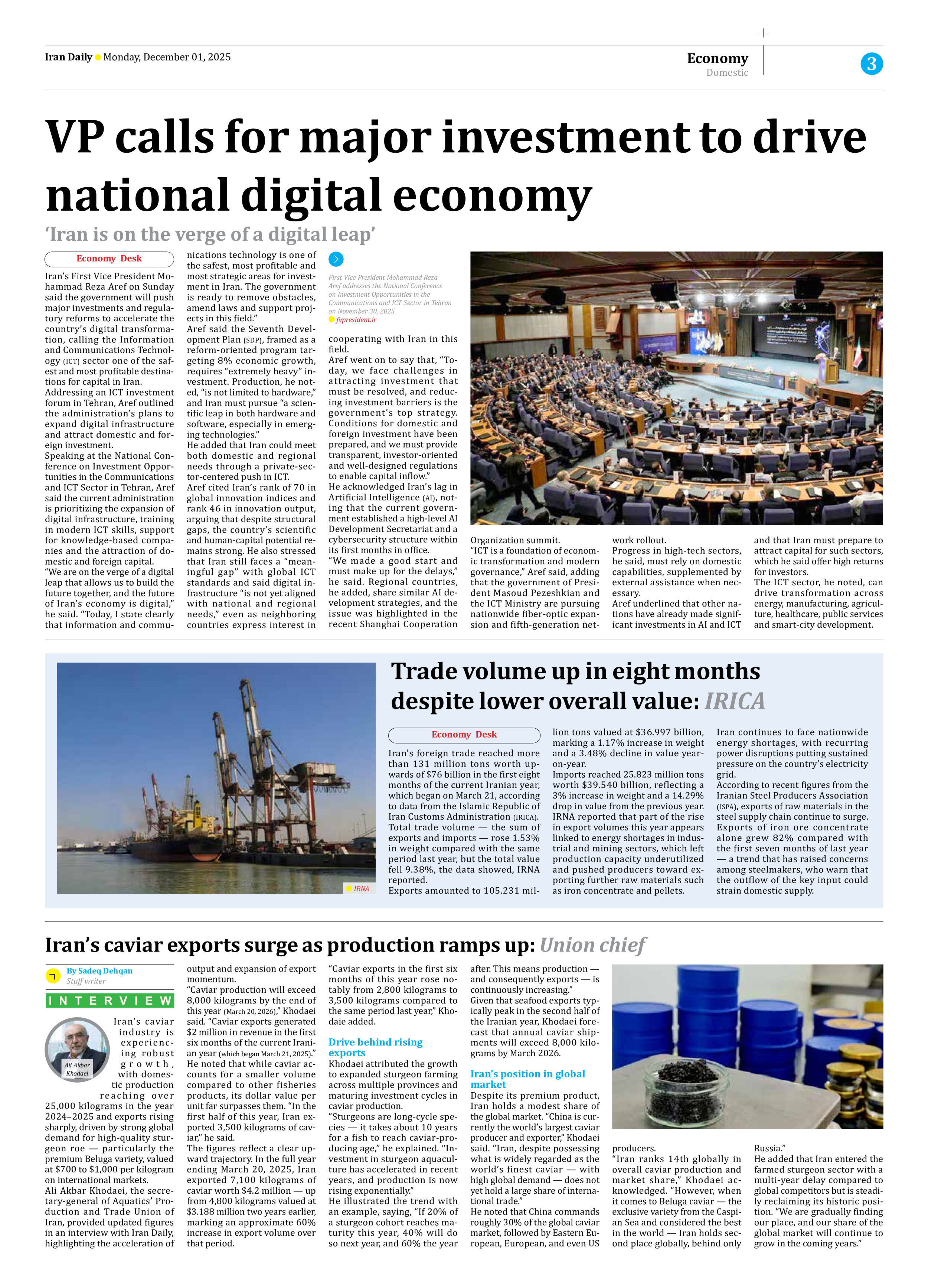


Iran’s caviar exports surge as production ramps up: Union chief
By Sadeq Dehqan
Staff writer
Iran’s caviar industry is experiencing robust growth, with domestic production reaching over 25,000 kilograms in the year 2024–2025 and exports rising sharply, driven by strong global demand for high-quality sturgeon roe — particularly the premium Beluga variety, valued at $700 to $1,000 per kilogram on international markets.
Ali Akbar Khodaei, the secretary-general of Aquatics’ Production and Trade Union of Iran, provided updated figures in an interview with Iran Daily, highlighting the acceleration of output and expansion of export momentum.
“Caviar production will exceed 8,000 kilograms by the end of this year (March 20, 2026),” Khodaei said. “Caviar exports generated $2 million in revenue in the first six months of the current Iranian year (which began March 21, 2025).”
He noted that while caviar accounts for a smaller volume compared to other fisheries products, its dollar value per unit far surpasses them. “In the first half of this year, Iran exported 3,500 kilograms of caviar,” he said.
The figures reflect a clear upward trajectory. In the full year ending March 20, 2025, Iran exported 7,100 kilograms of caviar worth $4.2 million — up from 4,800 kilograms valued at $3.188 million two years earlier, marking an approximate 60% increase in export volume over that period.
“Caviar exports in the first six months of this year rose notably from 2,800 kilograms to 3,500 kilograms compared to the same period last year,” Khodaie added.
Drive behind rising exports
Khodaei attributed the growth to expanded sturgeon farming across multiple provinces and maturing investment cycles in caviar production.
“Sturgeons are long-cycle species — it takes about 10 years for a fish to reach caviar-producing age,” he explained. “Investment in sturgeon aquaculture has accelerated in recent years, and production is now rising exponentially.”
He illustrated the trend with an example, saying, “If 20% of a sturgeon cohort reaches maturity this year, 40% will do so next year, and 60% the year after. This means production — and consequently exports — is continuously increasing.”
Given that seafood exports typically peak in the second half of the Iranian year, Khodaei forecast that annual caviar shipments will exceed 8,000 kilograms by March 2026.
Iran’s position in global market
Despite its premium product, Iran holds a modest share of the global market. “China is currently the world’s largest caviar producer and exporter,” Khodaei said. “Iran, despite possessing what is widely regarded as the world’s finest caviar — with high global demand — does not yet hold a large share of international trade.”
He noted that China commands roughly 30% of the global caviar market, followed by Eastern European, European, and even US producers.
“Iran ranks 14th globally in overall caviar production and market share,” Khodaei acknowledged. “However, when it comes to Beluga caviar — the exclusive variety from the Caspian Sea and considered the best in the world — Iran holds second place globally, behind only Russia.”
He added that Iran entered the farmed sturgeon sector with a multi-year delay compared to global competitors but is steadily reclaiming its historic position. “We are gradually finding our place, and our share of the global market will continue to grow in the coming years.”